In North America, most people think of Salem when witch trials are mentioned. I've already blogged about Virginia witches where the first such trial was held on the continent in 1626. But the neighboring colony of Maryland was known to have witch trials as well.
At least twelve people were prosecuted for being a witch in that colony. The earliest known trials were aboard ships bound for Maryland. In 1654, on the Charity from London, a storm struck at sea. Passengers aboard the ship claimed the relentless storm was caused by "the malevolence of witches." An old woman by the name of Mary Lee was found to have a "witch's mark." The crew hanged her. Her corpse and all of her belongings were thrown into the sea.
The second sea hanging involved the great grandfather of George Washington, Colonel John Washington, in 1659. He accused the owner of the ship Edward Prescott for hanging Elizabeth Richardson. Little is known as to why she was regarded to be a witch. Washington was unavailable for Prescott's trial. Prescott claimed John Greene had been in command of the ship at the time and was acquitted of any wrongdoing.
In 1665, a grand jury refused to indict Elizabeth Bennett for being a witch. Not much is known about the case, except that she was the wife of a wealthy landowner, which makes her quick acquittal understandable.
Rebecca Fowler wasn't so lucky. In 1685, she had "not the fear of God before her eyes, but being led by the instigation of the Devill certain evill & dyabolicall Artes called withcrafts charmes & sorceryes... did use practice & exercise... against one Francis Sandsbury... and Several other persons... and their bodyes were very much the worse, consumed, pined & lamed..."
Rebecca Fowler was hanged on the 9th day of October, 1685.
Similar charges had been brought against John Cowman in 1674. He was convicted "...for Witchcraft Conjuration Sorcery or Enchantment used upon the Body of Elizabeth Goodale." The governor gave him a last minute reprieve, providing the sheriff take him to the gallows and place a rope around his neck. After that he was to remain an indentured servant to the governor and Council that had spared his life.
The most famous Maryland witch is Moll Dyer. Because she was an herbal healer (a cunning woman?), she was said to have been accused of being a witch and driven out of her home during a winter night by the local townspeople and her home burned to the ground. Her body was found by a child a few days later frozen to a large stone. Unfortunately, historians have never uncovered any evidence that Moll ever existed. Even though the legend has been disregarded as a folktale, the rock where she supposedly died and left a hand print sits outside the historical society in Leonardtown.
Several other cases surfaced throughout the 17th and into the early 18th century. Katharine Pout was fined one hundred pounds of tobacco, and the last trial was held in 1712 when Virtue Violl was acquitted. Like most other areas, the majority of those accused were women, and in Maryland, those cases were 90 percent.
Kim Murphy
www.KimMurphy.Net
Sunday, 18 December 2011
Sunday, 11 December 2011
Hortense de Mancini
 |
| Hortense Mancini |
Born 'Ortensia' in Rome on 6th June 1646 to Baron Lorenzo Mancini, an Italian aristocrat and Girolama Mazzarini, the sister of Cardinal Mazarin, chief minister of France. Ortensia was the fourth of the five famous Mancini sisters, who along with two of their female Martinozzi cousins, were known at the court of King Louis XIV as the Mazarinettes. After her father’s death in 1650, her mother brought her daughters from Rome to Paris so Cardinal Mazarin, might gain them advantageous marriages.
Charles II proposed to Hortense in 1659, but Cardinal Mazarin believed the exiled king to have little in the way of prospects and refused the union. On Charles’ restoration, Mazarin realised his mistake and offered a dowry of 5 million livres, which Charles refused.
Hortense's hand was also requested by Charles Emmanuel II, Duke of Savoy, another first cousin of Louis XIV, but failed when Cardinal Mazarin refused to include the stronghold-castle of Pigneol in her dowry. A similar situation occurred when the Duke of Lorraine offered for her also.
On 1 March 1661, fifteen-year-old Hortense was married to the twenty-nine-year-old Armand-Charles de la Porte, duc de La Meilleraye, one of the richest men in Europe, and granted the title of duc Mazarin. On the death of Cardinal Mazarin shortly afterward, he gained access to his wife's huge inheritance, which included the Palais Mazarin in Paris and its fine art collection.
Hortense was young, bright, and popular; Armand-Charles was miserly, extremely jealous and mentally unstable. He had his female servants' front teeth knocked out to prevent them from attracting male attention, and chipped off or painted over the "dirty bits" in his art collection. He forbade his wife to keep company with other men, made midnight searches for hidden lovers, insisted she spend hours a day at prayer, and forced her to leave Paris and move to the country.
Rebellious, Hortense began a lesbian love affair with the sixteen-year-old Sidonie de Courcelles. Her husband sent both girls to a convent to cure their immorality, which failed as they plagued the nuns with pranks: adding ink to the holy water, flooded the nuns' beds, and headed for freedom up the chimney. The duchess in her memoirs refutes these claims saying that when she asked the nuns for water to wash her feet she was refused, and:
'It is true that we filled a large coffer which stood in our dormitory with water, and, the boards of the floor being very loosely joined together, the water which overflowed leaked through the wretched floor and wetted the beds of the good sisters. This accident was talked about as if it had been something which we had done of design.'
Despite their differences, Hortense and her husband had four children, whom she left behind when she made her escape with the help of her brother, Philippe, Duc de Nevers, who procured horses and an escort to take her to Rome, and the refuge of her sister Marie Mancini, now the Princess Colonna.
Charles Emmanuel II, Duke of Savoy, declared himself her protector as did Louis XIV and granted her a pension of 24 thousand livres. Hortense retired to Chambéry in Haute-Savoie and as Savoy’s mistress, established her home as a meeting place for authors, philosophers, and artists. After the death of the duke in 1675, she was turned out by his jealous widow, Marie Jeanne Baptiste de Savoie-Nemours, and Hortense's own husband froze her income, including the pension from Louis XIV. The English ambassador to France, Ralph Montagu, hoped Hortense would replace King Charles' current mistress, Louise de Kerouaille, Duchess of Portsmouth, and therefore increase his own standing.On January 2, 1676, the French Ambassador, Ruvigny, wrote to inform Pomponne that:
'The Duchesse de Mazarin had arrived two days previously in London, dressed as a cavalier, accompanied by two women and five men, without counting a little Moor, who takes his meals with her.'
Now 30, Hortense arrived under the pretext of a visit to her young cousin, Mary of Modena, the new wife of James, Duke of York. She cut an impressive figure, tall and beautiful in men's clothing or women's, she rode and drank hard, gambled, shot pistols, swam in rivers, took lovers of both genders, played the guitar and danced like a gypsy.Saint-Evremond, who cherished a boundless admiration for Hortense described her:
'She is one of those Roman beauties who in no way resemble your dolls of France ... the colour of her eyes has no name ; it is neither blue, nor grey, nor altogether black, but a combination of all the three ; they have the sweetness of blue, the gaiety of grey, and, above all, the fire of the black . . . there are none in the world so sweet . . . there are none in the world so serious and so grave when her thoughts are occupied with any serious subject . . . they are large, well-set, full of fire and intelligence ... all the movements of her mouth are full of charm, and the strangest grimaces become her wonderfully, when she imitates those who make them. Her smiles would soften the hardest heart and ease the most profound depression of mind they almost entirely change her expression, which is naturally haughty, and spread over it a certain tincture of sweetness and kindness, which reassures those hearts which her charms have alarmed. Her nose, which without doubt is incomparably well-turned and perfectly-proportioned, imparts a noble and lofty air to her whole physiognomy. The tone of her voice is so harmonious and agreeable that none can hear her speak without being sensibly moved. Her complexion is so delicately clear that I cannot believe that any one who examined it closely can deny it to be whiter than the driven snow. Her hair is of a glossy black, with nothing harsh about it. To see how naturally it curls as soon as it is let loose, one would say it rejoiced to shade so lovely a head ; she has the finest turned countenance that a painter ever imagined."
Hortense soon attracted the attention of Charles II and Nell Gwyn went into mourning, in ironical anticipation of the fall of the Duchess of Portsmouth. By mid 1676, Hortense had replaced Louise de Kerouaille in Charles II's affections and was granted a Royal pension of £4,000, considerably lightening her financial troubles, but causing poor Louise to pour out her anxiety to anyone who would listen.
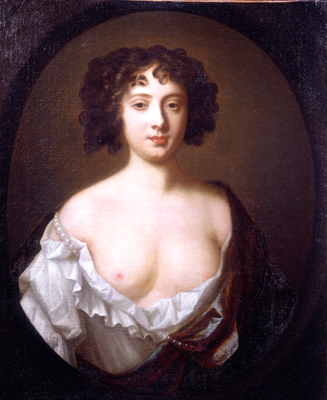 |
| Louise de Kerouaille Duchess of Portsmounth |
Obtusely, Hortense began a lesbian relationship with Anne Lennard, Countess of Sussex, a girl half her age and the king's illegitimate daughter by Barbara Palmer. Gossip about the two was salacious and Lady Chaworth wrote to her brother Lord Roos in December, 1676:
"Lady Sussex and Madame Mazarin have privately learnt to fence, and went downe into St. James Parke the other day with drawne swords under theire night gownes, which they drew out and made severall fine passes with, to the admiration of severall men that was lookers on in the Parke."
Anne's husband subsequently ordered his wife to the country, where she refused to do anything but lie in bed, repeatedly kissing a miniature of Hortense.
The introduction to Aphra Behn's ‘The History of the Nun’ has been taken as a suggestion that Behn too had romantic relations with Hortense, who also infuriated Charles II by beginning an affair with Louis I de Grimaldi, Prince de Monaco. Charles cut off her pension, but almost immediately repented and restarted the payments, though this behaviour signified the end of her position as the king's favourite. She and Charles remained friends, and Louise de Kerouaille returned to her role as the King's mistress.
A few days before Charles II’s death in 1685, the diarist John Evelyn wrote:
the King sitting and toying with his concubines, Portsmouth, Cleveland, and Mazarin [Hortense] Six days after, all was in dust.
Hortense was well-provided for by the next king, James II, possibly due to her kinship with the new queen, Mary of Modena. Even when James fled England and William and Mary came to power in 1688, she remained in London, albeit with a reduced pension, where she presided over such as Charles de Saint-Évremond, the poet and epicurean, who brought to her door all the learned men of London.
Evelyn recorded her eventual death in 1699 at the age of 53:
......... born at Rome, educated in France, and was an extraordinary beauty and wit, but dissolute, and impatient of matrimonial restraint, so as to be abandoned by her husband, and banished: when she came to England for shelter, lived on a pension given her here, and is reported to have hastened her death by intemperate drinking strong spirits.
With the exception of Marguerite de Valois, Hortense and her sister, Marie Mancini, were the first women in France to put their memoirs into print, possibly to record for posterity the cause of separation from their abusive husbands. Hortense may have committed suicide, keeping her life dramatic until the very end. Her creditors seized her corpse, but her husband, the only man rich enough to redeem it, claimed her body and carted it around on his travels in France, before finally allowing it to be interred by the tomb of her uncle, Cardinal Mazarin.


Sunday, 4 December 2011
The Pendle Witches and Their Magic: Part Two

Blacko Tower, a Victorian folly (ca 1890) near Malkin Tower Farm, Lancashire
The crimes of which Mother Demdike and her fellow witches were accused dated back years before the 1612 trial. The trial itself might have never happened had it not been for King James I’s obsession with the occult. Until his reign, witch persecutions had been relatively rare in England compared with Scotland and Continental Europe. But James’s book Daemonologie presented the idea of a vast conspiracy of satanic witches threatening to undermine the nation. Shakespeare wrote his play Macbeth, which presents the first depiction of a witches’ coven in English drama, in James I’s honour.
To curry favour with his monarch, Lancashire magistrate Roger Nowell of Read Hall arrested and prosecuted no fewer than twelve individuals from the Pendle region and even went to the far fetched extreme of accusing them of conspiring their very own Gunpowder Plot to blow up Lancaster Castle. Two decades before the more famous Matthew Hopkins began his witch-hunting career in East Anglia, Roger Nowell had set himself up as witchfinder general of Lancashire.
What do we actually know about Mother Demdike? At the time of her trial she appears as a widow and matriarch, living in a place called Malkin Tower with her widowed daughter Elizabeth Device, and her three grandchildren, James, Alizon, and Jennet. Her clan was very poor and supported themselves by a combination of begging and by the family business of cunning craft. The trial transcripts mention that local farmer John Nutter of Bull Hole Farm near Newchurch hired Demdike to bless his sick cattle. Interestingly John Nutter chose not to testify against her family in the trial.
Demdike’s family at Malkin Tower had a powerful rival in the form of Chattox, another widow and charmer, who lived a few miles away at West Close near Fence. Chattox allegedly bewitched to death her landlord’s son, Robert Nutter of Greenhead, for attempting to rape her daughter, Anne Redfearne. For social historians it’s interesting to see how having a fearsome reputation as a cunning woman could be the only true power a poor woman could hope to wield.
Unfortunately this could also backfire as it did with Demdike’s granddaughter, Alizon Device, who exchanged angry words with a pedlar outside Colne in March, 1612. Moments later the pedlar collapsed and suddenly went stiff and lame on one half of his body and lost the power of speech. Today we would clearly recognise this as a stroke. But the pedlar and several witnesses were convinced that Alizon had lamed her victim with witchcraft. Even she seemed to believe this herself, immediately falling to her knees and begging his forgiveness. This unfortunate event triggered the arrest of Alizon and her grandmother. Alizon wasted no time in implicating Chattox, her grandmother’s rival, and Chattox’s daughter, Anne Redfearne.
The four accused witches were interrogated by Roger Nowell, and then force-marched to Lancaster Castle, walking over fells and moorland. Both Demdike and Chattox, whose real name was Anne Whittle, were frail and elderly. It was amazing they survived the journey. In Lancaster they were handed over to the sadistic Thomas Covell, the gaoler who reputedly slashed the ears off Edward Kelly, friend of John Dee, when he was arrested on the charge of forgery. The women were chained to a ring in the floor in the bottom of the Well Tower. Although torture was officially forbidden in England, gaolers were allowed to starve and beat their prisoners at will. Being chained to a ring in the floor and kept in constant darkness would certainly feel like torture for those who had to endure it.
On Good Friday following the arrests, worried family and friends met at Malkin Tower to discuss what they would do in regard to this tragic situation. Constable John Hargreaves came to write down the names of everyone present and later Roger Nowell made further arrests, accusing these people of convening at Malkin Tower on Good Friday for a witches’ sabbat, something he would have read about in Daemonologie. The arrests didn’t stop until he had the mythical thirteen to make up the alleged coven. Twelve were kept at Lancaster and one, Jennet Preston who lived over the county line in Gisburn, Yorkshire, was sent to York. Apart from Chattox and Demdike and their immediate families, none of these newly arrested people had previous reputations as cunning folk. It seemed they were just concerned friends and neighbours who were caught in the wrong place at the wrong time.
Kept in such horrible conditions, Demdike died in prison before she came to trial, thus cheating the hangman. The others experienced a different fate.
The first to be arrested, Alizon was the last to be tried at Lancaster in August, 1612. Her final recorded words on the day before she was hanged for witchcraft are a moving tribute to her grandmother’s power as a healer. Roger Nowell, the prosecutor, brought John Law, the pedlar she had allegedly lamed, before her. Again Alizon begged the man’s forgiveness for her perceived crime against him. John Law, in return, said that if she had the power to lame him, she must also have the power to heal him. Alizon regrettably told him that she wasn’t able to, but if her grandmother, Old Demdike had lived, she could and would have healed him.
Mother Demdike is dead but not forgotten. By the mid-17th century, Demdike’s name became a local byword for witch, according to John Harland and T.T. Wilkinson’s Lancashire Folklore. In 1627, only fifteen years after the Pendle Witch Trial, a woman named Dorothy Shaw of Skippool, Lancashire, was accused by her neighbour of being a “witch and a Demdyke.”
History is a fluid thing that continually shapes the present. Long after her demise, Mother Demdike and her fellow Pendle Witches endure, their story and spirit woven into the living landscape, its weft and warp, like the stones and the streams that cut across the moors. Enthralled by their true history, I wrote my novel, Daughters of the Witching Hill, dedicated to their memory. Other books have been written about the Pendle Witches, but mine turns the tables, telling the story from Demdike and Alizon Device’s point of view. I longed to give these women what their world denied them—their own voice. Their voices deserve to finally be heard.
Sources:
Owen Davies, Popular Magic: Cunning-folk in English History (Hambledon Continuum)
Eamon Duffy, The Stripping of the Altars: Traditional Religion in England 1400-1580 (Yale)
Malcolm Gaskill, Witchfinders: A Seventeenth Century English Tragedy (John Murray)
John Harland and T.T. Wilkinson, Lancashire Folklore (Kessinger Publishing)
King James I, Daemonologie, available online
Jonathan Lumby, The Lancashire Witch-Craze (Carnegie)
Margaret Murray, The Witch Cult in Western Europe, available online
Edgar Peel and Pat Southern, The Trials of the Lancashire Witches (Nelson)
Robert Poole, ed., The Lancashire Witches: Histories and Stories (Manchester University Press)
Thomas Potts, The Wonderfull Discoverie of Witches in the Countie of Lancaster, available online
Keith Thomas, Religion and the Decline of Magic (Penguin)
John Webster, The Displaying of Supposed Witchcraft (Ams Pr Inc)
Emma Wilby, Cunning Folk and Familiar Spirits (Sussex Academic Press)
Benjamin Woolley, The Queen’s Conjuror: The Life and Magic of Dr. Dee (Flamingo)
Friday, 11 November 2011
Aphra Behn

I have heard of Aphra Behn, of course, as the first women who earned a living from her writing. What I didn’t know about her was she was born Aphra or ‘Eafrey’ Johnson, and spent a year in Surinam, Dutch Guiana in the West Indies, where her father was given a diplomatic post, although he allegedly didn’t survive the journey. Aphra returned to London as a widow, claiming her husband was a Dutchman called Johan Behn, but nothing is known of him, so his existence is still in debate. Perhaps Aphra simply tried to avail herself of the freedom a widow had over a single woman in the 17th Century.
At this time, the Anglo Dutch War was not going well and a group of Cromwellian exiles in Antwerp were working with the Dutch to undermine the Restoration regime. Aphra was employed by Charles II as a spy, and under the codename, ‘Astrea’, was sent to Antwerp with instructions to reacquaint herself with a former suitor, William Scott, son of the regicide Thomas Scott who was executed in 1660, and discover what the Dutch were up to.
William was eager to ingratiate himself with the English government, but he didn’t know very much so Aphra left Antwerp with very little information. Maybe as a result of this, her expenses were not paid by the infamous William Chiffinch, Charles II’s advisor, administrator of the ‘Secret Service’ budget and reputed pimp to the king.
This led to her borrowing the money to enable her to return to London in January 1667, but also resulted in her spending some time in gaol for debt as she had no means to repay it. Perhaps King Charles was told of her fate, or another benefactor stepped forward, but Aphra’s debts were finally discharged and she was released sometime in 1669.
Understandably, Aphra left the world of espionage and wrote plays for the theatre. The Forc'd Marriage was first performed in 1670 by The Duke's Company, followed by The Amorous Prince, in 1671. The Dutch Lover (1673), Abdelazar, (1676), The Town Fop, (1676), The Debauchee, (1677), and The Counterfeit Bridegroom, (1677).
In March, 1677, Aphra’s most successful work, The Rover was produced and Nell Gwyn came out of retirement to play the role of the whore, Angelica Bianca ('white angel'), her performance praised by The Duke of York (later James II) who was also rumoured to have been Aphra’s lover.
Nell Gwynn also took the lead as Lady Knowell in Aphra’s next play, Sir Patient Fancy (1678), and The Feigned Courtesans (1679), which Behn dedicated to Nell. Maybe due to the demands of the debauched Royal Court, Aphra’s plays were becoming sexually risqué, with Behn herself being accused of being a libertine. Her friendship with the Earl of Rochester, infamous for his sexual escapades and explicit poetry did nothing to allay this impression. In fact her hero in, The Rover, was said to have been based on Rochester.
Aphra openly expressed her views on love and sex in her writing, and her poetry portrays romantic relationships with both men and women, discusses rape and impotence, puts forth a woman's right to sexual pleasure, and includes scenes of eroticism between men.
In 17th Century Theatre, women were assumed to be of low morals, their success coupled with envy in a traditionally male profession. Ignoring them all, and enjoying the patronage of the King, Aphra continued writing. The tragicomedy The Young King was produced in the autumn of 1679, The Revenge in 1680, followed by The Second Part of The Rover in early 1681, The False Count in November and The Roundheads in December, 1681. The City Heiress was produced in the spring of 1682. Audiences loved her plays with their rampant sexual content, but she had her critics. Alexander Pope, for instance, wrote of Behn:
The stage how loosely does Astræea tread
Who fairly puts all characters to bed.
When The Duke's Company merged with the King's Company to form the United Company, Aphra turned to writing poetry. Poems Upon Several Occasions appeared in 1684, as did Love Letters Between a Nobleman and His Sister.
When Charles II died in 1685 and was succeeded by his brother, the Duke of York, as James II. Behn wrote verses on both occasions, and returned to writing for the stage. The Lucky Chance was performed in 1686 followed by the farce The Emperor of the Moon, which was not successful.
In 1688, Behn published Oroonoko, about a noble slave and his tragic love. Aphra claimed to have based this story on a slave leader she had met during her year in Surinam. It was an instant success, going through many reprints, and was even adapted for the stage by Thomas Southerne in 1695.
By the time James II was forced to abdicate his throne, Aphra was quite ill with rheumatoid arthritis. Her own descriptions of her lame hands and the lampoonists' cruel verses mocking her "limbs distortured" suggest she kept writing despite extreme pain. Aphra died on April 16, 1689, and was buried in Poets’ Corner, Westminster Abbey. Two of her plays, The Widdow Ranter and The Younger Brother, were produced and published postuhumously.
The introduction to her "The History of the Nun" has been taken as a suggestion that Behn had romantic relations with Hortense Mancini, another of Charles II’s mistresses and notoriously bi-sexual. In it she says:
.......how infinitely one of Your own Sex ador'd You, and that, among all the numerous Conquest, Your Grace has made over the Hearts of Men, Your Grace had not subdu'd a more intire Slave; .............. the honour and satisfaction of being ever near Your Grace, to view eternally that lovely Person, and here that surprising Wit; what can be more grateful to a Heart, than so great, and so agreeable, an Entertainment? And how few Objects are there, that can render it so entire a Pleasure, as at once to hear you speak, and to look upon your Beauty?
Aphra was unapologetic on the subject of her explicit writing, saying she was: ‘forced to write for Bread and not ashamed to owne it.’
Virginia Woolf wrote of Aphra:
All women together ought to let flowers fall upon
the tomb of Aphra Behn, ...for it was she who earned
them the right to speak their minds.
Sunday, 6 November 2011
Gambling on love

I've been reading about John Law: gambler, criminal, genius, founder of our monetary system. His story is nothing short of amazing, but it is the story of his wife Catherine that intrigues me most.
Early in his eventful career, after a night of successful gambling, Law was introduced to Madame Catherine Seigneur (née Knowles, or Knollys, 1669 — 1747), an English noblewoman — a descendent of Anne Boleyn, in fact — who was married to a Frenchman.
Although there are no images of her (regretfully), she is described as having "dainty features, a generous bosom and minuscule waist." The Duc de Saint-Simon described her as "rather handsome," but flawed by a birthmark that covered one eye and the upper part of one cheek.
Saint-Simon goes on: "She was proud, overbearing and very impertinent in her talk and manners."
The few bits available give hints of her character: "...she was accustomed to say there was not a more tiresome animal in the world than a Duchess." [Memoirs of the life of John Law of Lauriston]
Attracted to this clever, outspoken women, Law pursued her. She was a married noblewoman, and he a gamester with criminal record and a mysterious if questionable lineage. Such an alliance was unthinkable, but they were in France, far from home. And far from her husband, it would appear; at the least, there is no record of his objection.
Law had a "knack" of winning at dice and games; when the pattern became visible, he was in the habit of moving on. But this time there was Catherine. He asked her to run away to Italy with him.
To run off with Law would ruin Catherine's reputation forever; there would be no turning back. One can only surmise that she was 1) miserable in her marriage, and 2) madly in love with John Law, for she agreed to this ruinous course of action.
She became Lady Catherine Law, although marriage was impossible. News of her betrayal made a news journal in Paris.
It was a peripatetic life: Genoa, Rome, Florence, Turin, Venice. At each city Law supported them with his gambling, successfully playing the tables — but all the while researching banking and finance. Over time — and countless moves, often "on the run," and either in greatly feted glory or in hiding from an outraged mob — Catherine bore him two children, a son and a daughter.
She seemed to have been game for it all. Their's is surely a love story. If only I could discover more.
{Image: an engraving from a print by Leon Schenk showing John Law as Controller General of Finance of France.}
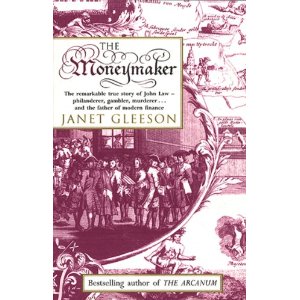
Source: The Moneymaker by Janet Gleeson — a fantastic biography.
Sandra Gulland
=================================================
WEBSITE: http://www.sandragulland.com/
BLOG: http://bit.ly/TheWritingLife
FACEBOOK: http://www.facebook.com/novelistSandraGulland
TWITTER: http://twitter.com/Sandra_Gulland
=================================================
Subscribe to:
Posts (Atom)