Showing posts with label Charles II. Show all posts

Sunday, 24 August 2014

Margaret [Peg] Hughes Prince Rupert's last Love

Margaret [Peg] Hughes
Actresses first appeared on the English stage in 1629, when a troupe of French players gave a performances at Blackfriars. A Thomas Brande wrote to Archbishop Laude expressing the anger of the crowd, in that the French actresses were 'hissed, hooted, and pippin-pelted from the stage,' thus Brande concluded he, 'did not think they would soon be ready to try the same again'.

This same troupe reappeared a few weeks later at the Fortune and Red Bull theatres, and received similar abuse, so to compensate, the Master of the Revels returned part of their licence fee. Three years later,  the Puritan author William Prynne brought out his Histrio-Mastix, The Player's Scourge, or Actor's Tragedy in which he stigmatized all 'woman-actors' as 'monsters', and their performances, 'impudent', 'shameful', and 'unwomanish'.

The ban on theatres which was imposed by the Commonwealth in 1642, was lifted by Charles II, who granted two royal patents to perform ‘legitimate drama’ in London to Sir Thomas Killigrew and Sir William Davenant. By 1661, the prejudice against women actors had declined, so when Killigrew and Davenant received a renewal of the letters patent,they included a clause that females could perform. The King’s Company and the Duke’s Company were formed, both briefly based in The Cockpit Theatre (also known as the Phoenix Theatre) Drury Lane, later moving to the Theatre Royal, Drury Lane.

Margaret Hughes appeared in Killigrew’s ‘Othello’ as Desdemona in December 1660 at a converted tennis court called the Vere Street Theatre.  The audience were asked: ‘And how do you like her?’ The applause that followed guaranteed the place of actresses on the English stage - however this story may be allegorical, as four years earlier, Davenant's  'Siege of Rhodes' was performed at Rutland House, with Mrs. Coleman as Ianthe.  

Not much is known about Peg’s early life, and she was already 30 before she performed Desdemona, but she apparently took the London theatre scene by storm.With her long dark hair, sleepily sensual eyes and lovely face, Margaret ‘Peg’ Hughes counted among her lovers a brief liaison with Charles II, Charles Sedley, the famous fop and, reputedly, other members of the court circle.

Prince Rupert

Samuel Pepys, who recorded going backstage on 7 May 1668 after a performance of The Virgin Martyr and stole a kiss from an actress named ‘Pegg’ whom he described as ‘a mighty pretty woman, and seems, but is not, modest’ She was the first actress to play Theodosia in John Dryden's Evening's Love, or, The Mock Astrologer, which premiered on 22 June 1668.

According to the Count de Gramont’s memoirs, Peg was with the count on a summer visit to Tunbridge Wells in 1668 when she met Prince Rupert. No longer a young and dashing cavalier, he was still a rich and handsome man who had turned his back on his homeland after a fierce quarrel with his elder brother, Charles Louis the Elector Palatine. He lived in England under the patronage of his cousin, King Charles II. By 1669 , Peg became a member of the King's Company which gave her status and immunity from arrest for debt. She was also painted four times by Sir Peter Lely.  

Peg initially refused Rupert's gifts, preferring instead to ‘sell her favours at a dearer rate’.  This unexpected rejection upset Rupert a great deal, but this did not mean he was about to propose marriage. At least not a regular one. Some accounts say that the pair went through a ‘left-handed marriage’ ceremony, in that the groom held the bride’s right hand in his left hand instead of in his right - a ceremony that meant neither Hughes nor any children they might have would inherit Rupert’s royal titles or privileges.  

At the end of that year, Peg left the stage in order to set up home with the fifty-year old Prince, who was generous to Peg’s family and employed at least one of her brothers in his household.
It appears, though, that their ‘marriage’ was a happy one as Rupert rejected his elder brother’s pleas to marry more appropriately and produce an heir for the Palatine. 

For the next six years, Peg lived an expensive lifestyle with her royal lover, giving birth to their daughter, Ruperta in 1673. Rupert gave Peg at least £20,000 worth of jewelry during their relationship, including several items from the Palatinate royal collection.

In 1676, Peg emerged from retirement for a year with the Company at the Dorset Garden Theatre, near the Strand. Rupert then bought a 'grand building' worth £25,000 that he bought in Hammersmith from Sir Nicholas Crispe where he installed Peg and their daughter.


Ruperta Howe


In June 1670, Peg's brother became embroiled in a quarrel with one of the king's retainers over which of the royal mistresses, Margaret Hughes or Nell Gwyn, was ‘the handsomer now att Windsor’. Insults flew,  swords drawn, and Hughes' brother was killed.

Rupert installed Peg in the lavishly furnished mansion at Hammersmith, later known as Brandenburg House, where Margaret gave birth to a daughter in 1673, christened Ruperta. 

Margaret returned to the stage in 1676 as a member of the Duke of York's Company, based at the Dorset Garden Theatre. After that season, Peg retired from acting and devoted herself to Rupert, now fifty-seven and with failing health. 

Rupert reputedly gave Peg a pair of pearl drop earrings that once belonged to his mother. Rupert's youngest sister, the Electress Sophia of Hanover, complained bitterly to her husband, Ernest Augustus, Elector of Hanover, but when she saw how well Peg looked after her elderly bachelor brother, she was forgiven and allowed to keep them.
 
By 1680, Rupert was bedridden and used an invalid chair. He wrote to Sophia that, ‘Margaret ‘took great care of me during my illness and I am obliged to her for many things’. Of his life with Peg, he also said, ‘as for the little one [Ruperta], she cannot resemble me, [for] she is turning into the prettiest creature. She already rules the whole house and sometimes argues with her mother, which makes us all laugh’.

Two days before his death, Rupert signed his will which stated Margaret was to receive all his money, plate, English estates, and investments, including: the string of pearls which had once belonged to his mother, the winter queen; his diamonds; and all of his tapestries, gold stucco work, and hangings. He  had already given her a large cabinet worth £8000 that she was to keep. Rupert died at his house in Spring Gardens, Westminster after a bout of pleurisy, and was buried in the crypt of Westminster Abbey.

Electress Sophia, Rupert's sister
From his deathbed the prince made a last request to Charles II that a marriage be contracted between Ruperta and Lord Burford, son of Nell Gwyn and the king. This, however, was refused. Concerned that his daughter should make an advantageous match, Rupert stipulated in his will that she should be ‘dutifull and obedient to her mother, and not … dispose herself in marriage, without her consent, and the advise of the … Earl of Craven’ 


The Earl of Craven was appointed executor and Margaret and Ruperta were the chief beneficiaries. Rupert’s former mistress, Francesca Bard, was excluded and their son, Dudley Bard, was left only Rupert's house at Rhenen and monies owed to him by the emperor and the elector palatine.

This was an era when women did not attend funerals, thus Rupert's coffin was accompanied to the grave on 6 December 1682 by a party which included a ‘Mr. Hughes—Gentleman’, probably another brother or kinsman to Margaret. Within a few months Craven had already paid out £6000 each to her and her daughter, and had sold one of the most valuable items—the pearl necklace given by Rupert's father to Elizabeth—to Nell Gwyn for £4520 in an attempt to clear household debts.
Rupert and Peg's House in Hammersmith
Hughes had an 'uncomfortable widowhood' without Rupert's support, exacerbated by her gambling. Elizabeth of Bohemia's earrings were sold to the Duchess of Marlborough. Hughes sold the house in Hammersmith to two London merchants: Timothy Lannoy and George Treadwell. [The name changed to Brandeburgh House when bought by the Margrave of Brandenburg-Anspach]  

Margaret moved to Eltham in Kent where she died in October 1719, and was buried at Lee, Kent.Her daughter, Ruperta, ultimately married Lt-General Emanuel Scrope Howe, future MP and had four children by him - James, Henriette, William and Sophie. Ruperta died in 1719.

Sunday, 20 July 2014

The Windsor Nell Gwynn Knew

As royal mistresses go, Nell Gwynn is probably our most favourite of King Charles II's mistresses - and with good reason. This saucy, funny, beautiful actress was quite a loveable character - and her royal lover certainly knew that. John Evelyn referred to Nell as, "the Comedian & Apple-woman's daughter", whilst Samuel Pepys called her, "pretty witty Nell." She had risen from impoverished prostitute and orange seller to admired Restoration actress before catching the eye of the Merry Monarch. She had two sons by Charles - Charles and James.


Last month, my husband and I moved from Lancashire to Windsor, and I was excited for many reasons, not least because Windsor has an abundance of 17th-century history. As I turn one corner, walk down this street, stop in front of this house, I can't get over how much history is everywhere. Very near Windsor Castle, there is a small, quaint street which has an array of little shops and eateries. I daresay most tourists - overwhelmed by so much to see - don't realise how old the buildings are. There is a Chinese restaurant in what is referred to as "Nell Gwynn's House" - and there is an inscription on the exterior of this building that states it was built in 1640. You can see how close the castle is to the site of Nell's house.


"The Protestant Whore" had previously lived in houses in Lincoln's Inn Fields and Pall Mall. In Windsor, however, Nell Gwynn is most closely associated with Burford House. In The Story of Windsor, Maurice Bond stated, "Charles II had a strong affection for Windsor. [His] mistress, Nell Gwynn, had a house especially built for her (Burford House) just outside the Castle Walls, and her descendants, the Beauclerks, Dukes of St. Albans, came to play a considerable role in the life of the borough" (page  63).

James Beauclerk, Charles Beauclerk, 1st Duke
St. Albans, Nell Gwynn, by Richard Tompson,
after Sir Peter Lely, before 1693.
The Windsor that Nell Gwynn knew was one of rural life mixed with cockfighting, horse races, and there was a bustling new coffee house. According to The Physical Shape and Urban Landscape of New Windsor 1500-1780 by E.J. Brown, "a coach and postal service were introduced in 1673 and 1674." The River Thames runs by, dividing Windsor from Eton. Windsor Castle, now known to be the oldest and largest inhabited castle in the world, was extensively renovated during the Restoration, following its use as a prison under Cromwell. You can read more about its history here.

By the time Nell began living in Windsor, the 1670s, the town had begun to see a rise in population. Such increase understandably led to some concerns about contaminated wells, more refuse on the streets, and associated health risks. In the early 18th-century, during the reign of Queen Anne, the population had risen more and the queen asked for water to be brought in from a neighbouring area.

As with the home in Pall Mall, London, Nell Gwynn wanted to secure the freehold of the house instead of the leasehold she was originally given. Now, this is a problem many people still face. Indeed, my husband and I had a leasehold in London and we had to pay rent for the land even though we owned the house. It's all rather confusing, but then as now it was far better - more secure - to have the freehold on a property than a leasehold. 

Nell, always a sharp cookie, knew this and did obtain the freehold (first for the Pall Mall property) by telling the king that, "she had always conveyed herself free under the crown , but that she would not accept the house until its freehold was conveyed free to her by the crown." Nell and Charles's descendants continued to own Burford House until the late 18th century.

Image found in The House of Nell Gwynn, 1670-1974.

Burford House, however, was an enchanting dwelling, as you can see from the image above. Great, fabulous gardens were created, and it is believed that the land surrounding the house was no more than forty acres. You can tell how countryfied it was. It is to this day a remarkably verdant area - and I can understand why Charles liked it so - it's very different and quiet - in comparison to London. As a great deal of construction was going on inside Windsor Castle itself at that time, Nell was able to have the interiors of her new, modern home decorated by the highly sought-after painter Antonio Verrio and some elaborate woodcarvings were also created for parts of the house by the talented Baroque woodcarver Grinling Gibbons. We can only imagine how beautiful the end result was! 


Despite her favourable position as a royal mistress, poor Nell was often in debt. In fact, one of King Charles II's last words was to his brother, James. The following is from John Evelyn's Diary entry for 6th of February, 1685:

He spake to the Duke [James, Duke of York] to be kind to his Concubines the DD: of Cleveland, & especially Portsmouth, & that Nelly might not starve.

...because she was so often in debt, starvation was a frightening possibility. James stayed true to his promise to his brother and paid of Nell's debts. Nell and Charles's son, the Duke of St. Albans, was financially better off than his mother.

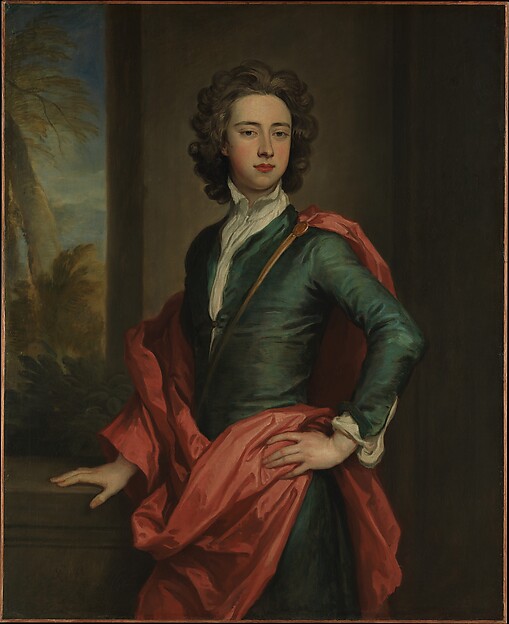
Charles Beauclerk, 1st Duke St. Albans. The Metropolitan Museum of Art.

As stated in The Windsor Beauties:

The Earl of Burford was created Duke of St. Albans in January 1684, and ample provision was made for him by his father. There was a settlement of £5000 a year, chargeable on the Exchequer, he inherited on his mother's death Burford House, and he was given the reversion of the sinecure office of Master Falconer of England and Registrar of the Court of Chancery, both to be hereditary, worth some £1500 a year.
Beauclerk later became a favourite of King William III's following the Glorious Revolution of 1688/89, at which point his fortunes increased. Beauclerk lived in Burford House and eventually married Diana de Vere, with whom he had twelve children.

As I've walked around this part of Windsor, I've noticed so many shop signs and gift shop trinkets that feature Nell. Nell as the busty orange-seller, Nell as the romantic actress, Nell as the wanton mistress. A highly romanticised depiction of her from a 19th-century painting adorns the door to the Windsor & Royal Borough Museum (perfectly situated in the building that Christopher Wren designed!).


It's quite easy to imagine her in her colourful dresses, a bright smile upon her face, as she walked around these streets. I think she'd be astonished to find that, after all this time, people still think on her fondly. I like to think it's because she's the most accessible of Charles II's mistresses, and her warmth transcends time. 

Bibliography:
Adamson, Donald and Peter Beauclerk Dewar. The House of Nell Gwynn, 1670-1974.
Bond, Maurice. The Story of Windsor.
Brown, E.J. The Physical Shape and Urban Landscape of New Windsor 1500-1780.
Evelyn, John. Diary.
Pepys, Samuel. Diary.
Melville, Lewis. The Windsor Beauties: Ladies of the Court of Charles II.
Powell, Roger. Royal Sex: The Scandalous Love Lives of the British Royal Family.

Andrea Zuvich (aka The Seventeenth Century Lady) is usually a 17th-century historian and authoress of historical fiction set in the 17th-century, but she has had to take a break from her beloved history for a month to deal with the craziness of moving house. Now that's sorted out (whew!) she's back, working on three books: William & Mary: A Novel, William Alone: A Sequel, and Anthea: Confessions of a Restoration Actress. She is also thinking about writing a non-fiction history on the Stuarts. She was recently listed as one of the Most Followed Historians on Twitter.


Sunday, 26 January 2014

Bettie, Cromwell's Favourite Daughter

NPG 514, © The National Portrait Gallery, London
Oliver Cromwell is a name that can conjure up strong emotions - even now, some 356 years after his death! To some, he is a glorious hero of republicanism - of freedom from monarchical tyranny. To others, he is the epitome of tyranny and hypocrisy. Utter the name of Cromwell, and images immediately come into view - of soldiers - Roundheads against Cavaliers - and battles such as Naseby, Marston Moor, Dunbar, and many others, flood into our thoughts. When we think of Oliver Cromwell, we think of the hard Parliamentarian - the man who became Lord Protector over the Commonwealth of England. We think of a man who ruthlessly crushed Royalists and Catholics in Ireland. We think of the man whose signature was elegantly penned onto the third spot on the death warrant of King Charles I. We think of a man who became a king in all but name - a man who eventually lived in the same palaces as the king whom he had sentenced to death. 
NPG D28739, © The National Portrait Gallery, London
But Cromwell had another side to his character - that of a loving husband and father. Cromwell's wife, Elizabeth, was a dutiful Puritan wife. Oliver's letters to his wife were full of love - so much so that I found myself completely taken aback by it. 
Oliver and Elizabeth had many children together - Their second daughter, Elizabeth, is perhaps the least well known of the daughters, and so I find her all the more interesting. To be perfectly frank, the only offspring of the Cromwells I had heard of was Richard Cromwell and Bridget Cromwell (since she married Henry Ireton). Therefore, I was pretty surprised to learn about Elizabeth Cromwell, who was affectionately nicknamed Bettie. She was painted by John Michael Wright in 1658 (the year of her death). 
NPG 952, © The National Portrait Gallery, London
Several sources claim that Elizabeth was Cromwell's favourite child, and she possessed a sweet disposition, although she seems to have suffered from what Cromwell referred to as 'vanity and a carnal mind'. Born in July of 1629, Elizabeth was the youngest of Cromwell's children, having followed several siblings, but she was then herself followed by three more. She was truly the apple of her father's eye. When I first saw the portrait featured above, I could see some facial characteristics that she had in common with her father, but I was also surprised by the rather sumptuous dress she is dressed in. Further research revealed that this portrait was most likely painted posthumously. It truly is a stunning work, as you can see - and the vibrant colours are typical of a Wright.
NPG 5497 © The National Portrait Gallery, London

It may amuse the reader to note that John Michael Wright was also a popular portrait painter during the subsequent Restoration. Wright's arguably most famous portrait is that of Charles II's volatile mistress, Barbara Palmer (nee Villiers), Lady Castlemaine, which appears on the right. One can imagine that the Lord Protector would have been quite displeased with the goings-on at the court of the Merry Monarch, but then again, when it came to the Commonwealth and the court of Charles II, it truly was a case of one extreme to the other!
The following is a rather romantic illustration of Cromwell, surrounded by his children (including Bettie), begging him not to proceed with the execution of King Charles. Apparently, Bettie was quite good at stopping prisoners from being executed, but this, sadly did not work out for the king, who was beheaded outside Whitehall Palace on the 30th of January, 1649.
NPG D32080, © The National Portrait Gallery, London
By the time she was sixteen years old, Bettie had fallen in love with the mild-mannered twenty-two-year-old Parliamentarian soldier (who was also her father's Master of the Horse) John Claypole, and she was lucky to have been able to marry for love. She and John were happy in each other's embrace and in the showers of gifts they received from her father (Cromwell made Claypole a peer, thus making his daughter Lady Claypole). The couple had several children.
In 1655, however, the then twenty-six-year-old Bettie began to have noticeable health problems. Lady Antonia Fraser states, 'Bettie Claypole was seriously ill (probably with the first manifestation of the cruel cancer that was ultimately to kill her)'. 
In August of 1658, and after a horrendously painful time, Bettie died. She was only twenty-nine! 
Cromwell was inconsolable. For such a would-be hard man, the death of his favourite little girl was almost too much for him to bear. His health went into rapid decline, and he died only a few months after Bettie. His son, Richard, became the next Lord Protector.
The poet Andrew Marvell wrote a beautiful long poem about the Lord Protector. In this, he alluded to Cromwell's devotion to his daughter when she was on her deathbed. The following is a brief excerpt from 'A Poem on the Death of Oliver Cromwell' :
'If he Eliza lov'd to that degree  
(Though who more worstly to be lov'd then she) 
If so indulgent in his own how deare 
To him  the children of the Highest were? For her he once did natures tribute pay 
For these his life adventur'd every day  
And it would be found could we his thoughts have  
Their griefs struck deepest if Eliza's last.' [2]
And so, Bettie was laid to rest in Westminster Abbey, where other members of her family (including her paternal grandmother Elizabeth) were buried. Cromwell would later be buried in the Abbey as well, but his body was later disinterred and put through posthumous execution during the Restoration. All other Cromwell family bodies were also disinterred and thrown into a pit outside the Abbey. As luck would have it, however, Bettie's tomb remained unnoticed (for it was in another part of the building), and was therefore spared the Stuart revenge. As a result, she is still interred in Westminster Abbey! You can read more about that on the Abbey's website. 
[1] Fraser, Lady Antonia. 'Cromwell, Our Chief of Men'. Weidenfeld & Nicolson Ltd, 1973.
[2] Marvell, Andrew. You can read the complete poem here.
Andrea Zuvich is a 17th-century historian and historical fiction writer. Her biographical fiction debut, His Last Mistress is about the Duke of Monmouth and his doomed relationship with Henrietta Wentworth. She also wrote the historical horror The Stuart Vampire and is currently working on William & Mary: A Novel. www.17thcenturylady.com

Sunday, 19 January 2014

A mystery cloaked in the obvious


            Who is buried in Ulysses S. Grant’s tomb? Is the Pope Catholic? Who wrote Mary Dyer’s last letter?
In previous books about Mary Dyer, in internet genealogy sites that copy from one another, and going all the way back to the 17th-century Quaker chroniclers, we are told that Mary Dyer (known as the “Quaker Martyr”) wrote two letters in late October 1659: the night before her death sentence was to be executed, and again, after her reprieve. Those writers give us the text content of the letters. The inscription on the Mary Dyer sculpture in Boston is taken from the text of the second letter.
While researching my novels on the Dyers, I tracked down original documents to see what the penmanship was like. (I didn't attempt graphological analysis.) Were there cross-outs, ink blots, even margins, evidence of a bumpy surface on which the paper was placed, or did the text flow freely from mind to the page? Many men who were fairly high in colonial government could only make marks instead of signatures. William Dyer was a businessman, clerk, and eventually a colonial official (first attorney general in all of America)—was he measured in his phrasing, did he cram his handwriting to save space at the end of a line, did he write in even planes or slant it up or down, and did he use standard spellings of his day or write phonetically?
Of course, I had similar questions about Mary’s writing. Many women could read their Bibles, at least, but not every man or woman could also write (print or cursive), and if they did, it looked like chicken scratches.
So I set about looking for these original holographs. After many hours of research, I found two of William’s letters regarding Mary (the ones transcribed accurately on several websites), and one of Mary’s letters, in the Massachusetts Archive and its state library.

Fragmentary image of Mary Dyer's letter to the Boston court,
26 October 1659.

Image courtesy of Massachusetts Archive
As soon as I read Mary’s letter, I noticed that it bore little resemblance to the text she’s supposed to have written the night before she expected to die.
First lines of the letter everyone thinks Mary wrote:

Whereas I am by many charged with the Guiltiness of my own Blood: if you mean in my Coming to Boston, I am therein clear, and justified by the Lord, in whose Will I came, who will require my Blood of you, be sure, who have made a Law to take away the Lives of the Innocent Servants of God, if they come among you who are called by you, 'Cursed Quakers,' altho I say, and am a Living Witness for them and the Lord, that he hath blessed them, and sent them unto you: Therefore, be not found Fighters against God, but let my Counsel and Request be accepted with you, To repeal all such Laws, that the Truth and Servants of the Lord, may have free Passage among you and you be kept from shedding innocent Blood, which I know there are many among you would not do, if they knew it so to be: Nor can the Enemy that stirreth you up thus to destroy this holy Seed, in any Measure contervail, the great Damage that you will by thus doing procure: Therefeore, seeing the Lord hath not hid it from me, it lyeth upon me, in Love to your Souls, thus to persuade you: I have no Self Ends, the Lord knoweth, for if my Life were freely granted by you, it would not avail me, nor could I expect it of you,…

First lines of the letter Mary actually wrote (line breaks follow Mary’s line breaks in the original holograph):

from marie dire to the generall court now this present 26th of the 8 moth 59
assembled in the towne of boston in new Ingland greetings of grace mercy
and peace to every soul that doth well : tribulation anguish and wrath to all that doth evell
Whereas it is said by many of you that I am guilty of mine owne death by my
coming as you cal it voluntarily to boston: I therefore declare unto every one
that hath an eare to hear: that in the fear peace and love of god I came and in weldoing
did and stil doth commit my soul and body to him as unto a faithful creator
and for this very end hath preserved my life until now through many trialls and
temptations having held out his royal scepter unto mee by wch I have accesse
into his presence and have found such favoure in his sight as to offer up my
life freely for his truth and peoples sakes :

So what accounts for the huge difference in the two versions? The short answer is that somehow, Quaker minister and writer Edward Burrough received a copy of Mary’s original letter, and created his own letter, putting Mary’s name to it for persuasiveness and authority. And for 350 years, everyone has thought Burrough’s letter was Mary’s.
But it’s not.
Why would Burrough do that?  His purpose was not to preserve Mary’s words, but to put an end to the Quaker persecutions raging in England and New England by writing a pamphlet to King Charles II, refuting the defensive pamphlet written by the Boston magistrates after Mary’s unpopular execution in June 1660. Burroughs’ efforts succeeded, and the king ordered Governor Endecott to stop executions and refer any capital cases to England for trial.
Cover page of Burrough's 1660 pamphlet
My training and career have been focused on writing and editing magazines, books, and websites for nonprofit organizations, religious entities, and universities. It’s the practical, workhorse side of public relations and marketing. It was my job to mold (and often rewrite) the words of the CEO or other executives to more precisely fit the mission and message of the organization. If I may project backward by 350 years, I suspect that immediately after Mary’s execution in 1660, someone in Boston stole and copied Mary’s letter(s) to the General Court, and sent the copy to Burrough in England. It was his purpose to craft an image for the new Quaker movement, and do to King Charles what Mary had already done to the people of Massachusetts:
1.      create outrage that the Boston authorities were out of control,
2.      that they’d gone too far by killing a high-status woman who was innocent of a capital offense, and
3.      that they must stop the persecution of people who were only obeying God.

But Mary’s letter(s) contained words meant only for the Boston magistrates—words of softer persuasion, that they would listen to God’s voice in their hearts and stop the torture and killings of God’s people, the Quakers. So Burrough rewrote or ghost-wrote the letter in fiery, angry language to fit his agenda, presented the pamphlet (containing only the first letter) to the king in audience in winter 1661, and obtained the desired writ. Only one more Quaker was hanged after Mary, because of the delay in trans-Atlantic travel. Another Quaker who had been condemned to die was reprieved and banished because the writ came in time to save him.
Then in 1662, Burrough, a Quaker preacher and political advocate, was arrested for holding illegal religious meetings in his home. He was sent to Newgate Prison, and despite a release order from the king (which was ignored, probably by anti-royal Puritan rebels left over from the Cromwell days). Burrough remained in prison and died there at age 29 in February 1663. Prison conditions were extreme: starvation, filth, vermin, and disease killed many prisoners, and unheated dungeons in freezing winters would certainly hasten death.
With Mary Dyer and Edward Burrough dead and Quaker persecutions surging again, no one remained to think about or argue who wrote the letters. Somehow, Mary’s letter was returned to the General Court files kept by the malevolent Edward Rawson, secretary, and that’s the letter that remains in the archive vaults to this day. A second letter—if it ever existed—is not preserved, though someone wrote a letter that purports to be Mary’s, for which we have no holograph. It’s as strongly worded as the other letter’s Burrough version, so perhaps he wrote the second letter and didn’t use it in his pamphlet.
If Mary’s first letter was changed so radically, we have to assume that the second letter was also altered significantly. But we have no original with which to compare.
I used the text of Mary’s original first letter, making it more modern with paragraph breaks and conventional spellings, in my second novel, Mary Dyer: For Such a Time as This. I used phrases from the second letter (whether written by Mary and edited or rewritten by Burrough) in dialog, but chose not to reproduce the second letter.
Someday, when my fantasy of all of this intricate and fascinating Great Migration-era story becomes a TV series on PBS and BBC, it would be fun to explore or invent who purloined Mary’s letters and sent copies to England.
Was there a Quaker mole in the midst of the Boston wolves?   
 
The letter in Mary Dyer’s hand
Mary came to the end of the large sheet of paper, and turned it over to write six more lines, the ghost image you see behind the words in the middle of this fragment. On the right vertical edge of the paper are water stains which smeared the ink. Perhaps it was raining when the messenger carried her letter from the jail to the Massachusetts General Court, presided over by Governor John Endecott. The letter was folded at some point, and the paper has flaked away at some folds and edges, but for the most part, it's legible, even after more than 350 years! 
Front of the Oct. 26, 1659 letter that
Mary Dyer wrote in prison.
Paper was a luxury commodity in seventeenth-century New England because it had to be imported. In Europe, paper was milled from macerated hemp, flax, and linen or cotton rags. (Wood pulp was not used until 1843.) Important documents like royal charters were written on vellum (calf skin) or parchment (sheep or goat skin).
William Dyer, Mary’s husband, would have had a ready supply of paper for his work as clerk, recorder, secretary, attorney general, and solicitor to the colonial assembly. His penmanship is fine, and contains few corrections, which means the documents were copied from draft notes, or that he was confident of his writing and reporting abilities and got it right the first time.
As I mentioned before, Mary Dyer was among the privileged few women who could both read and write. And judging from the even, consistent appearance of her handwriting, she had plenty of practice. Perhaps Mary kept a journal that was lost or burned, or wrote letters to friends that have been lost to the ages. In my novels, I suggested that Mary kept farm and business accounts for the family, and during her time in England, kept a journal and wrote letters. Keeping ledgers was common among merchant-class women, and in England the aristocratic women kept journals and wrote letters and books.
The letter she wrote to the General Court while in prison was very legible, but she had more words to write than she had paper, so she had to turn the paper over and write six more lines on the back, which most writers did not do because the ink could bleed through. She probably had to buy the sheet of paper and use of a quill pen and ink from the jailer, as Quakers were not allowed any books or writing materials in the prison—upon conviction, the law required that those items be burned to prevent them from proselytizing, journaling, or fomenting more rebellion.
(Of course, burning Quaker possessions also destroyed evidence that might have been used against them, but the Governor and assistants didn’t seem to have thought of that—nor  had they ever watched CSI or Law and Order. I find it amusing that one of the Plymouth Colony Quakers used the lack of evidence because his books were burned, to successfully to defend himself.)
All of New England’s paper was imported from England at this time. There, all the paper for books, broadsheets, pamphlets, government and private use, was made by one or two companies who held a monopoly on the process. Mary’s paper’s finish was a horizontal “laid,” which is a fine texture of parallel lines rolled onto the paper when it’s still wet. Cheaper paper of the era, made at most paper mills in England, was a coarse gray, but this paper’s original color may have been a white or cream, which browned with age. Its content was probably 100 percent linen rag. It appears it was a quality sheet of paper, perhaps obtained from the office of Edward Rawson, MassBay Colony secretary, and is the same type of paper that William Dyer used for Rhode Island business and the letters he sent to the Boston court on behalf of his wife.
I wondered if Mary had written the letter in a prison cell, or if she was in a room with a table and some light. There’s no evidence of an uneven or rough surface under the writing, so I think a table was used. In comparison to William’s fine-tipped pen which perhaps had a metal nib, Mary’s writing is much more thick or bold, so the pen might have been of low quality or needed trimming. But she had enough light to keep her lines and letters even. She didn’t write words that she scribbled over. And if she made a mistake, perhaps she was able to scrape off the ink and rewrite a word, but I can’t tell from a computer screen.
In the text she wrote, Mary Dyer cast herself in the role of biblical Queen Esther, a Jewess who threw herself on the mercy of the Babylonian King Ahasuerus to save her people from slaughter. No one approached the totalitarian, oft-drunken monarch Ahasuerus and lived unless the king held out his scepter in acceptance, which he did for Esther. Esther’s guardian, Mordecai, had told her that it was her destiny to persuade the king to stop the persecution and genocide, saying that God had brought Esther to her role “for such a time as this.” And Esther was successful in saving her people.
Mary saw herself as called by God to take a stand before the ultra-fundamentalist government of Massachusetts Bay and Plymouth colonies, at “such a time as this,” the height of Puritan-on-Quaker persecution, by saying that they were persecuting Christ’s children, and therefore, Christ himself. She asked them to search themselves for any spark of the Light of Christ within them, and warned them of eternal damnation if they persisted in their policies and attitudes. 

Mary Dyer: "but to me to live is Christ and to die is gaine"
At the page turn, Mary asked that Quakers be allowed to attend the execution and clothe the bodies of her Friends Stevenson and Robinson (and herself) with shrouds. The aftermath of the death penalty was to strip the bodies after death and throw them naked into an open pit near the road where birds, tidewater, and nature would decompose them and serve as a warning and crime deterrent to passersby. There was a fence around the pit to prevent the bodies being taken away.
Boston court records do not show if Mary’s letter was read in court, or if they denied or accepted her request. Many letters of the time, in England and New England, show the date they were read and recorded. They say “endorsed” or “denied” and are dated. There was no such notation on her letter, although there’s a scrap of paper taped to the letter which states that it’s from Mary Dyer, with the date she wrote it. It’s not in Mary’s hand, though. It seems to be a file note.
Perhaps there was no resolution noted on the letter because nine days before the October execution, her fate had already been decided by the court.
Did Mary’s letter have any effect, then, on stopping Governor Endecott and Reverends John Norton and John Wilson from their bloody persecution and death penalties? Probably not.
But her death itself, seven months later, did cause considerable outrage amongst even the non-Quaker populace, and of course Edward Burrough used Mary’s letter as a model for his successful pamphlet.
The unintended effect of Mary Dyer’s letter is that 350 years later, we gain insight into the real story and intimate details behind the legend.


Christy K Robinson is the author of three books set in the 17th century: the biographical novels Mary Dyer Illuminated, and Mary Dyer: For Such a Time as This, and (nonfiction) The Dyers of London, Boston, & Newport. For more information: http://marybarrettdyer.blogspot.com/p/blog-page.html

Sunday, 5 May 2013

Charles II-The Lady Who Might Have Been His Queen

Henriette Catherine of Nassau

No, not Frances Stuart, who refused the king’s advances and ran off with the Duke of Richmond. This lady appeared much earlier, when Charles II was in exile during the 1650’s.

Henriette Catherine was the second to youngest daughter of Frederik Hendrik of Orange  and Amalia of Solms-Braunfels. The House of Orange had already provided a bridegroom for Charles I’s eldest daughter, Mary, Princess Royal. One of Frederick and Amalia’s daughters, Louise Henrietta, had tentatively been suggested as a bride for Prince Charles, but she married the Elector of Brandenburg.

Around 1656, while staying in Bruges during his exile, Charles was attracted to the eighteen-year-old Henriette Catherine of Orange, who had already shown her strong spirit in refusing to comply with a betrothal her parents had made for her in infancy to a Friesian prince because of her ‘unconquerable aversion’ to him.

Henriette Catherine and Charles wrote to each other diligently with Charles using a code name ‘infanta’. He extolled the lady’s virtues and the contents of her letters to Lord Taaffe, and even ordered six pairs of gloves from Paris for ‘my best friend’. On Shrove Tuesday, Charles planned to eat pancakes and draw valentines with the women, while privately drinking ‘the infanta’s health. ‘For I cannot choose but say she is the worthiest to be lov’d of all the sex.’

When Cromwell died two years later, even the Dowager princess of Orange, Henriette Catherine’s mother and Mary of Orange’s mother-in-law, imagined that the penniless emigree courting her daughter would soon be reinstated as a powerful king. Charles himself was equally confident in his imminent return to England, and he issued a formal proposal for Henriette Catherine's hand.

His widowed sister, Mary of Orange disapproved of the match, as did the dowager Queen Henrietta Maria, who had embarked on a romance with Harry Jermyn, a liaison of which Charles fervently and openly disapproved. Despite the change of regime in England, there still appeared no sign that Charles was about to regain his throne.

Henriette Catherine’s mother, realised they had been too hasty, and Charles’ approaches were reconsidered. The following year, a new suitor was selected for Henriette Catherine, John George of Anhalt-Dessau and they were married in September 1659.

Charles was philosophical and told Lord Taaffe that his fondness for Henriette Catherine inspired in him a real wish for her true happiness and he would not interfere. Henriette Catherine married her prince and embarked on a happy thirty-four year marriage that produced ten children.
Frederick and Amalia of Nassau with their daughters
How different the history of England might have been had Charles married this Protestant, and fertile, Dutch Princess. 

~~~~~~~~~~~~~~~~~~~~~~~~~~~~~~~~~~~~~~~~~~~~~~~~~~~~~~~~~~
Anita Davison is a Historical Fiction Author whose latest release, Royalist Rebel, is published under the name Anita Seymour by Claymore Press.
~~~~~~~~~~~~~~~~~~~~~~~~~~~~~~~~~~~~~~~~~~~~~~~~~~~~~~~~~~