Showing posts with label King James I. Show all posts

Saturday, 27 February 2010

King James I: Royal Demonologist


Even by the standards of his age, King James VI of Scotland, who later became James I of England, stood out as a deeply superstitious man, ruled by his obsession with the occult.

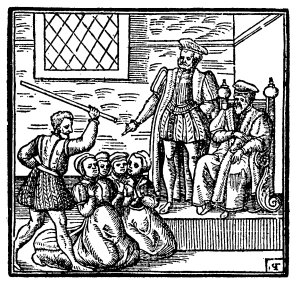
Before his reign, witchcraft persecutions had been rare in Britain. But that all changed in 1590 when James personally oversaw the trials by torture for around seventy individuals implicated in the North Berwick Witch Trials, the biggest Scotland had known. The witches’ alleged crime? Raising a storm which nearly sank James’s ship when he sailed home from Norway with his new bride, Anne of Denmark. Possibly dozens of accused witches were executed by burning at the stake, although the precise number is unknown.

In 1597 James published his book, Daemonologie, his rebuttal of Reginald Scot’s skeptical work, The Discoverie of Witchcraft, which questioned the very existence of witches. Daemonologie was an alarmist book, presenting the idea of a vast conspiracy of satanic witches threatening to undermine the nation.

In 1604, only one year after James ascended to the English throne, he passed his new Witchcraft Act, which made invoking spirits a crime punishable by execution.

James’s ideas on witchcraft were later popularised by Shakespeare’s play Macbeth, which had its premier performance at James’s court in 1606. For the first time in history, English drama depicted witches gathering in secret for their own malign rituals and scheming.

The weird sisters, hand in hand,
Posters by the sea and land,
Thus do go, about, about,
Thrice to thine, and thrice to mine,
And thrice again, to make up nine.
Peace, the charm's wound up.
(Macbeth, I,iii, 32-37)


According to Instruments of Darkness by James Sharpe, this terror of supposed witch covens was the driving factor mobilising 17th century witch hunts. Previously the belief in witches’ covens had been a Continental European concept, foreign to traditional British folk magic, practised by individuals, not collectives. No evidence exists that supposed witches in Early Modern Britain organised themselves into collectives, and nothing of the black mass can be traced to England at this time.

It wouldn't take long before life began to imitate James's and Shakespeare's dark fiction.

Six years on, in 1612, the King’s paranoid fantasy of satanic conspiracy, planted in the minds of local magistrates hoping to earn his favour, culminated in one of the key manifestations of the Jacobean witch-craze: the trials of the Lancashire Witches of Pendle, which resulted in the execution of seven women and two men. According to Thomas Potts's The Wonderfull Discoverie of Witches in the Countie of Lancaster, the official trial transcripts, the accused allegedly gathered "according to solemn appointment" at Malkin Tower on Good Friday, "with great cheer, merry company and much conference," and then plotted to blow up Lancaster Castle with gunpowder. As far-fetched as this scenario seems--where would a group of impoverished commonfolk even get hold of gunpowder--it fed directly into James' fears following the Gunpowder Plot of 1605.

James’s unfortunate legacy extends even into our age. The King James Bible, completed in 1611, saw the scriptures rewritten to further the King’s agenda. Exodus 22:18, originally translated as, “Thou must not suffer a poisoner to live,” became “Thou must not suffer a witch to live.”


Speaking of the Pendle Witches, local preparations for commemorating the 400th anniversary of the 1612 Lancashire Witch Trials are underway. Read more about it here.

Sunday, 24 January 2010

On making the 17th Century Book Video


An increasing number of authors are creating video trailers to promote their books. Historical fiction gives an added depth and flavour to the process, a chance to show off your period garb or highlight the elements of history that your book draws out.

I was very fortunate that my publisher, Houghton Mifflin Harcourt, arranged for me to create such a trailer for my forthcoming novel, Daughters of the Witching Hill. The history of the Pendle Witches is so rich in its own right, it's just crying out to be filmed.

My marketing director arranged for me to work with London filmmaker Callum Macrae of Outsider Television. Callum is a seasoned veteran who has filmed in war zones, done documentaries, and worked for programmes such as Panorama. He has also recently started doing "Lit Vids"--literary videos. Here is a link to the trailer he did for Tom Levenson's nonfiction book, Newton and the Counterfeiter.

First, Callum and I worked out a draft script by email. Callum had many brilliant ideas. What we ended up aiming for was something quite ambitious--more like a mini-docudrama than the typical promotional video.

Callum drove up on a Thursday with his assistant camera woman, the beautiful and brilliant Livvy Haydock. The first day we discussed the script while driving around various locations in the Pendle region. The rugged landscape proved to be as indispensible for the filming as it was for the actual storytelling. You could just picture the characters emerging from the misty moorland.

We shot on location at my stables with scenes of me on horseback since riding my horse around the Pendle region was such an instrumental part of my creative process. I had considered riding in costume, but, alas, I never learned to ride side-saddle. Callum actually thought it was better that I just ride as Mary in the twenty-first-century, and so that's what I did, less-than-flattering-riding-helmet and all. Booshka, my Welsh Section D mare, was impeccably well-behaved, even though she couldn't understand why we wanted her to keep walking back and forth over and over again in front of the camera for over half an hour.

I had never realised how many "takes" you need to get a scene just right.

After Miss Boo got her treats and was turned out to play in the field with her friends, we drove on to Malkin Tower Farm, where the owners, Rachel and Andrew Turner, gave us a warm welcome and showed us what are believed to be the ruined foundations of what was once Malkin Tower, home to my protagonist Mother Demdike and three generations of her family.

Malkin Tower Farm has a number of lovely, inviting holiday cottages in an area of outstanding natural beauty. If you ever visit Pendle, it's the perfect place to stay. They welcome walkers and cyclists, and have two very friendly and engaging dogs.

I crouched down near the stones, explaining their significance to the camera, while camera assistant Livvy donned historical costume and did a sequence in the background, walking down the steep slope around the ruins, as Mother Demdike's granddaughter, Alizon Device. Callum filmed another sequence of Livvy as Alizon walking through gnarled winter trees. With her long blond hair and porcelain skin (she wore no make up for the filming), Livvy was hauntingly perfect as Alizon.

Since we were so pressed for time, having to do all the filming on one day in the fleeting winter daylight, we put the historical costumes on over our modern clothes. So, in the costume sequences, I was wearing a long skirt over my riding breeches and tall boots. In the non-costume sequences, I wore my 17th century bodice and chemise-like blouse and corset under my winter jacket. I spent the entire day in my corset, rode my horse in my corset, even mucked out in my corset. How is that for historical authenticity?

After Malkin Tower Farm, we drove on to the old quarry outside the village in Newchurch in Pendle. It was while walking past this quarry at daylight gate--twilight in the local dialect--that Mother Demdike, called Bess in my novel, first met Tibb, her familiar spirit. In traditional English folk magic, no cunning woman could work her spells without a familiar, or otherworldly ally. So the day she met Tibb was really the turning point of her life, when she first came into her powers. A fanciful Victorian stonemason carved a man's head on the quarry stone to commemorate the legends of Tibb.

In the quarry I discussed all this for the camera before changing into costume and reciting an excerpt from the novel, in character as Mother Demdike, describing the moment when she first met her familiar spirit, who appeared to her in the guise of a beautiful young man. Callum wanting me speaking, not reading, so I had to learn all the passages by heart.

The light in the quarry kept changing dramatically. At once point we were enveloped in dense fog before it lifted to dazzling evening sunlight. Then, off down the valley, mist lifted off the damp green fields like plumes of rising smoke.

By the time we finished the filming, daylight gate was closing. It was getting dark and we'd finished filming all the outdoor sequences just in the nick of time.

We drove back to the stable where we turned an empty stall into a witch's cottage with dried herbs hanging on the wall, an old fashioned willow broom, candles, and even sheep skulls for ambiance. Callum also had a smoke machine going to create an eerie atmosphere.

Our props included facsimile editions of the two historical books my novel draws on as primary sources, The Wonderfull Discoverie of Witchcraft in the Countie of Lancaster, by Thomas Potts, the official transcripts of the 1612 Pendle Witch Trial, and Daemonologie, written by King James I, a witch-hunter's handbook that his magistrates were expected to read. I found jpegs of the original, historical title pages of these documents on the internet and then Callum printed them out at home and treated them with tea stains and coffee grounds until they resembled yellowing, crumbling old manuscript pages.

In our "witch's cottage," I discussed the significance of the historical documents and then recited some more passages from the novel, in costume and in character as Mother Demdike. My chosen excerpt was from the opening of the novel, when Mother Demdike, her daughter Liza, and granddaughter Alizon confront churchwarden Richard Baldwin who has refused to pay Liza for the work she's done carding wool for him. According to the primary sources, Baldwin tried to drive the women away with a horse whip, calling them whores and witches. He is recorded as saying, "I will burn the one of you and hang the other."

To punctuate these scenes of conflict between Mother Demdike and the authorities, we used a braided leather whip, purchased from a London joke shop. Callum cracked the whip on the floor while Livvy filmed close up shots.

I was worried that the noise might spook the horse in the next stall, so I went out to check. The horse in question merely nuzzled my pockets for treats, so he didn't seem too traumatised.

A dog club was meeting at the stable grounds that night, so our audio takes had the odd bark and howl in the background which added to the aura of mystery.

We weren't finished at the stable until nearly 9:00 at night, by which time the fog outside was so thick, it made the smoke machine redundant.

Back at my home, we finished the voiceover takes.

I can hardly wait to see the finished product, which Callum and Livvy will edit. After the publisher has approved it, the short film should go live on sites like Amazon.com and Barnesandnoble.com. Watch this space.

Sunday, 18 October 2009

Most Haunted's Pendle Witch Hunt: A Sceptic's Guide


Halloween, 2004

Living TV's Most Haunted investigated several farmhouses around Newchurch in Pendle in search of the ghosts of the Pendle Witches of 1612. Their team of ghost hunters not only claimed to have had a direct encounter with the Pendle Witch "coven" in an old house on Lower Well Head Farm, but that the spirit of Old Demdike attempted to strangle TV psychic Derek Acorah, who has since been outed as a fake.

While I realise that the people most likely to read this blog take TV psychics with a healthy dose of scepticism in the first place, Halloween seems to drag out all kinds of ghoulish speculation about historical witches and cunning folk in a way that is not only historically inaccurate but disrespectful. The Pendle Witches were not ghouls. They were real living people who were held for months in a lightless dungeon in Lancaster Castle, chained to a ring in the stone floor, before being tried without any barrister and then hanged.

It doesn't help matters that reference sites such as Wikipedia mention the Most Haunted series in the same paragraph as William Ainsworth's delightfully gothic novel, The Lancashire Witches, first published in 1849, that revived the Pendle Witch story after it had lain dormant for two centuries.

Derek Acorah's bad acting notwithstanding, Most Haunted's Pendle Witch programme was full of inaccuracies.

1. The programme, investigating paranormal activity at a number of sites around Newchurch, can't even get the name of the village right. They refer to it as "Newham," just as Derek Acorah claims to channel "Elizabeth Southworth"--Mother Demdike's real name was Elizabeth Southerns. The Lancaster Witch Trials of 1612, under the reign of James I, are referred to as a "Tudor witch trial." I could go on and on. Each viewing reveals more bloopers.

2. Yvette Fielding makes a big deal about the noise of barking dogs as an indicator of paranormal activity and lurking evil. The real reason for the dog noise is quite banal. Lower Well Head Farm is situated next door to Meadow Top Boarding Kennel where one may hear barking dogs at any hour of the day or night.

3. Derek Acorah claims to psychically sense Demdike and Chattox gathering at Lower Well Head Farm in 1610 to work magic with the rest of their "coven." There are two major errors here.

English cunning folk appeared to work alone or in small family groups but there is no evidence that they worked in covens, which appeared to be a Contintental European concept first popularised in Britain by King James I in his book, Daemonologie, a witch-hunter's handbook and required reading for local magistrates. Shakespeare's play Macbeth, originally performed for James I and his court in 1605, presents the first depiction of a witches coven in English literature.

The second major error is that all recorded confessions in the Pendle Witch trials seem to indicate that Demdike and Chattox were bitter enemies in 1610 and unlikely to meet up to collaborate on any kind of magical working.

During the live "investigation," Most Haunted's viewers were invited to text their answer to the either-or-question: Where the Pendle Witches innocent victims or were they real witches with real powers? The superficiality of this question is an insult to the historical realities of cunning folk who lived in an era when everyone, rich and poor, educated and illiterate, believed that magic was real.

Cunning craft was the family trade for both Demdike (Elizabeth Southerns) and Chattox (Anne Whittle). Of course, they believed they had powers. Their very livelihood depended on it. Of course, they owned up to Roger Nowell, the prosecuting magistrate, about their familiar spirits. Without their familiars, they would have no powers and they would be revealed to be bigger fakes than Derek Acorah! How could a cunning woman bless and heal without the aid of her spirit--her otherworldly ally?

Were they innocent victims? How does one define innocence in the complex world of Jacobean witch-hunts? Anne Whittle, aka Chattox, confessed to bewitching to death her landlord's son, her motive being that he attempted to rape her daughter, Anne Redfearn, and to drive her entire family out of their cottage. In a time and place where there was a different law for the rich than for the poor and where the wealthy knew they could get away with rape, a fierce reputation as a cunning woman may have been the only power an impoverished woman could hope to wield. Was Chattox an evil witch for wanting to protect her daughter? Family love seemed to guide her every action. In the 1612 trial, she broke down and confessed her crime, then tearfully pleaded her daughter's innocence and begged the gentlemen of the court to let Anne Redfearn go free. But Anne was hanged alongside her mother.

As for Elizabeth Southerns, aka Old Demdike, the trial transcripts reveal that local farmers called on her to heal their children and their cattle. She was a cunning woman of long standing before she finally died in Lancaster Prison, aged "foure-score yeares," ie eighty years old, according to Court Clerk Thomas Potts. What is amazing is not that the magistrate finally arrested her but that she practised her craft for decades and none in her community spoke against her until the very end.

It is my belief that the Elizabeth Southerns, Anne Whittle, and the other accused witches live on in Pendle as part of the undying spirit of the landscape. They are the strong cunning folk who will never be banished. But you won't find them channeled by bad TV psychics. Walk the land instead, listen to the language the land speaks, the wind and rain, the dance of the seasons. That is where the real magic begins.


For a more nuanced view on the Pendle Witches than what you will find in Most Haunted, I recommend the following books:

Primary Source:

The Wonderfull Discoverie of Witches in the Countie of Lancaster by Thomas Potts

Daemonologie by James I

Secondary Sources:

The Lancashire Witch-Craze by Jonathan Lumby

The Lancashire Witches: Histories and Stories, edited by Robert Poole

The Trials of the Lancashire Witches by Edgar Peel and Pat Southern