Showing posts with label Deborah Swift. Show all posts

Monday, 7 July 2014

Light and Shadow in the 17th Century

by Deborah Swift

When I first began writing novels set in the 17th century, I quickly became aware that lighting would play an important part in any night time scene. If outdoors, then the phase of the moon dictates how much light there is to see by, and any indoor scene would need to be lit by some means.

So what did ordinary people use in their daily lives?

The earliest form of lighting, which existed in Greek and Roman times and persisted until well after the 17th century was the rush-light. Gathered in the height of summer, the rushes were stripped to leave only a narrow sliver of green attached to the pith. These were then dried in the sun and were sold on, or used at home. To give you an idea of their lightness and fragility, a pound in weight of rush-dips contained 1600 dry rushes (according to Gilbert White of Selborne )
Chobham_Museum_rush_lightholder
Chobham Museum, Rushlight holderphoto by Brian Wood
Rushes were dipped in bacon or mutton fat in an oval grease pan. This type of light might last for a half hour, but the light was meagre and smoky, and several lights might need to be burned to provide useful light for work. The rush was supported by a clamp in a rush-light holder, and when it became low could be burned at both ends. (Yes, you guessed, origin of the phrase; 'burning the candle at both ends'.) Children were often responsible for making rush-lights and keeping them alight, as they were very fiddly and delicate to handle.

Candles were the light of choice for more wealthy householders, and rush-light holders often had a candlestick attached, see left. Candles were made the same way as rush-lights with string dipped several times in grease, or by moulding them with a 'candle stool'.

Candle stool for moulding candles
Beeswax candles were made from rolled sheets of wax and were very expensive, so reserved for special occasions. With the mutton fat candles the string burned more slowly than the grease and had to be trimmed often.


1680 Candlestick
A candlestick could be a simple wooden or brass holder, or something more elaborate. Candles were often supported by pushing them onto spikes, rather than into a cup type holder.


Antique 1800s Early Wrought Iron Free standing candleabra such as this Spanish 17th Century example, were common, as were wall sconces, usually of a simple wrought iron variety. These examples are later, but something similar is referred to in Evelyn's diary of the 17th century.

A lamp was often just a candle inside a metal carrier, and often not glazed but with holes cut to let out the light, or bars to prevent the candle from falling over and setting light to the furnishings. See the picture at the top of the post. Examples with glass are rare, but this is a German hand-held lantern. The front hinges open so that you can insert a candle, and there is a 'chimney' to let the smoke out. The handle is at the back, as heat rises and this prevents the hand being burned.

I became especially interested in different types of lighting because my latest novel for teens and adults, 'Shadow on the Highway' has many night-time scenes.

In order to understand the visual effect of the light and shadow of naked flames I turned to artists such as Gerrit Von Honthorst (see below) and Rembrandt. I hope to write a further post on these artists as their paintings really helped to shape the world  of light and shadow I was trying to create. The painting I've put in this post is called 'The Denial of St Peter', though the subjects are dressed as contemporaries to Honthorst. The darkness where things can be out of sight so easily, is a thing that novelists often forget to take account of, but this painting makes it very evident.

Gerrit_van_Honthorst_-_De_Verloochening_van_Sint_Petrus


'Shadow on the Highway' is coming out in a few weeks time as an e-book from Endeavour Press, and the paperback will follow later. It is about the life and legend of Lady Katherine Fanshawe, the highwaywoman.
Here is a sneak preview of the cover.

Sunday, 22 June 2014

Hoydens Round Up...

With three new members of the Hoydens and Firebrands team we thought it timely to do a little catch up on our recent releases and forthcoming news.

Starting with our newest members:

CHRISTY ROBINSON

Nothing much to report on my books, except I'm formatting a Kindle version of my third book into a paperback version. It's my nonfiction book, The DYERS of London, Boston, & Newport.
Find out more about Christy at http://marybarrettdyer.blogspot.com 


JO ANN BUTLER
The Golden Shore, the final mss for my Herodias Long trilogy, is coming together nicely. It should be ready to publish next spring, if I don't let playing bass clarinet in several community bands distract me!
To read more about Jo Ann visit http://www.rebelpuritan.com/


DEBORAH SWIFT 
My teen/adult novel 'Shadow on the Highway' - will be published by the UK's Endeavour Press. It is the first of a series of books based on the life of notorious Highwaywoman Lady Katherine Fanshawe, and is set at the end of the English Civil War. Great fun to write - you can read more about Lady Katherine here: http://riddleofwriting.deborahswift.com/2014/04/13/my-main-character-lady-katherine-fanshawe/ 

'A Divided Inheritance' is now available as an audiobook and in large print. 
 Meanwhile, I am continuing work on my novel based around Pepys's Diary and on the sequel to 'Shadow on the Highway'.

ALISON STUART

My English Civil War, castle siege story, CLAIMING THE REBEL'S HEART came out in January to some lovely reviews. For more information and to read an excerpt visit my website: http://www.alisonstuart.com/claiming-the-rebels-heart.html
In a change of pace (or period), my first foray into Regency, a regency romantic suspense, LORD SOMERTON'S HEIR was published with Escape Publishing (and imprint of Harlequin Australia) in May.
I may have some other, really exciting news but I can't say anything yet... curses!

ANITA DAVISON - Some really big news...

I have two novels being re-released with Books We Love under the titles, The Rebel's Daughter and The Goldsmith's Wife.

The Rebel's Daughter

Helena Woulfe, the daughter of a wealthy Exeter nobleman leads a privileged life. 
However, as King Charles II's reign comes to an end, so does her innocence.
Rebellion sweeps the West Country and when her family is caught in its grip, 
she finds herself on the road searching for her missing Rebel father and brother after the Duke of Monmouth’s bloody defeat in battle at Sedgemoor.
King James II wants revenge on those who opposed him and their lives are further torn apart when soldiers ransack her home. 
The family estate is confiscated by the crown and given to their bitterest enemy.
Feeling bereft and abandoned, they go to London. Helena hopes the city will overlook 
their past and she can make a new life for herself, and perhaps find love. 
Only, there are others lurking, willing to do harm to a traitor's daughter.
Before she can find happiness with Guy, the man who offers her the security and 
respectability she seeks, she learns her family’s allegiances can snatch away her 
safety at any time.

The Goldsmith's Wife

It is 1688 and in London, and Helena has what she always wanted, respectability and security, although her brothers remain a worry - Aaron schemes in Holland with the Prince of Orange to depose the reigning King James II, and Henry carries his own sorrow, pining for another man's wife.
 
Prince William arrives in England to re-establish the Anglican Church,and when anti-Papist riots break out in London, Helena is forced to flee from her home – again.
 While Helena strives to keep what she holds dear, can she and her brothers attain what they desire and above all, will they ever learn the fate of their missing Father, who disappeared after the Battle of Sedgemoor?


KIM MURPHY

I had an excellent interview in The Atlantic for I Had Rather Die: Rape in the Civi War. 
http://www.theatlantic.com/health/archive/2014/02/gender-race-and-rape-during-the-civil-war/283754/
And my second book in The Dreaming series Wind Talker will be released in the fall. Like Walks Through Mist, it will be a mix of the modern and 17th-century Virginia.


MARY SHARRATT reports she is between books at the moment and ANDREA ZUVICH is in the throes of moving house when all life stops... 


Sunday, 4 May 2014

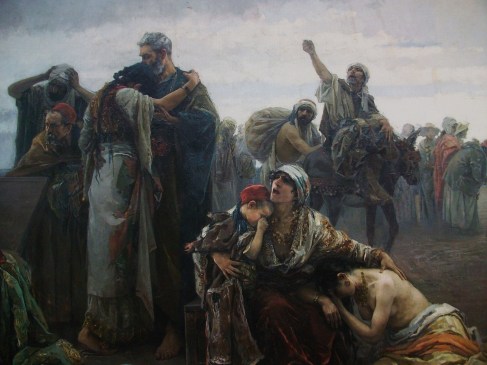
A Seventeenth Century Atrocity - Muslim Spain

by Deborah Swift
Seventeenth Century Seville
Seventeenth Century Persecution in Spain
The Spanish Inquisition is associated with the persecution of the Jews but it is not common knowledge that Muslims were also tried and tortured by this institution. During my research trip to Seville I visited the remains of the San Jorge Castle, the place of imprisonment for victims of the regime. There I saw chilling evidence of this persecution, which the Inquisition applied not only to rival faiths to Catholicism but also to mystics of their own faith.

Whereas in seventeenth century England Catholicism was repressed, in Spain Catholics were the ruling majority. To understand the climate of oppression for religious minorities in Spain in 1609, one must look back a few centuries to 1248, when Seville, formerly a Moorish city, fell to Christian armies.

Symbols of Lost Culture
During the following centuries after moorish Spain was conquered, Christians were determined to expand their dominion over Spain, and in 1492 Muslim Granada fell - a momentous day for Christian Europe, a day of rejoicing, but for Muslims it became a day of eternal sorrow. Just as the day is marked by celebrations in Spain, in Morocco black flags are hung out to indicate loss and mourning. Some descendants of those expelled still retain the original 15th century keys of their Andalusian homes as a symbol of their lost culture.

After the conquest of Granada by Christians, the Jewish population was driven out, whilst tolerance was promised to its Moorish citizens. So by the seventeenth century the Moors had become indelibly Spanish. Some were genuine Christian converts, and many, like Sancho Panza’s neighbour Ricote (in Cervantes’ novel Don Quixote), and Luisa in my novel 'A Divided Inheritance', thought of themselves as ‘más cristiano que moro’ (More Christian than Moor).

The Burning of Books
A short period of relatively peaceful co-existence between the Muslims and Christians was shattered when the Archbishop of Granada, Hernando de Talavera, was replaced by the fanatic Cardinal Cisneros, and Muslim religious leaders were persuaded to hand over more than 5,000 priceless books with ornamental bindings, which were then consigned to bonfires. Only a few books on medicine were spared the flames. Unsurprisingly, this event led to an armed response from Muslims in the First Rebellion of the Alpujarras in 1499. By 1502 the monarchy had rescinded the treaty of tolerance and Muslims in Andalusia were forced to convert or leave. Those who converted were called Moriscos, which means “little Moors”.

Many Moriscos professed their allegiance to Christianity while practicing Islam in secret. Every aspect of the Islamic way of life, including the Arabic language, dress and social customs – was condemned as uncivilised and pagan. A person who refused to drink wine or eat pork, or who cooked meat on a Friday might be denounced as a Muslim to the Inquisition. Even practices such as buying couscous, using henna, throwing sweets at a wedding or dancing to the sound of Berber music were un-Christian activities for which a person might be reported to the Inquisition by his neighbour, and obliged to do penance. 

Rebellion
Further repression of the Moriscos resulted in a second Rebellion. Fearing the rebels were conspiring with the Turks of the Ottoman Empire, the uprising was brutally suppressed by Don John of Austria. In a spate of atrocities the town of Galera, to the east of Granada, was razed to the ground and sprinkled with salt, after the slaughter of 2,500 people including 400 women and children. Some 80,000 Moriscos in Granada were forcibly dispersed to other parts of Spain, including Seville. Christians from northern Spain were settled on their empty lands. Ayamena and Nicoloao in my story were displaced from Granada before settling in Seville.

As early as the 16th century The Council of State proposed expulsion as a solution to the on-going Morisco 'problem', for which the previous expulsion of the Jews provided a legal precedent. However, the action was delayed because of Spain’s pressing political concerns abroad and because of the drawbacks of losing so many skilled Muslim labourers from the Spanish working population. Muslim labourers and artisans were responsible for much of the beautiful spanish architecture we admire so much today.

Final Expulsion of 400,000 people
Image
Juan de Ribera, the ageing Archbishop of Valencia, who had initially been a firm believer in missionary work, and the conversion of the Moorish population to Christianity, became in his declining years the chief partisan of expulsion. In a sermon preached on September 27th, 1609, he said that Spanish land would never become fertile again until these heretics (the Moriscos) were expelled. The Duke of Lerma, the corrupt chief minister agreed with him. The new king, Felipe III, known as Phillip the Pious for his supposed religious zeal, finally acquiesced to political pressure and in the expulsions began. The embarkation order was read out in Seville on January 10th 1610. The entire Muslim population, along with anyone who had converted from Islam to Christianity, was ordered to leave Spain on threat of death. By 1613 it is estimated 400,000 people had been forcibly removed in this mass expulsion from Spanish territory.

This little-known part of seventeenth century forms one of the threads of the narrative in my novel, 'A Divided Inheritance'.

Read more in this excellent article by Roger Boase in History Today

Monday, 9 December 2013

Hoydens News - December 2013

It is good to stop and draw breath for a minute and reflect on the busy year the Hoydens have enjoyed.

But firstly we are thrilled to welcome three new members as regular posters to the Hoydens. All these ladies have been guest posters over the past year so they will be familiar to you all. So in no particular order allow us to introduce:

CHRISTY ROBINSON
Christy K Robinson is published in the historical fiction, nonfiction, and inspiration genres, and has edited and contributed to a variety of other books and magazines during her career as a writer and editor. Mary Dyer Illuminated and Mary Dyer: For Such a Time as This are her first novels. To follow her research in 17th-century England and New England, or to contact her, visit http://ChristyKRobinson.com  

Andrea Zuvich, aka The Seventeenth Century Lady, lives in a small town in England. She is a full-time historian, author of historical fiction set in the 17th Century, and often gives lectures about the Late Stuart period, in which she specialises. Originally from Philadelphia, Zuvich grew up in Florida with a keen interest in Early Modern European history. She was one of the original developers of and guides on the Garden History Tours at Kensington Palace. Find out more about Andrea at The Seventeenth Century Lady Website

and
JO ANN BUTLER
Jo Ann Butler, author of The Reputed Wife and Rebel Puritan, was born during the twelve days between Christmas and Epiphany, when Teutonic myth destines her to become a werewolf. In the meantime, she has been a colonial archeologist, genealogist, home health therapist, executive dogsbody, and a computer jockey in San Diego’s aerospace industry. Now Ms. Butler is an essayist and historical novelist. What comes next – besides lycanthropy? 

We are looking forward to their future posts.

And for the battle hardened veterans?

For ANITA DAVISON (writing as ANITA SEYMOUR) The year started off with the release of ROYALIST REBEL, a fictionalised account of the life of the scandalous Elizabeth Murray.  She is currently entertaining murderous thoughts and working on a cosy mystery set in the early years of the twentieth century.


MARY SHARRATT goes from strength to strength with her critically acclaimed recent release ILLUMINATIONS: A NOVEL OF HILDEGARD VON BINGEN winning the 2013 Nautilus Gold Award: Better Books for a Better World. 


DEBORAH SWIFT's latest release A DIVIDED INHERITANCE, a story of love and treachery set in early seventeenth century England and Spain, is getting consistent 4 and 5 star reviews. She has just finished a teen (YA) novel set in the English Civil War so all fingers are crossed that her agent finds a home for it.


KIM MURPHY's non fiction book, book I HAD RATHER DIE: RAPE IN THE CIVIL WAR  (that is the American Civil War) will be released on January 1 2014.  
 "A meticulously documented and gut-wrenching account of the gratuitous acts of violence against women's bodies, black and white, slave and free, young and old… A major work of scholarship that was long overdue, and that all historians should be grateful for." --Susan Brownmiller, author of Against Our Will: Men, Women and Rape.


ALISON STUART's late 2012 release, the  World War One paranormal romance GATHER THE BONES went on to become an Amazon best seller and to gather award nominations in five major awards during 2013.  In 2013 she released a short time travel romance with an English Civil War setting SECRETS IN TIME (currently on sale at Amazon until 14 December). In January 2014 CLAIMING THE REBEL'S HEART, an English Civil War set historical romance based (very, very loosely) on the siege of Brampton Bryan castle will be released. 

If you are looking for some good holiday reading, there are some wonderful options here...

The Hoydens thank their readers for all the support during 2014 and wishes everyone a happy and safe holiday season.

Sunday, 1 December 2013

London before the Great Fire by Deborah Swift

Whilst researching A Divided Inheritance I had to find out what London was like before the Great Fire. My novel is set in 1609, and at that time London was mostly still Elizabethan, even medieval in character, just as Shakespeare would have known it. The closely packed houses would have been timber-framed and tiled with red tiles just as in this 1920's painting of Staples Inn, Holborn.

The City skyline was characterised by the spires of innumerable churches from all the different parishes : St Giles, Criplegate, St Mary le Bow, (of the famous Bow Bells) St Michael Paternoster. Most had been there since medieval times, and all had bells to summon parishioners to prayer, to ring out for births, marriages and deaths, and to tell the hour. More about these churches can be discovered in Reaching for the Heavens: the City Churches of Medieval London by Sarah Valente Kettler & Carole Trimble.

Just what this skyline looked like can be seen in Visscher's fabulous engraving, a map I consulted often whilst working out the layout of London for all three of my novels. Of course the landscape is dominated by the bridge (see my previous post) - still the only one across the Thames, and St Paul's Cathedral, which undfortunately had lost its spire during a storm when it was struck by lightning.

Southern Bridge Gate still held the spikes which displayed the heads of traitors. In my novel these traitors would likely have been the Gunpowder Plotters, to act as a warning to Catholics about their fate should they decide to try the same ploy to remove James I from the throne.


Living in the city was not as romantic as it looks from a distance as narrow alleyways led down to the river where the night-soil men dumped the city's waste. Within the actual city streets the houses were two to three storeys high, with overhangs that blocked the light. Apart from churches, the other large buildings were the Halls of the City Companies, such as Brewers, Bankers, Cloth Merchants. London trade through shipping made up a third of all England's trade. The Halls had often been acquired from the monasteries after the dissolution (in fact in The Gilded Lily, Whitgift's Pawnbrokers is on just such a site.)

E.3 (2)
Plan of Greyfriars Monastery before it was used as a hospital
Another example of a monastery being re-used is the old cloisters of Greyfriars Monastery in Newgate Street, which  became a hospital for poor children, known as Christ's Hospital. As well as housing the invalid poor, the former nave was used by a stationer to store books. You can imagine how the repressed Catholics felt, seeing their holy buildings now converted for trade - and not always ethical trade at that.

There was some new building going on at this time though, but upstream at Westminster, then unconnected to the city itself. Nearing completion was the new Banqueting Hall by Inigo Jones. It was built to replace a previous one lost by fire, and linked to the city via a highway running through the village of Charing. It was set amongst other noblemen's houses which enjoyed the setting of formal gardens. The purpose of this building in 1622 was to act as a symbol to glorify the house of Stuart, and provide the centrepiece of a proposed palace. The actual banqueting hall is just a fraction of the development below, shown just to the left of the main courtyard, so you can see how ambitious the plans were.

File:Ingo Jones plan for a new palace at Whitehall 1638.jpg
Outside the city gates though, the houses sprawled haphazardly beyond the walls. The population increased from 250,000 to 400,000 from the beginning of James's reign until the Great Fire. This is even despite the Plague which killed 100,000 people. Slum areas within the city and outside its walls became gradually known as 'rookeries'. One famous rookery is the St Giles area and it existed from the 17th century and into Victorian times. Another is Seven Dials - named for its innovative plan of seven streets radiating from a central 'sundial'. Unfortunately Seven Dials became overrun with cheap and shoddy housing and soon became a byword for the hangout of the criminal underclass. More about rookeries in The Beer Flood - the tale of the exploding brewery in St Giles.

The nickname 'rookery' came from the fact that there were similarities between a city slum and the nesting habits of the rook, a crow-like bird which nests in large, untidy colonies. The nests are all crammed together.  The word might also be linked 16th century underworld expression to 'rook'  - which means to steal. Rooks were notorious birds for thieving. Many of these urban slums remained similar for a few hundred years, with no great increase in sanitation or home comforts.
Rookery at St Giles about 1800
My protagonist Elspet Leviston was lucky, she lived in a better area close to Convent Garden (now Covent Garden). When researching her house I could find no manor house still surviving in London that I thought was suitable in terms of period, so I used the model of Bampfylde House in Exeter as my inspiration for West View House in the book.
Bampfylde House Exeter
You can find out more about Jacobean Houses and Bampfylde House in particular on another of my posts here. Scroll  down to find the post. Happy Reading!

My latest book - A Divided Inheritance - is the story of a lace-trader's daughter who must leave her London home to track down her cousin, a man who has stolen her inheritance.

Not only must she confront the cousin she loathes, but she must travel to Seville, a city in the grip of the Inquistion, and a place which in 1610 is about to undergo one of the biggest upheavals in its history.

More about my researches about Golden Age Seville and the book can be found on my website

Bibliography : Wren's London by Eric de Mare
The Illustrated Pepys by Robert Latham
Life in Stuart London by Peggy Miller

Sunday, 24 November 2013

17th Century Musings - Guest Debra Brown

The Hoydens are delighted to welcome Debra Brown to be our guest this week. Debra is the webmistress and doyenne of a fellow blog, the English Historical Fiction Authors Blog as well as being an author in her own right.

The contributors to this blog have come together to produce a gorgeous book with a luscious cover:  CASTLES, CUSTOMS AND KINGS (buy links are at the end of this post) - the perfect Christmas present for a lover of history. Contributors include our own Hoyden, Deborah Swift.

I am in a position I dearly love as the owner of the English Historical Fiction Authors blog. Though I have a restless mind, running the blog makes me focus on a daily dose of British history written by numerous learned authors.

At this writing, we have nine hundred fifty two posts in the line-up. This means I have read around nine hundred fifty luscious, English/British history posts. Can you imagine? Finally those dates I memorized in school have events connected to them, and I even know something about the events.

It is exciting to have released an historical anthology this fall—a select group of posts from the first year of the EHFA blog titled Castles, Customs, and Kings: True Tales byEnglish Historical Fiction Authors. It contains a wide variety of topics which are organized in the chronological gamut from the Roman era to World War II written by fifty-five authors.
Here on Hoydens and Firebrands, the focus is on the 17th century—so allow me to share some interesting Stuart era points from the book.

Margaret Skea wrote about The Three Weddings of James VI and I (But Only One Wife). Most of us only get married once, she said, and that to the same person.

Anne of Denmark
James chose Anne, Queen of Denmark, saying she pleased his subjects and God—who had “moved his heart in the way that was meetest”. Margaret confesses she is not sure whether James’ understanding of God’s will was influenced by the fact that Anne was eight years younger than himself while the other candidate, Catherine of Navarre, was eight years older and looking her age. Anne first married James by proxy with George Keith, Earl Marishchal standing in.

Anne left Denmark to meet her man with a small fleet, but storms battered the ships, endangering her life. The Admiral concluded this was the work of witches and sought safe haven in Norway. Witch trials followed in both countries.

James, to bypass concerns for his safety, sneaked off to Norway on ships paid for by the Lord Chancellor of Scotland. Their second wedding took place in Oslo, and finally in January 1590 for the benefit of the Danish royal family, they married a third time at the castle of Kronborg in Denmark.

James I was obsessed with daemonology and witches, according to Deborah Swift. In her essay called A Witch’s Lair Found Buried Under a Mound, she tells about a house that was uncovered just before the 400th anniversary of the Pendle Witch trials in 2012. In the walls of the house in what was called the wild and lawless region of Lancaster, an area “fabled for its theft, violence and sexual laxity, where the church was honoured without much understanding of its doctrines by the common people”, was found a mummified cat.
Concealing things in old buildings was common in the 17th century, Deborah says. Some 1,700 shoes concealed shoes have been found, not just in Britain, but also in Germany, Australia, Canada, and the United States. Perhaps the shoe was thought to trap the spirit of the wearer.

Sam Thomas wrote So You Say You Want an Execution. As you might expect at such a well-attended correction of everything gone wrong from theft to murder, prayers were said, sermons preached, and speeches delivered.

However, Sam tells us, some executions had all the dignity of a three-ring circus. Peddlers strolled through the crowd crying their wares, and the crowd ate, drank, and socialized.
One pamphlet from 1696 shows a preacher delivering an execution sermon on one platform while behind him one can see not only the condemned offering up his last prayers, but a magician performing on an adjacent stage. Sam claims to prefer, in this case, to be the opening act rather than the headliner.

Read Sam’s article in Castles,Customs, and Kings to learn why one judge attacked a soon-to-be-killed prisoner.

Nell Gwyn
As most of us know, before the Restoration female roles in plays were performed by men. Charles II, however, had been to the theater in France during his exile where he saw women performing, and, Karen Wasylowski informs us in her post The First Actresses: Nell Gwyn to Sarah Siddons, he noted that it had caused neither outcry nor panic in the streets. A new career path for unprotected British women opened up: Actress.

The first “bombshell” actress was the King’s mistress, Nell Gwyn. She was sexy and funny, and she made use of the wardrobe malfunction in her portraits to enhance her notoriety. Unfortunately for serious actresses, by the mid-eighteenth century brothels had developed amidst other businesses around the theater district, increasing the connection between theater and sex, acting and prostitution.

In the second half of the 18th century, to bring greater legitimacy many full length portraits were made by famous artists, providing dignity and a positive image of their roles. Karen says, “A refined, gentle sort of eighteenth century Paparazzi mentality had begun.”

You will want to read Linda Collison’s essay Lloyd’s: Lifeblood of British Commerce and Starbucks of its Day to see how a coffeehouse developed into an insurance market, philanthropic efforts, and the creation of a fund for wounded soldiers and the dependents of those killed in battle.

Not all has gone well for Lloyds. They insured the “unsinkable” Titanic. The 1906 San Francisco earthquake, the attack on New York’s World Trade Center, Hurricane Katrina, and Japan’s 2011 earthquake and tsunami cost them. Linda says, “The history of Lloyd’s is a fascinating one, and still evolving. Wherever there is risk and money to be made you’ll find the name Lloyd’s.”

I have barely touched on a few of the nearly two hundred posts in this large, beautiful book. Readers have said, "It was literary comfort food – a recollection of childhood, warm and satisfying." "I found the approach charming and reassuring." "Despite the length, there is no encyclopedia feel and each author's voice is well preserved." "This book is a scholarly treasure trove with a wide appeal."

You can settle down for an evening with this book or pick it up during a coffee break. The topics are but a few pages each, and you can go from place to place in the book as your mood dictates. Castles, Customs, and Kings, edited by myself and M.M. Bennetts, is a wonderful gift for any lover of history.


Debra Brown is the author of the early Victorian novel The Companion of Lady Holmeshire.
Website. M.M. Bennetts, an early 19th century specialist, is the author of May 1812 and Of Honest Fame Blog


Sunday, 13 October 2013

What Lies on the Other Side - Death in the 17th Century

People have always been curious about where they go to after they die, and beliefs about the fate of the body and the ultimate destination of the soul, or essence of the person, carry profound religious significance, whatever century you live in.

Ay, but to die, and go we know not where;
To lie in cold obstruction and to rot;
This sensible warm motion to become
A kneaded clod; and the delighted spirit
To bathe in fiery floods, or to reside
In thrilling region of thick-ribbed ice;
To be imprison’d in the viewless winds,
And blown with restless violence round about
The pendent world.
Shakespeare, Measure for Measure 1604

In the seventeenth century evidence of mortality was present everywhere and often the causes of death were little understood. London preacher Sampson Price wrote, 'Some we see come to their graves by apoplexies, lethargies,dead palsies, some by sudden blows, some as a wasted candle goes out naturally.'  Death was altogether mysterious. In the 17th century the death rate was 25-35 per 1000 of the population (currently in the modern west it is at 8 per 1000), and as many as a quarter of women who died, died in childbirth. (Source - David Cressy)

The prevailing view at this time was that death was a consequence of man's sin 'begot of the devil' (James Cole) and so death was personified as an adversary or tyrant, whose sole aim was to destroy unwary sinners. Often death was drawn as a walking skeleton with a scythe, arrow, or spade in hand to dig the grave.
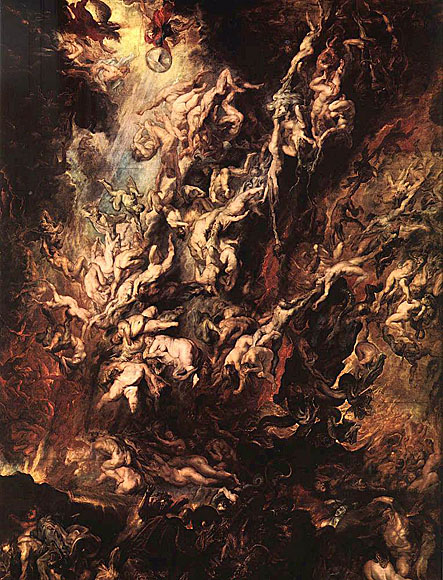
Fall of the Rebel Angels Rubens 1620
Catholics and Protestants had two different views of the afterlife. Protestants had rejected the idea of purgatory in 1574, believing it to have no scriptural foundation.
'the soul after death...does not wander up and down from place to place, nor yet remaineth in a third place, as papists and pagans have dreamed'  Clergyman Robert Pricke 1608

So now there were only two possibilities - salvation or damnation. 

This was a change which was enormously significant as it affected the entire view of the relationship with deceased family members. Suddenly there was no point to to masses, dirges or prayers for the dead, and the removal of this comfort had a profound effect on mourning and funeral custom. The deceased was no longer affected by any sort of intercession, so immediately conduct here on earth became crucial, and as everyone trasgresses as least in some way, the fear of hell became even more pronounced. 
'For truth I may this sentence tell, No man dies ill that liveth well.' Poet Robert Herrick 
Soul in hell
From a Broadside Ballad - St Bernard's Vision of Hell (1640)
Most wretched Flesh, which in thy time of life
Wast foolish, idle, vain, and full of strife;
Though of my substance thou didst speak to me,
I do confess I should have bridled thee.

But thou through love of pleasure foul and ill,
Still me resisted and would have thy will:
When I would thee (O Body) have control’d,
Straight the worlds vanities did thee with-hold.

So thou of me didst get the upper hand,
Enthralling me in worldly pleasures band,
That thou and I eternal shall be drown’d
In Hell, when glorious Saints in Heaven are crown’d.

So though the bodies of protestant souls remained in the churchyard, their souls were now beyond help and had either gone immediately to their reward, or were already in eternal torment in the gates of hell. Although the removal of purgatory from the view of the population was supposed to be the law - for example Bishop Richard Barnes of Durham instructed his parish that, 'no communions or comemmorations be said for the dead...nor any superfluous ringing at burials' -  in practice very few were willing to give up their familiar practices. 'Prayers for the dead' was such an ingrained social custom that it took almost a century for it to draw to a close.

Those who chose to maintain the Catholic faith - recusants - held their funerals at unlikely hours, or performed them quietly at home. But it was not only recusants who fell foul of the law: At Ribchester in 1639 one Robert Abbott was charged with an offence in which 'there was a cross towel laid over her corpse upon the bier, and she was set down at stone and wooden crosses by the way; and you did at the same cross in a superstitious manner take off your hat and kneeled down and prayed.'

In Stuart times these offences were as likely to be committed by protestants who felt unable to let go of the idea of purgatory. Unsurprisingly most people held a 'belt and braces' attitude. If there was even a faint possibility that prayers could do their dead relative good, then they would use them, and traditions such as praying  for the soul on the route to burial, or putting a penny in the mouth of the deceased for him to pay St Peter, still lingered right up to the end of the 17th century.

Both Catholics and Protestants continued to believe that there would be a general resurrection for the just, at the time of Christ's second coming, so the separation caused by death was only temporary. Whether this 'resurrection' was bodily and material, or metaphorical, was a matter for debate - just as it is today.

Resurrection of the Flesh by Luca Signorelli