Showing posts with label 17th century. Show all posts

Monday, 6 April 2015

Modest or Unmannerly, Which Instrument Shall She Play? - DM Denton

Music was such an integral part of 17th century life and Hoydens and Firebrands are delighted to welcome DM Denton with a fascinating post on women and music in the seventeenth century. Diane is the author of two books set in the 17th century in which the central protagonists are musicians.  

A HOUSE NEAR LUCCOLI and its sequel TO A STRANGE SOMEWHERE FLED focuses on chance encounters, beautiful music and the paradox of genius through an imagined intimacy with one of the most legendary and undervalued figures of Italian Baroque music, Alessandro Stradella. 


In the 17th century a refined young woman might want and even be encouraged to cultivate her musical ability and prove some accomplishment through singing and accompanying herself instrumentally—as recreation not occupation, of course. Considering her need to impress a suitor, show her figure off in the best possible way, express the sweetest tones of her personality and gentle capability of her character, which instrument should she play?

Men seemed eager to offer their opinions, asserting their duty in pointing out the dangers of women acting more passionately than discreetly—of them doing anything, which, to quote Pietro Aretino, 15th-16th century Italian playwright, “opens the gates of their modesty.” Roger North (1651-1734), English biographer, lawyer, architect, and amateur musician, expressed his thoughts on the matter in his autobiography, Notes of Me: “This lets me in to speak a little of teaching on which much of this depends;  for men the viol, violin, and the thorough bass instruments organ harpsichord and double bass are proper; for women the spinnet or harpsichord, lute and guitar;  for voices both. I cannot but commend the double bass or standing viol for plain basses especially for accompanying voices because of its softness joined with such a force as helps the voice very much; and the harpsichord for ladies rather than the lute; one reason is it keeps their body in a better posture than the other, which tends to make them crooked.


If playing the lute wasn’t advantageous to a lady’s appearance, then what were the consequences, not only to her posture but also her reputation, if she spread her legs for the viol? Thomas Middleton, Jacobean playwright, disapproved of women performing on such an “unmannerly instrument”.  French guitarist, lutenist, composer and theorist, François Campion, (aka Abbé Carbasus), cynical overall about women having musical ambitions, noted that “decency, modesty, and the hoopskirt fashion effectively prohibit the fair sex from playing the viol.” Evidently not, for play it they did, as shown by the engravings of Nicolas Bonnart.


Anyone who has seen the film Tous les Matins du Monde knows that the daughters of the great viol player Sainte-Columbe (1640-1700), were also accomplished on it. The biographer Titon tu Tillet (1677-1762) reported: “Sainte Colombe … gave concerts in his house, in which two of his daughters played, one the treble viol, the other the bass, and they formed with their father a three viol consort, which was a pleasure to listen to, even if it was made of rather ordinary symphonies and few chords.”


For the sake of decency, some women may have attempted to play the viol obliquely: per traverse, rather like riding a horse sidesaddle, more ladylike but not as physically viable. Despite its intention, it wasn’t a technique that gained popularity.


In disagreement with Roger North’s fluctuating opinion, artists Nicolas Arnoult and Abraham Bosse portrayed ladies of quality not only playing the harpsichord but also the lute.  John Essex, 17th—18th century English dancer, choreographer and author,  wrote that “The Harpsicord, Spinnet, Lute and Base Violin, are Instruments most agreeable to the Ladies: There are some others that really are unbecoming the Fair Sex; as the Flute, Violin and Hautboy [oboe]; the last of which is too Manlike, and would look indecent in a woman’s mouth; and the Flute is very improper, as taking away too much of the Juices, which are otherwise more necessarily employ’d, to promote the Appetite, and assist Digestion.” Probably more myth than fact was the criticism of a female playing the violin or flute because she would have to raise her arms and reveal her elbows.


Dutch painter Johannes Vermeer often used the theme of a woman practicing, performing on, sitting at or holding an instrument—guitar, virginal, harpsichord, lute, cittern, flute, trumpet—and gave us moments in time that implied collaboration, flirtatiousness even intimacy; and, conversely, duteousness, modesty, confinement even isolation. 


It seems Vermeer recognized that the allure of a female through her musical accomplishment could actually illuminate her virtue. The association between music-making and love-making was a respectable means to an end as long as it was correctly contained. On the other hand, naiveté, low resistance, high libido, adventurousness, or just chance and circumstance were more threatening to a woman’s reputation than the instrument she chose to play.


I’ll return to Roger North as he seems to admit music offers more that is positive than negative for all who partake of it, again from his Notes of Me: “And nothing of the unprofitable kind, can be so good as musick, who is a kind companion and admits all to her graces, either by men by themselves, or men, and women together, or the latter single, either with instruments and voices, or either alone, as the capacitys are, and fail not to entertain themselves, and their parents, and friends, with pleasures sensible to those that have found the sweets of them.” 

About DM (Diane) Denton: 

DM Denton, a native of Western New York, is an author and artist. She finds her voice in poetry and prose, in silence and retreat, in truth and imagination.  Through observation and study, inspired by music, art, nature and the contradictions of the creative spirit, she loves to wander into the past to discover stories of interest and meaning for the present, writing from her love of language and the belief that what is left unsaid is the most affecting of all. Her educational journey took her to the UK where she stayed for sixteen years. She returned to the US in 1990, to a rural area of Western New York State where she resides in a cozy log cabin with her mother and a multitude of cats. 
DM Denton has published two historical fictions: A House Near Luccoli and its sequel To A Strange Somewhere Fled, both released by All Things That Matter Press. For more information, please visit Diane’s blog, website, and Amazon author page for all her publications: 


Tuesday, 18 November 2014

Ride the TITLE WAVE into the 17th century


Books by Eve LaPlante, David Teems, Francis Bremer,
John Fox, and Nathaniel Philbrick.
 There’s a vast crowd of enthusiasts reading and discussing everything medieval and renaissance. But time didn’t stop with Elizabeth Tudor’s death in 1603. Are you looking for the rest of the story?

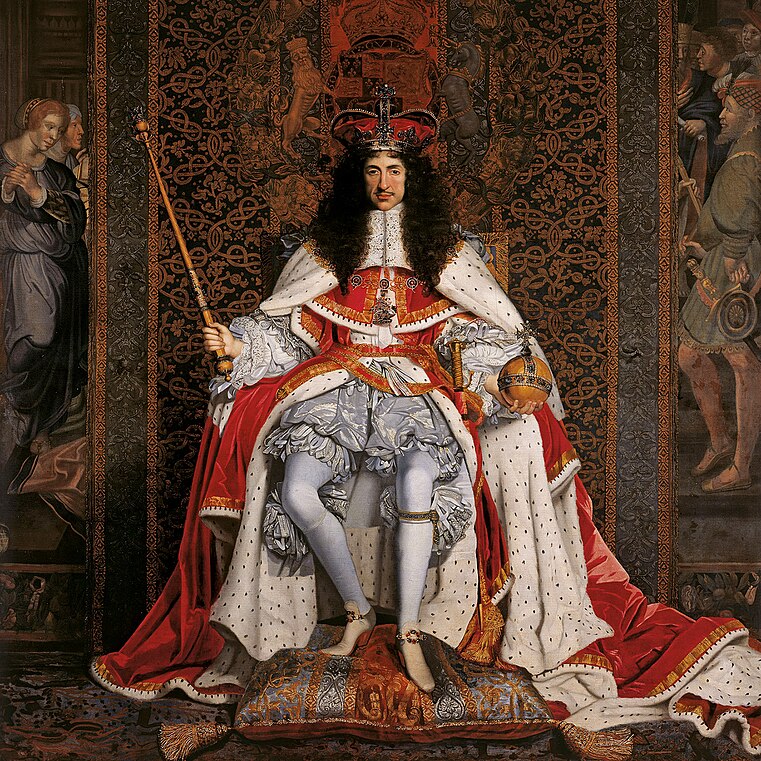
King James, his son King Charles I, and grandsons Charles II and James II kept the drama level high and dangerous in the seventeenth century. Their marriages and lovers, births and deaths, political intrigues, religious conflicts, witch hunts, and wars marked the beginning of our modern period. Their aristocrats and politicians, tradesmen, midwives, ministers, writers, musicians, scientists, and artists changed the world.  


Have you noticed that it’s the gift-giving season?  Why not knock out your whole gift list right now with these suggestions? The gift of a book is one that's remembered for years. Some people find it convenient to buy books for all their siblings, or as appreciation gifts for their children’s teachers. You might give paperback books to some in the family, or use the Kindle-gift option. Some books are stand-alone, some are part of a series.

This is a list of authors who have the 17th century covered, from Shakespeare and midwife forensic investigators to barber surgeons, Charles II’s mistresses, men and women who founded American democracy, servants and highway robbers, people who gave their lives for their principles or just because they were falsely accused as witches. In these books you’ll find sumptuous gowns and high society, educated women, poverty, prostitutes, and massacres, childbirth and plague, castles and manors, cathedrals and meetinghouses—even a vampire.

Our ninth or tenth great-grandparents knew these people—or were these people. (Well, probably not the vampire—but everyone else!) Discover what their lives were like, and how their lives formed who you are. Many of the book characters from the 17th century are based on facts, events, and real people. The authors, in addition to their literary skills, have spent months and years in research to get the 17th century world “just right,” so you’ll get your history veggies in a delicious brownie.

Ride the wave of the time-space continuum into the 17th century with these award-winning and highly-rated authors. The images you see are a small sample of what's available from this talented group! Click the highlighted author’s name to open a new tab.


Anna Belfrage Time-slip (then and now) love and war.


Jo Ann Butler — From England to New England: survival, love, and a dynasty.


Susanna Calkins — Murder mysteries set in 1660s London. 


Francine Howarth — Heroines, swashbuckling romance.


Judith James — Rakes and rogues of the Restoration.


Marci Jefferson — Royal Stuarts in Restoration England.


Elizabeth Kales French Huguenot survival of Inquisition.


Juliet Haines Mofford — True crime of New England, pirates.


Mary Novik — Rev. John Donne and daughter.


Donald Michael Platt Spanish Inquisition cloak and dagger.


Katherine Pym — London in the 1660s.


Diane Rapaport — Colonial New England true crime.


Peni Jo Renner — Salem witch trials.


Christy K Robinson — British founders of American democracy and rights.


Anita Seymour  Royalists and rebels in English Civil War.


Mary Sharratt — Witches (healers) of Pendle Hill, 1612.


Alison Stuart — Time-slip war romance, ghosts.


Deborah Swift — Servant girls running for lives, highwaywoman.


Ann Swinfen — Farmers fighting to keep land, chronicles of Portuguese physician.


Sam Thomas — Midwife solves murders in city of York.


Suzy Witten — Salem witch trials.


Andrea Zuvich — Vampire in Stuart reign, Duke of Monmouth and mistress.


Introduction and illustrated table by Christy K Robinson. You're welcome to share this page in your blogs, Facebook, Twitter, Pinterest, etc. Shortened URL: bit.ly/1xAUir1

Sunday, 20 July 2014

The Windsor Nell Gwynn Knew

As royal mistresses go, Nell Gwynn is probably our most favourite of King Charles II's mistresses - and with good reason. This saucy, funny, beautiful actress was quite a loveable character - and her royal lover certainly knew that. John Evelyn referred to Nell as, "the Comedian & Apple-woman's daughter", whilst Samuel Pepys called her, "pretty witty Nell." She had risen from impoverished prostitute and orange seller to admired Restoration actress before catching the eye of the Merry Monarch. She had two sons by Charles - Charles and James.


Last month, my husband and I moved from Lancashire to Windsor, and I was excited for many reasons, not least because Windsor has an abundance of 17th-century history. As I turn one corner, walk down this street, stop in front of this house, I can't get over how much history is everywhere. Very near Windsor Castle, there is a small, quaint street which has an array of little shops and eateries. I daresay most tourists - overwhelmed by so much to see - don't realise how old the buildings are. There is a Chinese restaurant in what is referred to as "Nell Gwynn's House" - and there is an inscription on the exterior of this building that states it was built in 1640. You can see how close the castle is to the site of Nell's house.


"The Protestant Whore" had previously lived in houses in Lincoln's Inn Fields and Pall Mall. In Windsor, however, Nell Gwynn is most closely associated with Burford House. In The Story of Windsor, Maurice Bond stated, "Charles II had a strong affection for Windsor. [His] mistress, Nell Gwynn, had a house especially built for her (Burford House) just outside the Castle Walls, and her descendants, the Beauclerks, Dukes of St. Albans, came to play a considerable role in the life of the borough" (page  63).

James Beauclerk, Charles Beauclerk, 1st Duke
St. Albans, Nell Gwynn, by Richard Tompson,
after Sir Peter Lely, before 1693.
The Windsor that Nell Gwynn knew was one of rural life mixed with cockfighting, horse races, and there was a bustling new coffee house. According to The Physical Shape and Urban Landscape of New Windsor 1500-1780 by E.J. Brown, "a coach and postal service were introduced in 1673 and 1674." The River Thames runs by, dividing Windsor from Eton. Windsor Castle, now known to be the oldest and largest inhabited castle in the world, was extensively renovated during the Restoration, following its use as a prison under Cromwell. You can read more about its history here.

By the time Nell began living in Windsor, the 1670s, the town had begun to see a rise in population. Such increase understandably led to some concerns about contaminated wells, more refuse on the streets, and associated health risks. In the early 18th-century, during the reign of Queen Anne, the population had risen more and the queen asked for water to be brought in from a neighbouring area.

As with the home in Pall Mall, London, Nell Gwynn wanted to secure the freehold of the house instead of the leasehold she was originally given. Now, this is a problem many people still face. Indeed, my husband and I had a leasehold in London and we had to pay rent for the land even though we owned the house. It's all rather confusing, but then as now it was far better - more secure - to have the freehold on a property than a leasehold. 

Nell, always a sharp cookie, knew this and did obtain the freehold (first for the Pall Mall property) by telling the king that, "she had always conveyed herself free under the crown , but that she would not accept the house until its freehold was conveyed free to her by the crown." Nell and Charles's descendants continued to own Burford House until the late 18th century.

Image found in The House of Nell Gwynn, 1670-1974.

Burford House, however, was an enchanting dwelling, as you can see from the image above. Great, fabulous gardens were created, and it is believed that the land surrounding the house was no more than forty acres. You can tell how countryfied it was. It is to this day a remarkably verdant area - and I can understand why Charles liked it so - it's very different and quiet - in comparison to London. As a great deal of construction was going on inside Windsor Castle itself at that time, Nell was able to have the interiors of her new, modern home decorated by the highly sought-after painter Antonio Verrio and some elaborate woodcarvings were also created for parts of the house by the talented Baroque woodcarver Grinling Gibbons. We can only imagine how beautiful the end result was! 


Despite her favourable position as a royal mistress, poor Nell was often in debt. In fact, one of King Charles II's last words was to his brother, James. The following is from John Evelyn's Diary entry for 6th of February, 1685:

He spake to the Duke [James, Duke of York] to be kind to his Concubines the DD: of Cleveland, & especially Portsmouth, & that Nelly might not starve.

...because she was so often in debt, starvation was a frightening possibility. James stayed true to his promise to his brother and paid of Nell's debts. Nell and Charles's son, the Duke of St. Albans, was financially better off than his mother.

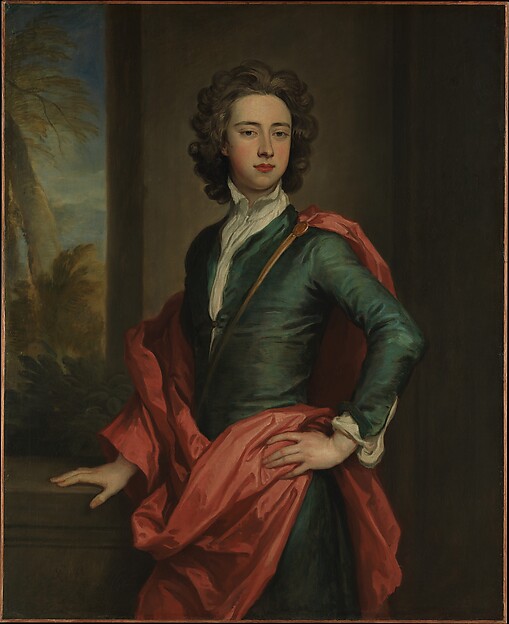
Charles Beauclerk, 1st Duke St. Albans. The Metropolitan Museum of Art.

As stated in The Windsor Beauties:

The Earl of Burford was created Duke of St. Albans in January 1684, and ample provision was made for him by his father. There was a settlement of £5000 a year, chargeable on the Exchequer, he inherited on his mother's death Burford House, and he was given the reversion of the sinecure office of Master Falconer of England and Registrar of the Court of Chancery, both to be hereditary, worth some £1500 a year.
Beauclerk later became a favourite of King William III's following the Glorious Revolution of 1688/89, at which point his fortunes increased. Beauclerk lived in Burford House and eventually married Diana de Vere, with whom he had twelve children.

As I've walked around this part of Windsor, I've noticed so many shop signs and gift shop trinkets that feature Nell. Nell as the busty orange-seller, Nell as the romantic actress, Nell as the wanton mistress. A highly romanticised depiction of her from a 19th-century painting adorns the door to the Windsor & Royal Borough Museum (perfectly situated in the building that Christopher Wren designed!).


It's quite easy to imagine her in her colourful dresses, a bright smile upon her face, as she walked around these streets. I think she'd be astonished to find that, after all this time, people still think on her fondly. I like to think it's because she's the most accessible of Charles II's mistresses, and her warmth transcends time. 

Bibliography:
Adamson, Donald and Peter Beauclerk Dewar. The House of Nell Gwynn, 1670-1974.
Bond, Maurice. The Story of Windsor.
Brown, E.J. The Physical Shape and Urban Landscape of New Windsor 1500-1780.
Evelyn, John. Diary.
Pepys, Samuel. Diary.
Melville, Lewis. The Windsor Beauties: Ladies of the Court of Charles II.
Powell, Roger. Royal Sex: The Scandalous Love Lives of the British Royal Family.

Andrea Zuvich (aka The Seventeenth Century Lady) is usually a 17th-century historian and authoress of historical fiction set in the 17th-century, but she has had to take a break from her beloved history for a month to deal with the craziness of moving house. Now that's sorted out (whew!) she's back, working on three books: William & Mary: A Novel, William Alone: A Sequel, and Anthea: Confessions of a Restoration Actress. She is also thinking about writing a non-fiction history on the Stuarts. She was recently listed as one of the Most Followed Historians on Twitter.


Sunday, 15 June 2014

Saint George’s Charm Against the Night-mare


George is the patron saint of England and his feast day is still celebrated on April 23 with the displaying of the English flag, which bears George’s red cross.

In medieval tradition, Saint George was the Virgin Mary’s champion knight; England itself was regarded as the Virgin’s dowry.

Saint George’s cult had both elitist and earthy aspects. On the one hand, he was the saint of nobility and monarchs. To join the Guild of Saint George, one had to own a horse, which made it exclusive indeed, because in the medieval and Early Modern period, as now, horses were expensive and only the wealthy could afford them. Poorer folk relied on oxen to pull their carts and ploughs.

On the other hand, the name George means farmer. In his more populist aspect, George was the patron of horses and the low born people who looked after them for their wealthy masters.

The following is a late medieval charm against the night-mare, which was believed to be a hag that entered the stable by night in spirit form and rode the horses until they were exhausted. This superstition was very long lived. Margaret Pearson, arrested in the Pendle Witch Trial of 1612, was accused of bewitching to death a mare in the village of Padiham, Lancashire.


 "Bewitched Groom" by Hans Baldung Grien


A Charm Against the Night-mare

Saint Jorge, our Lady Knight,
He walked day, he walked night,
Till that he founde that foule wight; (foul spirit)
And when that he her founde,
He her bete (beat) and he her bounde,
Till trewly ther her trowth she plight (till she finally made her vow)
That she sholde not come by night
Within seven rod of lande space
Theras Saint Jeorge y-named was.
St. Jeorge, St. Jeorge, St. Jeorge.

This rhyme was written on a piece of paper or parchment, then tied into the horse’s mane. To ensure full power, an amulet or piece of flint with a natural hole was also hung over the stable door. Earliest reference to this charm dates back to 1425-50, but it appeared in a book on witchcraft as late as 1584.

From C. and K. Sisan (eds.), The Oxford Book of Medieval English Verse, Oxford, 1973.

What happened to Margaret Pearson after being convicted of bewitching a horse to death? Unlike the other Pendle Witches who were hanged at Lancaster, she was spared the noose since she had only supposedly killed a horse and not a human. Instead she was pilloried on four consecutive market days in Padiham, Whalley, Clitheroe, and Lancaster, and sentenced to a year in Lancaster prison.


Sunday, 18 May 2014

He Who Commissioned Castle Howard: Charles, 3rd Earl of Carlisle

This weekend, I had the great honour of visiting Castle Howard in Yorkshire, England. This great building, though largely made in the 18th-century, was commissioned in 1699, so it's fair game here. There is only word to describe Castle Howard, and that is...wow!


© Andrea Zuvich 2014

With its design by English Baroque architects Sir John Vanbrugh and Nicholas Hawksmoor, Castle Howard is one of the great gems of late 17th/early 18th century architecture. Vanbrugh and Hawksmoor were also behind the Baroque extravaganza which is Blenheim Palace in Oxfordshire, England, as well as other fabulous buildings, including the Orangery at Kensington Palace. Whilst we were there, my husband asked me several questions about its history - including who commissioned the building. That's a very good question, so why don't we find out more about Charles Howard, 3rd Earl of Carlisle, and his role in the creation of the great Castle Howard.


Indeed, with a visit to a stately home or castle, the curious mind often wonders about the reasons which led to their creation. And so it is with Castle Howard. Who exactly was Charles Howard? Why was he important enough to have such a big house? Did he win military battles like Marlborough? Is that why he had such a house built? When I first became acquainted with the house, after watching the BBC/PBS television series, The Buccaneers, and of course, Brideshead Revisited, I was understandably impressed and awed by the building, but I didn't learn about the man who commissioned it until many years later.


Born in 1669, Charles Howard came from a distinguished aristocratic family. He was the son of Edward Howard, 2nd Earl of Carlisle, who in turn, was the son of Charles Howard (1629-1685). This first Charles Howard was created 1st Earl of Carlisle 1661 under the Restoration King Charles II. 
Image: official Castle Howard website

The 1st Earl's grandson, Charles (of Castle Howard fame) was a Minister of Parliament for Morpeth, but when his father died in his mid-forties, Charles became the third Earl when he was only twenty-three! He had to take on a lot of responsibilities as a result of this, but there were some perks, too. Charles inherited Henderskelfe Castle, a ruined Mediaeval castle, in 1692. 


A few years after inheriting this castle, he had it demolished to make way for a new building - which would become Castle Howard. As we drove away from the building, we saw a gatehouse with towers that have arrowslits (those cross-shaped openings once used for defense).
 This gatehouse and the mock fortification walls you see in the photos below were constructed in the 1720s. The history of that ruined castle in itself would make for interesting research, especially as it was partially rebuilt in the 1680s.


Charles then began to hold increasingly prestigious positions in government. Under William III, Charles Howard was one of that King's last Gentlemen of the Bedchamber (from 1700-1702), and he then had major positions under both Queen Anne and later King George. So whilst he was busy with politics, Vanbrugh and Hawksmoor (his assistant) were designing his dream house. Vanbrugh was, in the late-17th-century, a playwright and theatre manager (he owned the theatre which is now called Her Majesty's Theatre where The Phantom of the Opera has been playing since its debut in 1986).

Unlike Blenheim Palace, which was originally commissioned in honour of the great military leader, John Churchill, Duke of Marlborough, for his success at the Battle of Blenheim, etc, Castle Howard was not built for any such reason. It seems likely that Howard simply wanted a house, and he had both the perfect site for one and the money to make it happen. What we see today is an amalgamation of the original concept, Palladian extras, and a lot of Victorian touches which makes Castle Howard truly unique.


For a full article on Castle Howard, please visit my article at: http://www.andreazuvich.com/history/castle-howard-yorkshire/