Sunday, 28 March 2010
Sunday, 21 March 2010
March 22, 1622
 In Virginia, the date March 22, 1622, has been given many names. Period sources claim the day was a massacre. Since then, some historians state that it was Opechancanough's uprising or coup with the intent to annihilate the colonists. In my upcoming book, The Dreaming, I call it Opechancanough's organized attacks. Why? Because I show the event from the point of view of the Arrohateck, a tributary tribe of an alliance commonly referred to as the Powhatan.
When the paramount chief Powhatan died in 1618, leadership passed to his brother, Opitchapam. Although second in command, another brother, Opechancanough, soon became the real leader and planned a co-ordinated assault on the encroaching English settlements.
On the day of the attacks, warriors wore no face paint nor carried weapons to give the illusion that it was an ordinary one for work or trade. At the agreed upon time, they turned on the colonists and the bloodshed began, oftentimes using the colonists' own weapons or tools.
By the end of the day, over 300 colonists, equaling a third of the population, were dead. On both sides of the James River, the death toll included women and children. Until the annihilation of the Paspahegh in 1610, such a tactic had been uncharacteristic for Virginia Indians as it had been against the law of nations. The previous hostilities with the colonists had forever changed the nature of their warfare.
Legend states that a Native Christian boy by the name of Chanco saved Jamestown. The story goes that he warned his employer, Richard Pace, of the upcoming assault. Pace lived across the river from Jamestown, so he rowed to the colony to alert them before the impending disaster. As it turns out, there's no historical or archaeological evidence that Jamestown was ever threatened.
To explain the possible reason further, I consulted with a tribal historian and was informed a treaty had been in place since 1614 giving Jamestown to the colonists. During the time of peace before Powhatan's death, the colonists encroached further into Indian territory. Opechancanough's attacks were co-ordinated to enforce the treaty. Essentially it was his way of saying, the land belonged to the Native people, and the colonists needed to live by the rules they had agreed to.
The attacks were carried out in typical Indian fashion of striking as quickly and as hard as possible, then retreat. At that time, the Powhatan had the larger numbers and could have carried out even greater damage had they wished, which makes the treaty explanation very plausible.
In the end, the colonists responded by increasing their attacks on the indigenous population and seizing more of their land. Although Opechancanough is often portrayed as a villain in modern history books, he remains a hero to present-day Virginia Indians as a defender of their homelands.
Kim Murphy


Sunday, 14 March 2010
Dressing in Starlight
.
I've recently discovered a historical wonderful blog: Two Nerdy History Girls, written by novelists Loretta Chase and Susan Holloway Scott.Susan writes often about the 17th century, and most often about details of daily life, which I relish.

One of her recent posts had to do with gloves: Gloves for Show, Not for Snow. The details are delicious: gloves of white or cream perfumed leather, mittens of silk velvet with elaborately embroidered gauntlet cuffs decorated with spangles, pearls or beads.
A previous post on embroidered jackets — All That Glitters: Two Extraordinary Embroidered Jackets — notes that such richly-adorned, hand-decorated fabrics were common wear for the upper crust. Today, it's almost impossible to imagine the time that went into the creation of these works of art, and even more impossible to replicate: yet this is what a team of volunteers for the Plimoth Plantation in Plimoth, Massachusetts, did, in fact.

How many hours did it take to produce the embrodered jacket shown above? Four thousand — two to three people working full-time for one year. Over two hundred and fifty people took part in this project: stitchers, lace makers, spanglers. The jacket was named Faith, because that's what it took to make it.
The project added greatly to the understanding of history, techniques and materials. It certainly has added to my own understanding. This short video of a woman wearing the jacket in candlelight shows what an evening fête must have been like in the 17th-century, the metalic threads catching the light as a woman moved by, like fireflies on a summer night. This video — click here — shows the same enchanting effect.
The Embroiderers' Story is a blog that documented the process. It makes me long to take up my hoop and needle, but for now, I'll content myself with clothing my characters in starlight.
Sandra Gulland
*****
Author of the Josephine B. Trilogy and Mistress of the Sun
Website: http://www.sandragulland.com/
Blog: http://sandragulland.blogspot.com/
Facebook: http://tinyurl.com/3xzbgv
Twitter: http://twitter.com/Sandra_Gulland
Sunday, 7 March 2010
Mary II, Queen of England
 Maureen Waller's book, 'Ungrateful Daughters' depicts the lives of Mary and Anne, the daughters born to James, Duke of York and his first wife, Anne Hyde. These two little girls, brought up as Protestants on orders of their uncle, King Charles II, were considered minor royals. They had brothers who took precedence over them and the king had yet to marry, so no one imagined these girls were anywhere near the throne.
Of Anne Hyde's eight children, only Mary and her younger sister, Anne, survived into adulthood, and Mary was only nine when she died. Her father remarried the Catholic Mary of Modena, who was said to have announced to his children when he brought the fifteen year old princess to meet his daughters, ‘I have brought you a new playmate.’
At 15, Mary was married to William, Prince of Orange, her cousin, Charles II wanted Mary to marry the Dauphin Louis of France, but pressure from Parliament ensured the marriage took place, though Mary wept throughout the ceremony.
Mary grew to love her husband and with her personable nature, the Dutch people loved her, although Mary was unhappy due not only to William’s devotion to his mistress Elizabeth Villiers, but her three pregnancies ended in miscarriage or stillbirth.
Six foot tall, like her Uncle Charles, Mary possessed the dark hair, complexion and heavy lidded eyes of the Stuarts. She also battled with her weight all her life and tried to keep it down by daily walking.
Revolution - Charles II died in February 1685 without an heir, and his illegitimate son, James, Scott, Duke of Monmouth, led a rebellion to take the throne. Mary adored her handsome cousin and was devastated when her father had him executed in July 1685.
James II’s bid to annul the Test Act, his appointment of his Catholic friends into leading government positions in an attempt to grant freedom of religion to non-Anglicans made him universally hated. Then Mary of Modena gave birth to a son, James Francis Edward who was immediately baptized into the Catholic Church. Despite no evidence but gossip, the baby was called, ‘the warming pan baby’, purported to be smuggled into the Royal birth chamber as a substitute for the Queen’s stillborn baby. Princess Anne, Mary’s younger sister, told Mary in a letter that the Queen's pregnancy was a hoax, as Anne had tried to touch her growing bump and been slapped across the face with a glove.
William of Orange was invited to come to England to protect the Protestant Church. At first he was reluctant; but Mary convinced him she had no desire for political power for herself, he agreed. Five hundred of William’s ships landed in Torbay on 5 November, 1688, most of the disaffected English Army and Navy went over to William, and James escaped to France where he lived in exile until his death.
Mary was criticised for appearing cold to her father's plight, and was reported to have searched ther stepmother's apartments and gloated over the possessions she had left behind, refusing to send them on to her in France.
James sent Mary a letter condemning her for declaring herself queen, ‘while her father and brother lived’ She was so distraught, the coronation ceremony had to be postponed for several hours.
In 1692, she dismissed and imprisoned the soldier hero John Churchill, 1st Earl of Marlborough, suspected of negotiating with James II in St German. This harmed her relationship with her sister Anne, who was strongly influenced by Churchill's wife, Sarah.
Mary and William brought Dutch architecture and garden design to England. Mary loved Delft pottery and had cabinets full of ornaments in her private apartments. She also loved jewels, and William often had to warn her about over spending on jewellery. Mary died of smallpox at Kensington Palace at the age of 32.
William was reportedly inconsolable. He ordered work to be completed on a private closet for Mary in Hampton Court that she would never see, and gave all her jewels to her sister, Anne, a woman he had no time for during his wife's life.
Saturday, 27 February 2010
King James I: Royal Demonologist
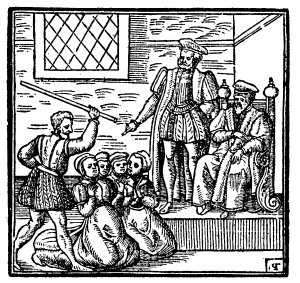
Even by the standards of his age, King James VI of Scotland, who later became James I of England, stood out as a deeply superstitious man, ruled by his obsession with the occult.
Before his reign, witchcraft persecutions had been rare in Britain. But that all changed in 1590 when James personally oversaw the trials by torture for around seventy individuals implicated in the North Berwick Witch Trials, the biggest Scotland had known. The witches’ alleged crime? Raising a storm which nearly sank James’s ship when he sailed home from Norway with his new bride, Anne of Denmark. Possibly dozens of accused witches were executed by burning at the stake, although the precise number is unknown.
In 1597 James published his book, Daemonologie, his rebuttal of Reginald Scot’s skeptical work, The Discoverie of Witchcraft, which questioned the very existence of witches. Daemonologie was an alarmist book, presenting the idea of a vast conspiracy of satanic witches threatening to undermine the nation.
In 1604, only one year after James ascended to the English throne, he passed his new Witchcraft Act, which made invoking spirits a crime punishable by execution.
James’s ideas on witchcraft were later popularised by Shakespeare’s play Macbeth, which had its premier performance at James’s court in 1606. For the first time in history, English drama depicted witches gathering in secret for their own malign rituals and scheming.
The weird sisters, hand in hand,
Posters by the sea and land,
Thus do go, about, about,
Thrice to thine, and thrice to mine,
And thrice again, to make up nine.
Peace, the charm's wound up.
(Macbeth, I,iii, 32-37)
According to Instruments of Darkness by James Sharpe, this terror of supposed witch covens was the driving factor mobilising 17th century witch hunts. Previously the belief in witches’ covens had been a Continental European concept, foreign to traditional British folk magic, practised by individuals, not collectives. No evidence exists that supposed witches in Early Modern Britain organised themselves into collectives, and nothing of the black mass can be traced to England at this time.
It wouldn't take long before life began to imitate James's and Shakespeare's dark fiction.
Six years on, in 1612, the King’s paranoid fantasy of satanic conspiracy, planted in the minds of local magistrates hoping to earn his favour, culminated in one of the key manifestations of the Jacobean witch-craze: the trials of the Lancashire Witches of Pendle, which resulted in the execution of seven women and two men. According to Thomas Potts's The Wonderfull Discoverie of Witches in the Countie of Lancaster, the official trial transcripts, the accused allegedly gathered "according to solemn appointment" at Malkin Tower on Good Friday, "with great cheer, merry company and much conference," and then plotted to blow up Lancaster Castle with gunpowder. As far-fetched as this scenario seems--where would a group of impoverished commonfolk even get hold of gunpowder--it fed directly into James' fears following the Gunpowder Plot of 1605.
James’s unfortunate legacy extends even into our age. The King James Bible, completed in 1611, saw the scriptures rewritten to further the King’s agenda. Exodus 22:18, originally translated as, “Thou must not suffer a poisoner to live,” became “Thou must not suffer a witch to live.”
Speaking of the Pendle Witches, local preparations for commemorating the 400th anniversary of the 1612 Lancashire Witch Trials are underway. Read more about it here.
Subscribe to:
Posts (Atom)