Doing research for my novels, I come across all sorts of fascinating people I cannot resist including in my latest wip.
I have heard of Aphra Behn, of course, as the first women who earned a living from her writing. What I didn’t know about her was she was born Aphra or ‘Eafrey’ Johnson, and spent a year in Surinam, Dutch Guiana in the West Indies, where her father was given a diplomatic post, although he allegedly didn’t survive the journey. Aphra returned to London as a widow, claiming her husband was a Dutchman called Johan Behn, but nothing is known of him, so his existence is still in debate. Perhaps Aphra simply tried to avail herself of the freedom a widow had over a single woman in the 17th Century.
At this time, the Anglo Dutch War was not going well and a group of Cromwellian exiles in Antwerp were working with the Dutch to undermine the Restoration regime. Aphra was employed by Charles II as a spy, and under the codename, ‘Astrea’, was sent to Antwerp with instructions to reacquaint herself with a former suitor, William Scott, son of the regicide Thomas Scott who was executed in 1660, and discover what the Dutch were up to.
William was eager to ingratiate himself with the English government, but he didn’t know very much so Aphra left Antwerp with very little information. Maybe as a result of this, her expenses were not paid by the infamous William Chiffinch, Charles II’s advisor, administrator of the ‘Secret Service’ budget and reputed pimp to the king.
This led to her borrowing the money to enable her to return to London in January 1667, but also resulted in her spending some time in gaol for debt as she had no means to repay it. Perhaps King Charles was told of her fate, or another benefactor stepped forward, but Aphra’s debts were finally discharged and she was released sometime in 1669.
Understandably, Aphra left the world of espionage and wrote plays for the theatre. The Forc'd Marriage was first performed in 1670 by The Duke's Company, followed by The Amorous Prince, in 1671. The Dutch Lover (1673), Abdelazar, (1676), The Town Fop, (1676), The Debauchee, (1677), and The Counterfeit Bridegroom, (1677).
In March, 1677, Aphra’s most successful work, The Rover was produced and Nell Gwyn came out of retirement to play the role of the whore, Angelica Bianca ('white angel'), her performance praised by The Duke of York (later James II) who was also rumoured to have been Aphra’s lover.
Nell Gwynn also took the lead as Lady Knowell in Aphra’s next play, Sir Patient Fancy (1678), and The Feigned Courtesans (1679), which Behn dedicated to Nell. Maybe due to the demands of the debauched Royal Court, Aphra’s plays were becoming sexually risqué, with Behn herself being accused of being a libertine. Her friendship with the Earl of Rochester, infamous for his sexual escapades and explicit poetry did nothing to allay this impression. In fact her hero in, The Rover, was said to have been based on Rochester.
Aphra openly expressed her views on love and sex in her writing, and her poetry portrays romantic relationships with both men and women, discusses rape and impotence, puts forth a woman's right to sexual pleasure, and includes scenes of eroticism between men.
In 17th Century Theatre, women were assumed to be of low morals, their success coupled with envy in a traditionally male profession. Ignoring them all, and enjoying the patronage of the King, Aphra continued writing. The tragicomedy The Young King was produced in the autumn of 1679, The Revenge in 1680, followed by The Second Part of The Rover in early 1681, The False Count in November and The Roundheads in December, 1681. The City Heiress was produced in the spring of 1682. Audiences loved her plays with their rampant sexual content, but she had her critics. Alexander Pope, for instance, wrote of Behn:
The stage how loosely does Astræea tread
Who fairly puts all characters to bed.
When The Duke's Company merged with the King's Company to form the United Company, Aphra turned to writing poetry. Poems Upon Several Occasions appeared in 1684, as did Love Letters Between a Nobleman and His Sister.
When Charles II died in 1685 and was succeeded by his brother, the Duke of York, as James II. Behn wrote verses on both occasions, and returned to writing for the stage. The Lucky Chance was performed in 1686 followed by the farce The Emperor of the Moon, which was not successful.
In 1688, Behn published Oroonoko, about a noble slave and his tragic love. Aphra claimed to have based this story on a slave leader she had met during her year in Surinam. It was an instant success, going through many reprints, and was even adapted for the stage by Thomas Southerne in 1695.
By the time James II was forced to abdicate his throne, Aphra was quite ill with rheumatoid arthritis. Her own descriptions of her lame hands and the lampoonists' cruel verses mocking her "limbs distortured" suggest she kept writing despite extreme pain. Aphra died on April 16, 1689, and was buried in Poets’ Corner, Westminster Abbey. Two of her plays, The Widdow Ranter and The Younger Brother, were produced and published postuhumously.
The introduction to her "The History of the Nun" has been taken as a suggestion that Behn had romantic relations with Hortense Mancini, another of Charles II’s mistresses and notoriously bi-sexual. In it she says:
.......how infinitely one of Your own Sex ador'd You, and that, among all the numerous Conquest, Your Grace has made over the Hearts of Men, Your Grace had not subdu'd a more intire Slave; .............. the honour and satisfaction of being ever near Your Grace, to view eternally that lovely Person, and here that surprising Wit; what can be more grateful to a Heart, than so great, and so agreeable, an Entertainment? And how few Objects are there, that can render it so entire a Pleasure, as at once to hear you speak, and to look upon your Beauty?
Aphra was unapologetic on the subject of her explicit writing, saying she was: ‘forced to write for Bread and not ashamed to owne it.’
Virginia Woolf wrote of Aphra:
All women together ought to let flowers fall upon
the tomb of Aphra Behn, ...for it was she who earned
them the right to speak their minds.
Friday, 11 November 2011
Sunday, 6 November 2011
Gambling on love
I've been reading about John Law: gambler, criminal, genius, founder of our monetary system. His story is nothing short of amazing, but it is the story of his wife Catherine that intrigues me most.
Early in his eventful career, after a night of successful gambling, Law was introduced to Madame Catherine Seigneur (née Knowles, or Knollys, 1669 — 1747), an English noblewoman — a descendent of Anne Boleyn, in fact — who was married to a Frenchman.
Although there are no images of her (regretfully), she is described as having "dainty features, a generous bosom and minuscule waist." The Duc de Saint-Simon described her as "rather handsome," but flawed by a birthmark that covered one eye and the upper part of one cheek.
Saint-Simon goes on: "She was proud, overbearing and very impertinent in her talk and manners."
The few bits available give hints of her character: "...she was accustomed to say there was not a more tiresome animal in the world than a Duchess." [Memoirs of the life of John Law of Lauriston]
Attracted to this clever, outspoken women, Law pursued her. She was a married noblewoman, and he a gamester with criminal record and a mysterious if questionable lineage. Such an alliance was unthinkable, but they were in France, far from home. And far from her husband, it would appear; at the least, there is no record of his objection.
Law had a "knack" of winning at dice and games; when the pattern became visible, he was in the habit of moving on. But this time there was Catherine. He asked her to run away to Italy with him.
To run off with Law would ruin Catherine's reputation forever; there would be no turning back. One can only surmise that she was 1) miserable in her marriage, and 2) madly in love with John Law, for she agreed to this ruinous course of action.
She became Lady Catherine Law, although marriage was impossible. News of her betrayal made a news journal in Paris.
It was a peripatetic life: Genoa, Rome, Florence, Turin, Venice. At each city Law supported them with his gambling, successfully playing the tables — but all the while researching banking and finance. Over time — and countless moves, often "on the run," and either in greatly feted glory or in hiding from an outraged mob — Catherine bore him two children, a son and a daughter.
She seemed to have been game for it all. Their's is surely a love story. If only I could discover more.
{Image: an engraving from a print by Leon Schenk showing John Law as Controller General of Finance of France.}

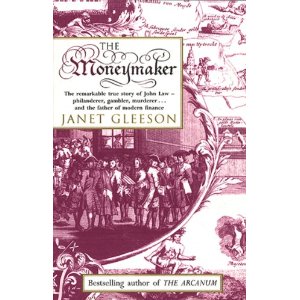
Source: The Moneymaker by Janet Gleeson — a fantastic biography.
Sandra Gulland
=================================================
WEBSITE: http://www.sandragulland.com/
BLOG: http://bit.ly/TheWritingLife
FACEBOOK: http://www.facebook.com/novelistSandraGulland
TWITTER: http://twitter.com/Sandra_Gulland
=================================================
Sunday, 30 October 2011
17th-Century Medicine
A couple of months ago while visiting Trinity College in Dublin, I saw an exhibit in celebration of 400 years of medicine. I was intrigued by the display. It had an original copy of the classic John Gerard's Herbal, or Generall Historie of Plantes. The glass cases also contained tools used by surgeons throughout the years. Notably absent was any mention of the cunning folk. Without saying as much, the exhibit really meant 400 years of male history, namely doctors and physicians. Anyone who was not a learned physician was simply regarded as a "quack". What many people don't realize is that during the 17th century there were few doctors. Even fewer people could afford the services of a doctor, and those who could often didn't trust them. Most healers were herbalists and/or users of magic. Anthropologists commonly refer to such healers as shamans.
In writing The Dreaming, I discovered that I needed guidance from the era I was writing about. I first looked to Gerard's Herbal, but it wasn't easy getting my hands on a copy. Instead, I turned to Nicholas Culpeper's Complete Herbal. Copies of this book are still easily available, and I was able to get a late 20th-century edition. Don't let a modern edition fool you. Culpeper's words were left intact. The book was, however, typeset in a modern font, making it a little easier to read.
Because my stories are set in Virginia, I also used medicinal guides that showed me what plants the Native Americans used. For instance, when I portrayed an outbreak of small pox, the Natives had no remedies. It was a new disease to the Americas and nearly wiped out the indigenous population. My cunning woman was all too familiar with the disease, and Culpeper let me know that saffron was a good herb of choice. But saffron was limited in Virginia because it had to be shipped from England. Thankfully, all was not lost. An African servant knew of another treatment called variolation.
In another scene, a teenager was bitten by a poisonous snake. In this case, my healer used a knife to make small incisions over the fang marks. She then sucked out the poison. I had been able to verify this treatment was indeed practiced by the Native people in the Virginia area for snake bites and thought it would make a good addition. It's only been within the last thirty to forty years that the method has fallen out of favor with modern emergency crews.
While these are only a couple of examples of 17th-century medicine, I think they give the general idea. There were gifted healers long before modern physicians.
Kim Murphy
www.KimMurphy.Net
Sunday, 23 October 2011
The Pendle Witches and Their Magic: Part 1
In 1612, in one of the most meticulously documented witch trials in English history, seven women and two men from Pendle Forest in Lancashire, Northern England were executed. In court clerk Thomas Potts’s account of the proceedings, The Wonderfull Discoverie of Witches in the Countie of Lancaster, published in 1613, he pays particular attention to the one alleged witch who escaped justice by dying in prison before she could come to trial. She was Elizabeth Southerns, more commonly known by her nickname, Old Demdike. According to Potts, she was the ringleader, the one who initiated all the others into witchcraft. This is how Potts describes her:
She was a very old woman, about the age of Foure-score yeares, and had been a Witch for fiftie yeares. Shee dwelt in the Forrest of Pendle, a vast place, fitte for her profession: What shee committed in her time, no man knows. . . . Shee was a generall agent for the Devill in all these partes: no man escaped her, or her Furies.
Quite impressive for an eighty-year-old lady! In England, unlike Scotland and Continental Europe, the law forbade the use of torture to extract witchcraft confessions. Thus the trial transcripts supposedly reveal Elizabeth Southerns’s voluntary confession, although her words might have been manipulated or altered by the magistrate and scribe. What’s interesting, if the trial transcripts can be believed, is that she freely confessed to being a healer and magical practitioner. Local farmers called on her to cure their children and their cattle. She described in rich detail how she first met her familiar spirit, Tibb, at the stone quarry near Newchurch in Pendle. He appeared to her at daylight gate—twilight in the local dialect—in the form of beautiful young man, his coat half black and half brown, and he promised to teach her all she needed to know about magic.
Tibb was not the “devil in disguise.” The devil, as such, appeared to be a minor figure in British witchcraft. It was the familiar spirit who took centre stage: this was the cunning person’s otherworldly spirit helper who could shapeshift between human and animal form, as Emma Wilby explains in her excellent scholarly study, Cunning Folk and Familiar Spirits. Mother Demdike describes Tibb appearing to her at different times in human form or in animal form. He could take the shape of a hare, a black cat, or a brown dog. It appeared that in traditional English folk magic, no cunning man or cunning woman could work magic without the aid of their spirit familiar—they needed this otherworldly ally to make things happen.
Belief in magic and the spirit world was absolutely mainstream in the 16th and 17th centuries. Not only the poor and ignorant believed in spells and witchcraft—rich and educated people believed in magic just as strongly. Dr. John Dee, conjuror to Elizabeth I, was a brilliant mathematician and cartographer and also an alchemist and ceremonial magician. In Dee’s England, more people relied on cunning folk for healing than on physicians. As Owen Davies explains in his book, Popular Magic: Cunning-folk in English History, cunning men and women used charms to heal, foretell the future, and find the location of stolen property. What they did was technically illegal—sorcery was a hanging offence—but few were arrested for it as the demand for their services was so great. Doctors were so expensive that only the very rich could afford them and the “physick” of this era involved bleeding patients with lancets and using dangerous medicines such as mercury—your local village healer with her herbs and charms was far less likely to kill you.
In this period there were magical practitioners in every community. Those who used their magic for good were called cunning folk or charmers or blessers or wisemen and wisewomen. Those who were perceived by others as using their magic to curse and harm were called witches. But here it gets complicated. A cunning woman who performs a spell to discover the location of stolen goods would say that she is working for good. However, the person who claims to have been falsely accused of harbouring those stolen goods can turn around and accuse her of sorcery and slander. This is what happened to 16th century Scottish cunning woman Bessie Dunlop of Edinburgh, cited by Emma Wilby in Cunning Folk and Familiar Spirits. Dunlop was burned as a witch in 1576 after her “white magic” offended the wrong person. Ultimately the difference between cunning folk and witches lay in the eye of the beholder. If your neighbours turned against you and decided you were a witch, you were doomed.
Although King James I, author of the witch-hunting handbook Daemonologie, believed that witches had made a pact with the devil, there’s no actual evidence to suggest that witches or cunning folk took part in any diabolical cult. Anthropologist Margaret Murray, in her book, The Witch Cult in Western Europe, published in 1921, tried to prove that alleged witches were part of a Pagan religion that somehow survived for centuries after the Christian conversion. Most modern academics have rejected Murray’s hypothesis as unlikely. Indeed, lingering belief in an organised Pagan religion is very difficult to substantiate. So what did cunning folk like Old Demdike believe in?
Some of her family’s charms and spells were recorded in the trial transcripts and they reveal absolutely no evidence of devil worship, but instead use the ecclesiastical language of the Catholic Church, the old religion driven underground by the English Reformation. Her charm to cure a bewitched person, cited by the prosecution as evidence of diabolical sorcery, is, in fact, a moving and poetic depiction of the passion of Christ, as witnessed by the Virgin Mary. The text, in places, is very similar to the White Pater Noster, an Elizabethan prayer charm which Eamon Duffy discusses in his landmark book, The Stripping of the Altars: Traditional Religion in England 1400-1580.
It appears that Mother Demdike was a practitioner of the kind of quasi-Catholic folk magic that would have been commonplace before the Reformation. The pre-Reformation Church embraced many practises that seemed magical and mystical. People used holy water and communion bread for healing. They went on pilgrimages, left offerings at holy wells, and prayed to the saints for intercession. Some practises, such as the blessing of the wells and fields, may indeed have Pagan origins. Indeed, looking at pre-Reformation folk magic, it is very hard to untangle the strands of Catholicism from the remnants of Pagan belief, which had become so tightly interwoven.
Unfortunately Mother Demdike had the misfortune to live in a place and time when Catholicism was conflated with witchcraft. Even Reginald Scot, one of the most enlightened men of his age, believed the act of transubstantiation, the point in the Catholic mass where it is believed that the host becomes the body and blood of Christ, was an act of sorcery. In a 1645 pamphlet by Edward Fleetwood entitled A Declaration of a Strange and Wonderfull Monster, describing how a royalist woman in Lancashire supposedly gave birth to a headless baby, Lancashire is described thusly: "No part of England hath so many witches, none fuller of Papists." Keith Thomas’s social history Religion and the Decline of Magic is an excellent study on how the Reformation literally took the magic out of Christianity.
However, it would be an oversimplification to state that Mother Demdike was merely a misunderstood practitioner of Catholic folk magic. Her description of her decades-long partnership with her spirit Tibb seems to draw on something outside the boundaries of Christianity.
Although it is difficult to prove that witches and cunning folk in early modern Britain worshipped Pagan deities, the so-called fairy faith, the enduring belief in fairies and elves, is well documented. In his 1677 book The Displaying of Supposed Witchcraft, Lancashire author John Webster mentions a local cunning man who claimed that his familiar spirit was none other than the Queen of Elfhame herself. The Scottish cunning woman Bessie Dunlop mentioned earlier, while being tried for witchcraft and sorcery at the Edinburgh Assizes, stated that her familiar spirit was a fairy man sent to her by the Queen of Elfhame.
Sunday, 16 October 2011
All Hallows Eve in Old Lancashire
Come Halloween, the popular imagination turns to witches. Especially in Pendle Witch Country, the rugged Pennine landscape surrounding Pendle Hill, once home to twelve individuals arrested for witchcraft in 1612. The most notorious was Elizabeth Southerns, alias Old Demdike, cunning woman of long-standing repute and the heroine of my novel Daughters of the Witching Hill.
How did these historical cunning folk celebrate All Hallows Eve?
All Hallows has its roots in the ancient feast of Samhain, which marked the end of the pastoral year and was considered particularly numinous, a time when the faery folk and the spirits of the dead roved abroad. Many of these beliefs were preserved in the Christian feast of All Hallows, which had developed into a spectacular affair by the late Middle Ages, with church bells ringing all night to comfort the souls thought to be in purgatory. Did this custom have its origin in much older rites of ancestor veneration? This threshold feast opening the season of cold and darkness allowed people to confront their deepest fears—that of death and what lay beyond. And their deepest longings—reunion with their cherished departed.
After the Reformation, these old Catholic rites were outlawed, resulting in one of the longest struggles waged by Protestant reformers against any of the traditional ecclesiastical rituals. Lay people stubbornly continued to hold vigils for their dead—a rite that could be performed without a priest and in cover of darkness. Until the early 19th century in the Lancashire parish of Whalley, some families still gathered at midnight upon All Hallows Eve. One person held a large bunch of burning straw on a pitchfork while the others knelt in a circle and prayed for their beloved dead until the flames burned out.
Long after the Reformation, people persisted in giving round oatcakes, called Soul-Mass Cakes to soulers, the poor who went door to door singing Souling Songs as they begged for alms on the Feast of All Souls, November 2. Each cake eaten represented a soul released from purgatory, a mystical communion with the dead.
In Glossographia, published in 1674, Thomas Blount writes:
All Souls Day, November 2d: the custom of Soul Mass cakes, which are a kind of oat cakes, that some of the richer sorts in Lancashire and Herefordshire (among the Papists there) use still to give the poor upon this day; and they, in retribution of their charity, hold themselves obliged to say this old couplet:
God have your soul,
Bones and all.
Other All Hallows folk rituals invoked the power of fire to purify and ward. In the Fylde district of Lancashire, farmers circled their fields with burning straw on the point of a fork to protect the coming crop from noxious weeds.
Fire was used to protect people from perceived evil spirits active on this night. At Longridge Fell in Lancashire, very close to Pendle Hill, the custom of ‘lating’ or hindering witches endured until the early 19th century. On All Hallows Eve, people walked up hillsides between 11 pm and midnight. Each person carried a lighted candle and if the flame went out, it was taken as a sign that an attack by a witch was impending and that the appropriate charms must be employed to protect oneself.
What do these old traditions mean to us today?
All Hallows is not just a date on the calendar, but the entire tide, or season, in which we celebrate ancestral memory and commemorate our dead. This is also the season of storytelling, of re-membering the past. The veil between the seen and unseen grows thin and we may dream true.
Wishing a blessed All Hallows Tide to all!
Source: Ronald Hutton, The Stations of the Sun: A History of the Ritual Year in Britain
Links:
Soul Cake Recipes
Souling Songs
Excerpt from Daughters of the Witching Hill
At Hallowtide, Liza insisted on walking up Blacko Hill, as we’d always done, for our midnight vigil on the Eve of All Saints. Under cover of darkness we crept forth with me carrying the lantern to light our way and John following with a pitchfork crowned in a great bundle of straw.
Once we reached the hilltop, after a furtive look round to make sure no one else was about, John lit the straw with the lantern flame so that the straw atop the pitchfork blazed like a torch. With him to hold the fork upright and keep an eye out for intruders, Liza and I knelt to pray for our dead. In the old days, we’d held this vigil in the church, the whole parish praying together, the darkened chapel bright as day with the many candles glowing on the saints’ altars. Now we were left to do this in secret, stealing away like criminals in the night, as though it were something shameful to hail our deceased. I prayed for my mam and grand-dad, calling out to their souls till I felt them both step through the veil to bring me comfort.
In my heart of hearts, I did not believe my loved ones were in purgatory waiting, by and by, to be let into heaven. There was no air of suffering or torment about them, only the joy of reunion. My mam, young and pretty, worked in her herb garden. She hummed a lilting tune whilst her earth-stained fingers pointed out to me the plants I must use to ease Liza’s birth pangs. Grand-Dad whispered his old charms to bless me and Liza and John.
A long spell I knelt there, held in the embrace of my beloved dead, till the straw on the pitchfork burned itself out, falling in embers and ash to the ground. Our John helped my pregnant daughter to her feet, then we made our way home through the night that no longer seemed so dark.
Subscribe to:
Comments (Atom)