The most infamous rogues of Charles II's court were the Duke of Buckingham and the Earl of Rochester. Both were members of a young group of courtiers called 'The Wits' so named because of their literary pretensions, and their reputation for quick repartee.
In this period of the seventeenth century, sandwiched between the rigours of puritanism and the later tragedies of the Plague and the Great Fire of London, the mood was one of
'a very merry, dancing, drinking, laughing, quaffing and unthinking time' (John Dryden)
The Earl of Rochester was described by John Burnet as 'a lawless and wretched mountebank; his delight was to haunt the stews, to debauch women, to write lewd songs and filthy pamphlets.' Johnny Depp plays the Earl of Rochester in this trailer for his Biopic 'The Libertine'
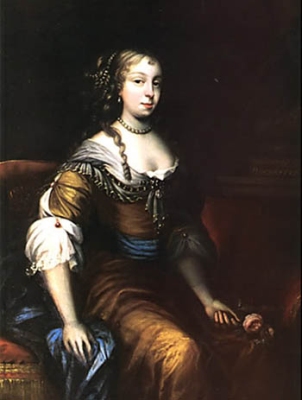
Rochester was banished from court and committed to the Tower of London after kidnapping an heiress. Elizabeth Malet was a wealthy young woman who Rochester hoped would solve his mounting debt problem with her considerable fortune. At first she was flattered and agreed to the match, but then changed her mind. Rochester ambushed her coach at Charing Cross and attempted to take her away, but the King had him pursued and arrested.
Elizabeth Malet by Peter Lely 1667
Later in her life, surprisingly, Elizabeth Malet relented and they were married in 1666, and had a relatively stable marriage, with Elizabeth maintaining their country estate at Adderbury near Oxford.
Rochester could not remain faithful however, and continued to enjoy numerous mistresses. When at home though, he would write verses lampooning life at court, including this one on Charles II -
We have a pritty witty king
Whose word no man relies on.
Who never said a foolish thing,
Nor ever did a wise one.
Rochester and Buckingham influenced in turn a 'fast set' of impressionable men at court. These men were nicknamed by Andrew Marvell, 'the Merry Gang.' Hester Chapman in her book Great Villiers calls them 'a ring of poisonous dragonflies', which is a wonderful description as it describes how beautiful they looked, but also how dangerous they were.
Two of them, Sir Charles Sedley and Lord Buckhurst were responsible for an incident outside the Cock Tavern in Bow Street where they postured naked and made obscene gestures to the crowd below from a balcony. (Good taste prevents me from relating this incident in more detail!) Lord Buckhurst was also renowned for being one of the lovers of Nell Gwyn.
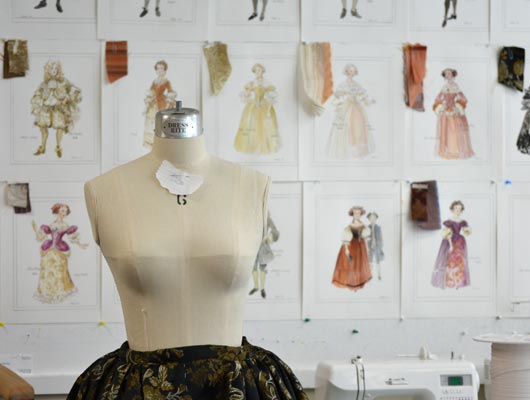
Many of the Merry Gang were also writers and playwrights of talent, involved with the new Vere Street theatre. Buckingham, Killigrew and Etheredge were all playwrights as was Wycherley whose work is still performed even today. Below you can see preparations for a modern production of The Country Wife, still going strong nearly four hundred years later. I drew on Wycherley's plays to give a flavour of period dialogue in The Gilded Lily.
Sedley was a talented writer, but during the performance of one of his plays the theatre roof fell in, injuring him. A flattering friend remarked that the play was so good and full of fire it had blown up the theatre, but Sedley apparently said, 'Nonsense! It was so heavy it brought down the house and buried the poet in his own rubbish.' So the Merry Gang were also renowned for their humour as well as their darker exploits. And I wonder if this is where we get the phrase to 'bring the house down'?!
In The Gilded Lily, Sedley, Buckhurst and George Etheredge all make an appearance. The lives of the Merry Gang are fascinating and complex, and for those who would like to know more I can recommend the following books;
The Lives of the English Rakes by Fergus Linnane
Constant Delights:Rakes Rogues and Scandal by Graham Hopkins
Charles II and the Duke of Buckingham - David Hanrahan
A Gambling Man, Charles II and the Restoration - Jenny Uglow THE GILDED LILY is out now in paperback, and on special offer on Kindle.
My name is Jackie Hodson and I’m writing, researching, stressing over a novel started mumble, mumble years ago.
It all began on a rainy day in Ireland. I never need an excuse to drop into a secondhand book shop but that day it was raining stair rods and the place was warm and dry and very welcoming. I don’t know how long I stayed. Time stops in a book shop. But I came out with a beautiful Victorian book called The 17th Century by Jacques Boulenger.
Later, I began reading. 17th century France was a new, fascinating subject for me. Then, on page 44 came the sentence - ‘Marie de Rohan had married the Duc de Luynes when she was seventeen: by the time her first husband died, her reputation was already so extremely bad that the Nuncio thought it his duty to advise the young Queen not to keep so compromising lady about her person...’
Intriguing.
It begged a question. Then another. And over the years, a captivating life evolved into Weave a Garland of my Vows, a story about Marie de Rohan of the ‘extremely bad reputation.’
Marie-Aimée de Rohan-Montbazon
The de Rohan were an old and very noble race from Bretagne, blood linked to many major European families including the Visconti, Navarre and the Stuarts. A de Rohan would not be exiled by anyone, including the King of France 'Roi ne puis, prince ne daigne, Rohan je suis'
Marie had a plan.....
On April 1st 1622, she wrote a letter to Claude de Lorraine, Duc de Chevreuse asking for his help. He discussed this letter with friends; they advised him to stay away from the widow but Claude ignored them and walked into an unexpected proposal of marriage.
On the 20th April 1622, the couple wed, the ceremony short and secret and attended by several members of the powerful Guise -Lorraine family ( motto: All for one.) but not a single de Rohan. Marie had allied herself with a foreign power - prince étranger - a prince living in France but belonging to a foreign sovereign dynasty who operated outside the normal jurisdiction of the French King.
‘The happy lovers have gone to praise God for their prosperity in the Chapel at Lesigny, and take possession together of the house the dead man prepared for them without ever thinking of it. It is the joke of the whole court.’
Louis was furious but he could do nothing to upset the Guisards and, by September, Marie returned to Anne and the court. Madame - out of the affection I bear my cousin, the Duc de Chevreuse, I am very glad his wife should come back- Louis
Within weeks, two events happened that were to have long term repercussions for Marie de Rohan. Marie de Medici’s favourite, the Bishop of Luçon was finally awarded a cardinal’s hat. Then George Villiers and Charles, Prince of Wales embarked on their ‘fatal mistake,’ - a secret trip to Spain known as The Spanish Match. ‘We go to mount Spain.’
Luçon became His Eminence, Cardinal Richelieu; Villiers saw Anne of Austria for the first time and an immense battle began for control of the Spanish Queen of France. It involved the whole court. Marie sided with Anne and the English. Many years later, she told Madame de Motteville, Anne’s biographer, that George Villiers, Duke of Buckingham was the only man she had ever truly loved. It was a true meeting of spirit and Marie agreed to help Buckingham beguile the ill-used, unhappy Queen. ‘The fairest vision which had ever gladdened his sight.’
After the aborted Spanish Match, England started negotiations for a marriage between Louis XIII’s sister, Henrietta Maria, and Prince Charles. The Stuarts’ greatest allies in France were family - the Guise-Lorraine and the de Rohan - and Claude and Marie were chosen as hosts for their ambassador, Henry Rich, Viscount Holland.
At 24 years of age, Marie was a rarity. She had never taken a lover but Rich held her spellbound and, by the time of the royal wedding, she was carrying Henry’s child. Claude knew about the affair but he had the honour of being James Stuart’s choice as proxy bridegroom. Marie’s dalliance amused him.
On Saturday 24th May 1625, George Villiers, Duke of Buckingham arrived in Paris. Anne was already half in love with him and Villiers made the most of the infatuation. But he and Marie misjudged their woman, as certain ‘goings on’ in a garden at Amiens proved. Anne would be admired but not touched.
With Claude and Marie escorting Princess Henrietta Maria, the new Queen of England, across the Channel, Louis took action against his apparently faithless wife. He banished all her closest servants and replaced them with Richelieu’s spies, published an edict barring access to Anne and barred the Duke of Buckingham from ever entering France again.
Meanwhile, Anne-Marie de Lorraine was born at Hampton Court in June 1625 and within a few weeks, her mother set the tongues of London wagging by swimming across the Thames.
'Twas calm, and yet the Thames touch'd heaven to day. The water did find out the Milky way, When Madam Chevereuze by swimming down, Did the faire Thames the Qu. of Rivers crown...’
But worse than that, Marie de Rohan ate meat in public on fast days, visited Buckingham and Henry Rich regularly, talked to Protestant churchmen and, according to the Bishop of Mende, she had ‘...come over here to establish brothels rather than serve religion.’
Repeated orders came from France recalling Marie before she caused any more trouble. She returned with a letter from Charles I to Louis XIII. ‘She returns to You worthy to be a shining star of any court and the precious proof of Our mutual friendship.’
Whilst in England, Marie had been in continual correspondence with Anne and other allies at court. She knew that the marriage of Louis’ brother, Gaston, was imminent. As she knew that if Gaston married and sired an heir, Anne of Austria’s humiliation would be complete.
So started the ‘Conspiration des Dames.’
The original aim of the conspiracy was to prevent this marriage, to remove both Louis and Richelieu and to marry Gaston to Anne of Austria. The removal of Richelieu was possible, if not easy, but the ousting of a monarch required planning and foreign aid.
‘She often suggested such brilliant expedients that they seemed like flashes of lightning, and were so wise that they would not be disowned by the greatest men of any age.’
Marie de Rohan as The Huntress Diana
Meanwhile, Eurpoe united behind Marie, and in France, the nobles and the Huguenots joined forces. England agreed to enter the country by sea from the west. The eastern borders were given to Savoy and Lorraine, the north to the Spanish Netherlands and the south went to Spain.
Then came betrayal... from the inside.
Gaston, unmasked also and forced to marry in a midnight ceremony officiated by Richelieu, was interrogated. He told them everything and when asked for the name of the instigator of the plot, he gave it willingly. Marie de Rohan, Duchesse de Chevreuse. If Marie’s guilt were proven then so would that of Anne of Austria. Marie went alone one evening to meet with Richelieu. She pleaded for the release of the prisoners, especially the young Comte de Chalais - even though he had betrayed her too.
‘I failed in judgement but I swear before God that, although I was aware of the faction, I never was its counsellor...It is very difficult not to be deceived by such devilish artifices, for who could escape a Princess (Marie de Rohan) so kindly looked on at the Courts of two of the greatest Queens in the world, whose manners are so easy and her rouge so well laid on...’
It was useless. De Chalais met his fate on 19th August 1626 after a trial for treason. Anne of Austria was brought before a royal council of Louis, Marie de Medici and Richelieu and questioned closely about her role in the affair. ‘She is too good a Spaniard.’ And the King held a warrant for the arrest and imprisonment of the Duchesse de Chevreuse.
Marie had a plan.
But that’s another story...
None of these roaring girls is ours: she flies With wings more lofty.
My thanks go to Anita and Alison and all at Hoydens and Firebrands for letting me visit your wonderful blog.
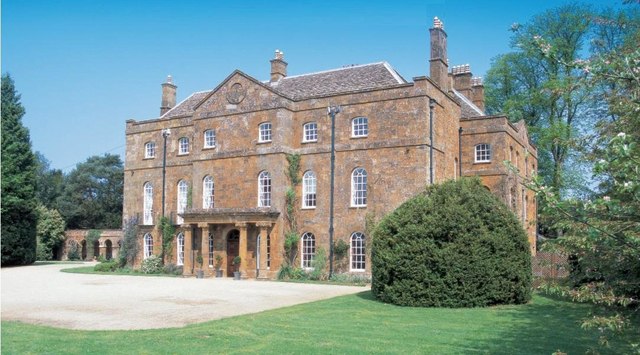 Later in her life, surprisingly, Elizabeth Malet relented and they were married in 1666, and had a relatively stable marriage, with Elizabeth maintaining their country estate at Adderbury near Oxford.