Sunday, 14 April 2013

17th-century Jews: Carving a Place in the New World


This week the Hoydens are pleased to welcome Patricia O'Sullivan.  Patricia is passionate  about bringing to light odd bits of history. Her first three novels deal with Sephardic Jews and Native Americans and she has also written about Irish slaves in the Caribbean and the limits on women throughout history. 


17th Century Jews:  Carving a Place in the New World

The Jewish Quarter of Amsterdam
Historian Christopher Hill described 17th-century England as “a world turned upside down”. The expression is taken from a ballad popular during the English Civil War. Hill and other historians have described in detail how the 17th century was a time when people sought to free themselves from authoritarian bonds: separatists broke from the English church, the middle class refused to continue to bow down to the propertied class, merchants exploiting the resources of the New World amassed fortunes that rivaled those of their landed betters, and women took to the stage, replacing male performers dressed in drag.

Another important, though quieter, change in the 17th century was the establishment of Jewish communities in the New World and key locations in Protestant Europe. During the 16th century, Iberian Jewish refugees of the Catholic Inquisition poured into the few European cities that granted them entry. The largest of these was Amsterdam. During the 17th century, hundreds of Jews left the crowded Jewish neighborhoods in Amsterdam for Dutch settlements such as Recife in Brazil, Manhattan in New Amsterdam, and the Caribbean islands of St. Martin, Bonaire, CuraƧao, St. Eustatius, Aruba, Saba, and Tortola.

However, Jews did not only settle in Dutch lands. A small, secret community of Jews lived in London during the 17th century under the protection of Oliver Cromwell. By 1677, there is evidence of a Jewish community in Newport, Rhode Island, the English colony established by Roger Williams as a safe haven from the theocratic rule of Puritans in Massachusetts Bay, Plymouth, and Connecticut.

Why should these Jewish settlements matter to a 17th-century historian? Because it is in moments of social upheaval that the ‘other’ has a chance of gaining a foothold in a new order. With their vast European contacts, Jewish merchants created valuable trade networks throughout the Atlantic world. They challenged civil injustices in colonial courts, established relationships with politicians and preachers, and risked everything they had to preserve their new freedoms and their old traditions. During a century of great change, European Jews carved a place for themselves in the New World and as well as the old one.

Oliver Cromwell with his secretary, John Milton
 In 1656, Oliver Cromwell spoke of the debt England, newly Protestant, owed the Jews. In England, he said, the Jews would finally see Christianity in its true form and embrace it. Despite Cromwell’s prediction, there was no mass conversion of Jews to Christianity in England or in any other Protestant region. The Protestant quest to convert the Jews seemed less urgent in the New World. In fact, in 1790, George Washington, in assuring the Jews of Newport their place in the United States, wrote:

It is now no more that toleration is spoken of, as if it was by the indulgence of one class of people that another enjoyed the exercise of their inherent natural rights. For happily the Government of the United States, which gives to bigotry no sanction, to persecution no assistance, requires only that they who live under its protection, should demean themselves as good citizens.

The century that turned the world upside down was the century in which Jews began their journey from a persecuted people to a tolerated minority. But it wasn’t until the end of the subsequent century that Jews were promised full rights in a nation that welcomed them with no expectation other than that they “demean themselves as good citizens.”


You can read about the 1656 readmission of the Jews to England in Patricia O’Sullivan’s Hope of Israel, about the 17th-century Jewish communities in New Amsterdam and Newport in Legend of theDead, and about how the Jews of St. Eustatius helped the Americans win their War of Independence against the British in A Notable Occupation. Visit Patricia's website for more details by clicking HERE.

Patricia O’Sullivan


Sunday, 7 April 2013

Rakes and Rogues of Restoration London by Deborah Swift

The most infamous rogues of Charles II's court were the Duke of Buckingham and the Earl of Rochester. Both were members of a young group of courtiers called 'The Wits' so named because of their literary pretensions, and their reputation for quick repartee.


In this period of the seventeenth century, sandwiched between the rigours of puritanism and the later tragedies of the Plague and the Great Fire of London, the mood was one of 
'a very merry, dancing, drinking, laughing, quaffing and unthinking time' (John Dryden)

The Earl of Rochester was described by John Burnet as 'a lawless and wretched mountebank; his delight was to haunt the stews, to debauch women, to write lewd songs and filthy pamphlets.'

Johnny Depp plays the Earl of Rochester in this trailer for his Biopic 'The Libertine'


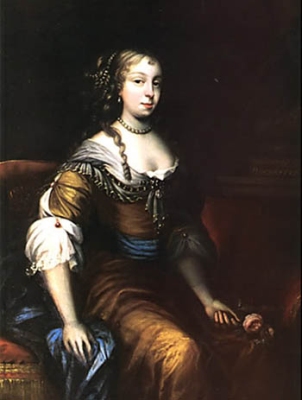
Rochester was banished from court and committed to the Tower of London after kidnapping an heiress. Elizabeth Malet was a wealthy young woman who Rochester hoped would solve his mounting debt problem with her considerable fortune. At first she was flattered and agreed to the match, but then changed her mind. Rochester ambushed her coach at Charing Cross and attempted to take her away, but the King had him pursued and arrested.

Elizabeth Malet by Peter Lely 1667
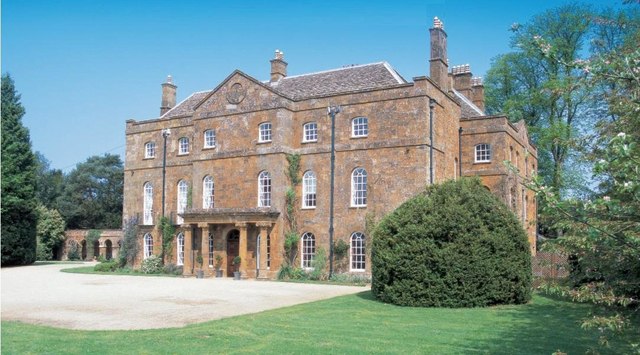
File:Adderbury Manor House - geograph.org.uk - 818088.jpgLater in her life, surprisingly, Elizabeth Malet relented and they were married in 1666, and  had a relatively stable marriage, with Elizabeth maintaining their country estate at Adderbury near Oxford. 


Rochester could not remain faithful however, and continued to enjoy numerous mistresses. When at home though,  he would write verses lampooning life at court, including this one on Charles II -

We have a pritty witty king
Whose word no man relies on.
Who never said a foolish thing,
Nor ever did a wise one.

Rochester and Buckingham influenced in turn a 'fast set' of impressionable men at court. These men were nicknamed by Andrew Marvell, 'the Merry Gang.' Hester Chapman in her book Great Villiers calls them 'a ring of poisonous dragonflies', which is a wonderful description as it describes how beautiful they looked, but also how dangerous they were.

Two of them, Sir Charles Sedley and Lord Buckhurst were responsible for an incident outside the Cock Tavern in Bow Street where they postured naked and made obscene gestures to the crowd below from a balcony. (Good taste prevents me from relating this incident in more detail!) Lord Buckhurst was also renowned for being one of the lovers of Nell Gwyn.

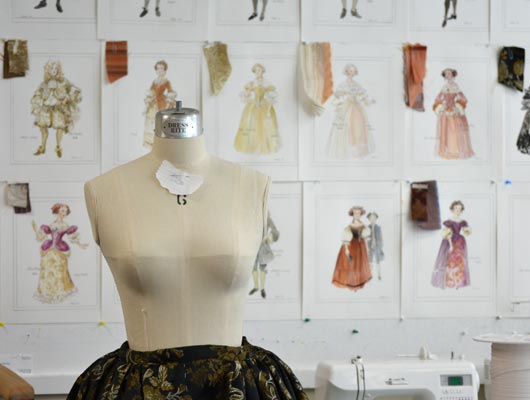
Many of the Merry Gang were also writers and playwrights of talent, involved with the new Vere Street theatre. Buckingham, Killigrew and Etheredge were all playwrights as was Wycherley whose work is still performed even today. Below you can see preparations for a modern production of The Country Wife, still going strong nearly four hundred years later. I drew on Wycherley's plays to give a flavour of period dialogue in The Gilded Lily.

Fully dressed
Preparations for a modern production of The Country Wife by William Wycherley
http://www.dal.ca/news/2011/03/28/meet_the_countrywife.html
Sedley was a talented writer, but during the performance of one of his plays the theatre roof fell in, injuring him. A flattering friend remarked that the play was so good and full of fire it had blown up the theatre, but Sedley apparently said, 'Nonsense! It was so heavy it brought down the house and buried the poet in his own rubbish.' So the Merry Gang were also renowned for their humour as well as their darker exploits. And I wonder if this is where we get the phrase to 'bring the house down'?!

In The Gilded Lily, Sedley, Buckhurst and George Etheredge all make an appearance. The lives of the Merry Gang are fascinating and complex, and for those who would like to know more I can recommend the following books;

The Lives of the English Rakes by Fergus Linnane
Constant Delights:Rakes Rogues and Scandal by Graham Hopkins
Charles II and the Duke of Buckingham - David Hanrahan
A Gambling Man, Charles II and the Restoration - Jenny Uglow

THE GILDED LILY is out now in paperback, and on special offer on Kindle.

Wednesday, 3 April 2013

Happy New Year?

"Baby New Year"—cartoon by John T. McCutcheon. 
The New Year has, over time, had many beginnings. I am posting this essay on Easter Sunday (2012), and this day would have been considered the beginning of the New Year at certain times in French history. 

The Julian Calendar, established by Julius Caesar in 46 BC, declared January 1 the first day of the year.

With the advent of Christianity, however, efforts were made to move New Year’s Day to something of more religious significance, such as Christmas or Easter.

Some countries continued to use January 1 (the date of Christ’s circumcision) and other countries made changes. Consequently, by the 1500s the European calendar system was a mess, countries beginning the year on different dates.

Resurrection by Wenzel Hollar, completed during the 17th century

Since the 14th cenutry, most regions in France had been using Easter as the start of the year. (And doesn't spring simply feel like be beginning of the new year?) Using Easter as the date caused confusion, however, since Easter is tied to the lunar cycle and changes from one year to the next, so around 1500 many people in France began to use January 1 as the start of the calendar year.

For instance, in early sixteenth-century French books, it is common to see both forms of dating listed side-by-side. Just imagine the confusion when the French Revolution created yet another calendar.

King Charles IX of France
In 1563 King Charles IX of France decreed January 1 to be the first day of the year and was declared law the following year. (Britain didn't change the start of its calendar year to January 1 until 1752.)


With all the confusion, April Fool's Day was apparently born. (Read more about that here.)


Sandra Gulland
Author of The Josephine B. Trilogy and Mistress of the Sun

*****
Website: http://www.sandragulland.com/
Blog: http://bit.ly/writinglife
Research blog: http://bit.ly/BaroqueExplorations
Facebook: http://www.facebook.com/novelistSandraGulland
Twitter: http://twitter.com/Sandra_Gulland
Tumblr: http://sandragulland.tumblr.com/


Sunday, 24 March 2013

17th-Century Blood Transfusions

Recently I was writing a scene where a character needed a blood transfusion. You're probably saying, "Wait a minute, they didn't give transfusions during the 17th-century, did they?" As it turns out, the 1600s claimed the first known successful transfusions. In 1613, a doctor by the name of William Harvey formulated the theory of blood circulation. Before then, blood was assumed to wash back and forth throughout the body like a tide. He tested his theory on corpses, so therefore didn't perform the first transfusion on a live person.

Around 1639, Francis Potter used quills as needles and tubes for the purpose of transfusion, and in 1649, he attempted the process between two chickens. Frustrated by the attempt, he was only able to get 2-3 drops of blood at a time.

Several others, familiar with Harvey's writings, attempted the procedure with animals. Robert Boyle in the mid-1600s, injected dogs with "liquors," which were substances that could include ale, wine, and opium. As one might guess, these experiments usually ended poorly for the dogs in question.

Dr. Richard Lower is credited with the first animal to human transfusion. His technique led from the carotid artery to a vein. However, the transfusion failed because the blood clotted in the silver tubing he used for the purpose. Nearly a year later, Lower was successful in transfusing a man from a sheep with his technique.

Meanwhile in France, Dr. Jean Baptiste-Denys was performing similar experiments. The people that were transfused with lamb's blood had severe reactions, which we now know happens if a person receives the wrong blood type. Denys transfused a couple of people with lamb's blood, and they survived, most likely due to the fact that they had received too little blood to get an allergic reaction. Another man, who received a transfusion, died after the second one. In 1668, Denys once again attempted a transfusion between a calf and a man with what appeared no outward effects. Two days later, he attempted to transfuse the man a second time, and "as soon as the blood entered his veins, he felt the heat along his arm..." The man survived, only to succumb after a third transfusion several months later.

As a result, the French parliament banned transfusions. The British parliament and Vatican followed suit soon after.

As for my character, since I have a time traveler involved, I was able to mix the scene using 17th-century equipment and early 20th-century knowledge.

Kim Murphy
www.KimMurphy.net

Sunday, 17 March 2013

Richmond Palace

Richmond Palace an engraving 1
Some of the most beautiful Royal Palaces lined the River Thames, and I have always wondered about the ‘lost’ ones; those that were left to become ruins, or destroyed long before photographs could tell us what they looked like. One of these is the castle which once stood between Richmond Green and the River Thames.

In Medieval times, Richmond Green was used for grazing sheep, archery, jousting tournaments and pageants. Now it is surrounded by Regency and Georgian houses which change hands for jaw slackening amounts, and where locals and dreamers sit at The Cricketers pub and pavement cafes to watch the cricket and attend fairs in the summer. Once these houses existed to serve the Royal Palace, and clues still exist as to its former splendour in the names of the streets that radiate on the west side of the green, like ‘Old Palace Gate’, ‘Friars Lane’, ‘Old Palace Yard’, and ‘The Wardrobe’. The only remaining section is a red-brick gatehouse which still bears Henry VII’s coat of arms. 

The manor of Shene contained a manor house since Henry I’s time, held by a Norman knight before being returned to Royal hands. Edward II owned it, and after his deposition by Queen Isabella it reverted to her. After her death, Edward III turned the manor house into the first ‘Shene Palace’, where he died in 1377.

His grandson, Richard II came to the throne as a boy, and while still a teenager, married Anne of Bohemia. Shene was their favourite home and when Anne died of the plague at the age of 27, Richard, stricken with grief, ‘caused it to be thrown down and defaced.’

Henry V began construction on a new castle-like building, though the work halted at his death in 1422. Building resumed for the new king, though Henry VI was then only 8 years old when he was crowned.

Edward IV gave Shene Manor to his queen, Elizabeth Woodville, who handed it over to the new Henry VII after his victory over Richard III, who subsequently married his daughter, Princess Elizabeth of York.

Henry VII's Coat of Arms
The wooden buildings were destroyed by fire when the king and his court were there celebrating Christmas in 1497. In 1500, the name of Shene was changed to Richmond, in honour of the title, Earl of Richmond, which Henry VII held when he won at Bosworth Field.

Built of white stone, the new palace had octagonal or round towers capped with pepper-pot domes that bore delicate strap work and weather vanes. Of three stories set in a rectangular block with twelve rooms on each floor round an internal court. This area contained staterooms and private royal apartments, while the ground floor was entirely given over to accommodation for palace officials.

A bridge over the moat, surviving from Edward III’s time, linked the Privy Lodgings to a central courtyard some 65 feet square, flanked by the Great Hall and the Chapel and with a water fountain at its centre. The Great Hall had a buttery beneath, the Chapel ceiling was of chequered timber and plaster decorated with roses and portcullis badges, underneath which were extensive wine cellars.

The middle gate opened into the Great Court, turreted and adorned with stone figures of two trumpeters, and to the east lay the palace wardrobe where soft furnishings were stored. There was also a moat, a Great Orchard, public and private kitchens and a Library.  The palace gardens were encircled by two-storey galleries, open at ground level and enclosed above, where the court could walk, play games, admire the gardens, watch the tennis.

Richmond Palace became a showplace of the kingdom, and the scene of the wedding celebrations of Henry VII’s eldest son, Prince Arthur to Catherine of Aragon, and the betrothal of Princess Margaret to King James of Scotland in 1503.

Henry VII died at Richmond in 1509, and the following year, his son, Henry VIII married his brother’s widow, Catherine of Aragon. In 1510 Catherine gave birth to a son, Henry, at Richmond, whose lavish christening celebrations had barely finished, when the baby died a month later.


Henry VIII’s jealousy of Wolsey’s palace at Hampton Court led to him confiscating Hampton and giving Wolsey Richmond in exchange. Richmond became home to Mary Tudor, who stayed for a few months before being moved to Hatfield House. Anne of Cleves then received Richmond as part of her divorce settlement from Henry VIII.

In 1554, when Queen Mary I married Philip II of Spain, Richmond was where they spent their honeymoon, and within a year, Mary had imprisoned her sister Elizabeth there.

Queen Elizabeth was particularly fond of Richmond as a winter home – and loved to hunt stag in the "Newe Parke of Richmonde" (now the Old Deer Park.] summoned companies of players from London to perform plays – including William Shakespeare’s, and died there in 1603.

James I gave Richmond to his son, Henry Prince of Wales, as a country seat, but before any refurbishment could be done, Henry died and it passed to Prince Charles, who began his extensive art collection, storing it at Richmond.

In 1625, King Charles I bought his court to Richmond to escape the plague in London, and established Richmond Park, using the palace as a home for the royal children until the Civil War.

After Charles I’s execution, the Commonwealth Parliament demolished the Chapel, Hall and Privy Lodgings and sold off the stone, though left the brick buildings of the outer ranges intact.

By the restoration of Charles II in 1660, only the brick buildings and the Middle Gate were left. The palace became the property of the Duke of York (the future James II) and his daughters, Mary and Anne grew up there. Their only surviving half-brother, Prince James Edward (the ‘Old Pretender’) was nursed at Richmond, but the restoration work, begun under the auspices of Christopher Wren, ceased in the revolution of 1688 when James II fled to France.

The surviving buildings were leased out, and in 1702, ‘Trumpeters’ House’ was built, replacing the Middle Gate where two statues of trumpeters stood. These were followed by ‘Old Court House’ and ‘Wentworth in 1705-7.
Richmond Palace Gate
The front of The Wardrobe still shows Tudor brickwork as does the Gate House. ‘Maids of Honour Row’ built in 1724 is a uniform terrace built for the maids of honour of Caroline of Anspach, the wife of George II. These replaced most of the buildings facing the Green in 1724-5 and the majority of the house now called ‘Old Palace’ was rebuilt in about 1740.

Traces of the elaborate gardens are still there, having been incorporated into private residences, but the view from the river is still beautiful and as you pass in a barge, and squint a little, maybe you can still see the ‘pepper pots’ and turrets of the old palace where kings and queens once lived.