Monday, 21 January 2013
The Soul is Symphonic: The Music of Hildegard von Bingen
Born in the Rhineland in present day Germany, Hildegard von Bingen (1098–1179) was a visionary nun and polymath. She founded two monasteries, went on four preaching tours, and wrote nine books addressing both scientific and religious subjects, an unprecedented accomplishment for a 12th-century woman. Her prophecies earned her the title Sybil of the Rhine.
Over eight centuries after her death, Hildegard was canonized in May 2012 and on October 7 was elevated to Doctor of the Church in October, a rare and solemn title reserved for theologians who have made a significant impact. Hildegard is only the fourth woman in the history of the Church to receive this distinction.
But to most people today, Hildegard is known best for her soaring ethereal music.
The first composer for whom we have a biography, she composed seventy-seven sacred songs, as well as Ordo Virtutum, a liturgical drama set to music.
Her melodies are completely unlike the plainchant of her era—or anything that has come before or since. Likewise her lyrics are highly original and feel fresh to us even today. She was the only 12th century writer to compose in free verse.
A Benedictine superior, Hildegard and her nuns sang the Divine Office eight times a day. She believed that song was the highest form of prayer—the mystical power of music reunited humankind to the ecstasy and beauty of paradise before the fall, connecting the singer directly with the divine, and joining heaven and earth in a great celestial harmony.
Singing the divine praises was absolutely central to Hildegard’s identity as a nun. But late in her life, the great composer and polymath was silenced.
Hildegard and her nuns were subject to an interdict, or collective excommunication, when they refused to disinter a supposed apostate buried in their churchyard. As punishment for their disobedience, they were forbidden the sacraments, the mass, even forbidden to sing the Divine Office.
It was the prohibition against singing that hit Hildegard the hardest. She wrote a passionate letter to her archbishop in protest. “The soul is symphonic,” she told him. She also warned him that by forbidding her and her daughters from singing God’s praise, the archbishop himself risked going to an afterlife destination where there was no music, ie hell.
Hildegard’s words seemed to give the man pause for thought. He lifted the interdict just a few months before her death in 1179.
“There is the music of heaven in all things,” Hildegard wrote. “But we have forgotten to hear it until we sing.”
I find her song Caritas Abundant in Omnia (Divine Love Abounds in All Things) to be particularly stirring. Hildegard conceived of Caritas, or Divine Love, as a feminine figure, an aspect of the Feminine Divine:
Caritas habundat in omnia
Divine love abounds in all things.
She is greatly exalted from the depths to the heights,
Above the highest stars,
And most loving towards all things,
For she gave the highest King the kiss of peace.
Mary Sharratt’s Illuminations: A Novel of Hildegard von Bingen is by Houghton Mifflin Harcourt and is Kirkus Review 2012 Book of the Year. Visit Mary’s website.
Monday, 14 January 2013
THE FATE OF THE REGICIDES
I am currently reading THE KING'S REVENGE by Don Jordan and Michael Walsh. This book follows the fate of the 59 regicides (the men who signed the death warrant of Charles I), following the restoration of the monarchy.
Back in 2009 I wrote about my own family connection with the regicide, Sir Michael Livesey. Whether I am indirectly descended from Sir Michael or not, the fate of the regicides has always been of interest to me and as the anniversary of the execution of Charles I rolls around (Jan 31), this book was top of my list for Christmas.
News of the King's execution (January 31 1649) reached the exiled royal family on February 4. On being told of his father's death, the young prince (now king), Charles burst into tears and fled from the room. He vowed vengeance on the men who had sent his father to his death.
After his unsuccessful attempt to regain the throne by force (1650-1), Charles II retired to exile on the continent The following years (the Interregnum) was marked by failed plots to assassinate Cromwell (one of which was the subject of my own novel THE KING'S MAN) or to raise the country and restore the monarchy by force of arms. In 1658 Cromwell died, to be succeeded by his son Richard. "Tumbledown Dick", as he was nicknamed, was not the man his father had been and secret negotiations began to restore the monarchy.
Some of the men now treating with the King were the same men who had set their hands to his father's death warrant, but Charles was always a pragmatist and restoration at whatever cost was the endgame.
Before Charles II set foot back in England the round up of the regicides begain. The first five men were arrested in Ireland and imprisoned. The capture included the prosecuting lawyer, John Cook (see Geoffrey Robertson's excellent biography of Cook, THE TYRANNICIDE BRIEF). Cromwell, Ireton and Bradshaw (the judge at Charles' trial), all of whom must have topped the Most Wanted list were already dead. The first arrest on English soil was Cromwell's old comrade and the chief architect of the King's trial, Sir Thomas Harrison.
In order to secure his restoration, Charles II issued the Declaration of Breda in which he promised clemency to those of his father's enemies who swore their fealty within forty days. There was, of course, an exception. There would be no clemency for those excepted by Parliament. On 9 May 1660 Parliament began to debate the "Bill of General Pardon, Indemnity and Oblivion". Despite assurances of the King's mercy, many of the regicides saw the writing on the wall and fled England.
A "death list" of seven regicides was agreed to: Harrison, Jones, Barkstead, Lisle, Scot, Holland and Saye. Three days after announcing the seven another fice were added - not judges but officials of the court (including Cook) and the king's executioners. However only Harrison, Cook and Jones were in custody, the others had slipped away. By the end of May a full blown manhunt was on for those regicides still in England.
By October, the death list comprised thirty two men (23 judges and 9 officials). The trials began in October 1660. All thirty two were to be excepted from pardon. A further nineteen living regicides, who had surrendered by the 40 day deadline, were granted exception. At the end of their trials, ten were sentenced to immediate death and were executed in the barbaric manner of the time - hanging drawing and quartering.
As an example to Hugh Peters who waited his turn, John Cook's end was particularly grisly. He was hanged until just conscious, cut down and his genitals cut off and dangled before his eyes. A screw (like a corkscrew) was inserted and twisted to slowly extract his intestines and these were held to the torch while Cook still lived. Normally the victim's suffering would end with the cutting out of his heart but the executioner prolonged Cook's agony until the man expired. The body was then beheaded and cleaved into 4 pieces (lengthways and horizontally) so that the four quarters could be impaled on the city gatehouse.
If the diarist John Evelyn is to be believed, the King himself was present at the executions. Evelyn wrote "I saw not their execution, but met their quarters, mangled and cut and reeking as they were brought from the gallows in baskets on the hurdle."
Those who had predeceased the restoration were not spared. The bodies of Cromwell, Ireton, Bradshaw were disinterred and hung on the gibbets at Tyburn before being beheaded.
And all of this before the king's coronation in May 1661.
Having dealt with the remaining English regicides, Charles unleashed a man hunt for the nineteen regicides who had evaded capture on English soil. Agents were dispatched to America and Europe, organised by a former parliamentarian, Sir George Downing (after whom Downing Street is named). His clerk, Samuel Pepys recorded the extent of Downing's intelligence network. One of Downing's agent was the beautiful female playwright, Aprha Behn (see Anita Davison's article Aphra Behn) who was sent to "turn" her former lover, William Scot into a spy for the King.
For those surviving regicides now living on the continent or in hiding in America, they lived their lives in constant fear of assassination or kidnap. Only Edmund Ludlow lived to see Charles II's death, dying of natural causes in Switzerland in 1691. My own reputed ancestor, Sir Michael Livesey died in the Netherlands in 1665, allegedly at the hands of Downing's agents.
It is a fascinating book and, for someone like me, with the reading attention span of a gnat (these days), an easy, if disturbing, read.
![]() |
| The death warrant of Charles I |
Back in 2009 I wrote about my own family connection with the regicide, Sir Michael Livesey. Whether I am indirectly descended from Sir Michael or not, the fate of the regicides has always been of interest to me and as the anniversary of the execution of Charles I rolls around (Jan 31), this book was top of my list for Christmas.
![]() |
| The Commissioners of the King's trial |
News of the King's execution (January 31 1649) reached the exiled royal family on February 4. On being told of his father's death, the young prince (now king), Charles burst into tears and fled from the room. He vowed vengeance on the men who had sent his father to his death.
After his unsuccessful attempt to regain the throne by force (1650-1), Charles II retired to exile on the continent The following years (the Interregnum) was marked by failed plots to assassinate Cromwell (one of which was the subject of my own novel THE KING'S MAN) or to raise the country and restore the monarchy by force of arms. In 1658 Cromwell died, to be succeeded by his son Richard. "Tumbledown Dick", as he was nicknamed, was not the man his father had been and secret negotiations began to restore the monarchy.
Some of the men now treating with the King were the same men who had set their hands to his father's death warrant, but Charles was always a pragmatist and restoration at whatever cost was the endgame.
Before Charles II set foot back in England the round up of the regicides begain. The first five men were arrested in Ireland and imprisoned. The capture included the prosecuting lawyer, John Cook (see Geoffrey Robertson's excellent biography of Cook, THE TYRANNICIDE BRIEF). Cromwell, Ireton and Bradshaw (the judge at Charles' trial), all of whom must have topped the Most Wanted list were already dead. The first arrest on English soil was Cromwell's old comrade and the chief architect of the King's trial, Sir Thomas Harrison.
In order to secure his restoration, Charles II issued the Declaration of Breda in which he promised clemency to those of his father's enemies who swore their fealty within forty days. There was, of course, an exception. There would be no clemency for those excepted by Parliament. On 9 May 1660 Parliament began to debate the "Bill of General Pardon, Indemnity and Oblivion". Despite assurances of the King's mercy, many of the regicides saw the writing on the wall and fled England.
A "death list" of seven regicides was agreed to: Harrison, Jones, Barkstead, Lisle, Scot, Holland and Saye. Three days after announcing the seven another fice were added - not judges but officials of the court (including Cook) and the king's executioners. However only Harrison, Cook and Jones were in custody, the others had slipped away. By the end of May a full blown manhunt was on for those regicides still in England.
By October, the death list comprised thirty two men (23 judges and 9 officials). The trials began in October 1660. All thirty two were to be excepted from pardon. A further nineteen living regicides, who had surrendered by the 40 day deadline, were granted exception. At the end of their trials, ten were sentenced to immediate death and were executed in the barbaric manner of the time - hanging drawing and quartering.
As an example to Hugh Peters who waited his turn, John Cook's end was particularly grisly. He was hanged until just conscious, cut down and his genitals cut off and dangled before his eyes. A screw (like a corkscrew) was inserted and twisted to slowly extract his intestines and these were held to the torch while Cook still lived. Normally the victim's suffering would end with the cutting out of his heart but the executioner prolonged Cook's agony until the man expired. The body was then beheaded and cleaved into 4 pieces (lengthways and horizontally) so that the four quarters could be impaled on the city gatehouse.
If the diarist John Evelyn is to be believed, the King himself was present at the executions. Evelyn wrote "I saw not their execution, but met their quarters, mangled and cut and reeking as they were brought from the gallows in baskets on the hurdle."
Those who had predeceased the restoration were not spared. The bodies of Cromwell, Ireton, Bradshaw were disinterred and hung on the gibbets at Tyburn before being beheaded.
And all of this before the king's coronation in May 1661.
Having dealt with the remaining English regicides, Charles unleashed a man hunt for the nineteen regicides who had evaded capture on English soil. Agents were dispatched to America and Europe, organised by a former parliamentarian, Sir George Downing (after whom Downing Street is named). His clerk, Samuel Pepys recorded the extent of Downing's intelligence network. One of Downing's agent was the beautiful female playwright, Aprha Behn (see Anita Davison's article Aphra Behn) who was sent to "turn" her former lover, William Scot into a spy for the King.
For those surviving regicides now living on the continent or in hiding in America, they lived their lives in constant fear of assassination or kidnap. Only Edmund Ludlow lived to see Charles II's death, dying of natural causes in Switzerland in 1691. My own reputed ancestor, Sir Michael Livesey died in the Netherlands in 1665, allegedly at the hands of Downing's agents.
It is a fascinating book and, for someone like me, with the reading attention span of a gnat (these days), an easy, if disturbing, read.
Wednesday, 9 January 2013
HOYDENS NEWS
A very happy Hoydens New Year to all our followers.
2012 has been an exciting year for all of us and to bring everyone up to date...
ANITA DAVISON (writing as ANITA SEYMOUR) has a new biographical novel, coming out on 31st January. With her feet firmly planted in the seventeenth century, ROYALIST REBEL tells the real life story of Elizabeth Murray.
It will be available from Amazon UK and US and all good book stores in the UK (and hopefully beyond!).
SANDRA GULLAND shared the outstanding news that the TV film rights for her Josephine Bonaparte Trilogy have been optioned with Michael Hirst as screen writer (who scripted THE TUDORS and ELIZABETH) and Kelsey Grammar as producer.
DEBORAH SWIFT's latest book THE GILDED LILY was released in late 2012.
The Gilded Lily was selected as one of the '13 must reads in 2013' by GoodMorning Texas TV programme.
Dee has been invited to appear on two panels ('Making it to Mainstream' about my unusual route to publication, and 'The Virtual Salon' about how blogging can link writers with readers) at the Historical Novel Society Conference in Florida. Dee says "If anyone is going to the conference, particularly if you are a fan of Hoydens and Firebrands or the 17th century, please come and say hello. "Or you could rescue my husband who as yet does not know what he is letting himself in for!"
She has just finished working with the copy-edits for her next book 'A Divided Inheritance' and it's scheduled for publication with Macmillan in October 2013.

ALISON STUART'S latest book, a "Downton Abbeyesque" ghost story, GATHER THE BONES, set post World War I, also came out in late 2012. Her next book, a historical time travel SECRETS IN TIME is out in April. It is her first unashamedly romance book with a cavalier hero (of course).
Late breaking news: GATHER THE BONES has been nominated as a Finalist in the Australian Romance Readers Awards.
KIM MURPHY has finished writing her non fiction book on rape in the American Civil War. A FATE WORSE THAN DEATH will be released either this fall or January 2014. She is currently working on the sequel to THE DREAMING: WALKS THROUGH MIST. The title for the sequel is THE DREAMING: WIND TALKER, which will include more conflict between the colonials and the Powhatan chiefdom in the seventeenth century.

MARY SHARRATT also had a late 2012 release with ILLUMINATIONS: A NOVEL OF HILDEGARD VON BINGEN which has been selected as a Best Book of 2012 by Kirkus, WGBH Greater Boston Public Television, The Examiner, The Reading Frenzy, and She Knows.
We may often write about different periods of history but our hearts belong to the seventeenth century.
Here's to another successful year for the Hoydens.
2012 has been an exciting year for all of us and to bring everyone up to date...
ANITA DAVISON (writing as ANITA SEYMOUR) has a new biographical novel, coming out on 31st January. With her feet firmly planted in the seventeenth century, ROYALIST REBEL tells the real life story of Elizabeth Murray.It will be available from Amazon UK and US and all good book stores in the UK (and hopefully beyond!).
The Gilded Lily was selected as one of the '13 must reads in 2013' by GoodMorning Texas TV programme.
Dee has been invited to appear on two panels ('Making it to Mainstream' about my unusual route to publication, and 'The Virtual Salon' about how blogging can link writers with readers) at the Historical Novel Society Conference in Florida. Dee says "If anyone is going to the conference, particularly if you are a fan of Hoydens and Firebrands or the 17th century, please come and say hello. "Or you could rescue my husband who as yet does not know what he is letting himself in for!"
She has just finished working with the copy-edits for her next book 'A Divided Inheritance' and it's scheduled for publication with Macmillan in October 2013.

ALISON STUART'S latest book, a "Downton Abbeyesque" ghost story, GATHER THE BONES, set post World War I, also came out in late 2012. Her next book, a historical time travel SECRETS IN TIME is out in April. It is her first unashamedly romance book with a cavalier hero (of course).
Late breaking news: GATHER THE BONES has been nominated as a Finalist in the Australian Romance Readers Awards.
KIM MURPHY has finished writing her non fiction book on rape in the American Civil War. A FATE WORSE THAN DEATH will be released either this fall or January 2014. She is currently working on the sequel to THE DREAMING: WALKS THROUGH MIST. The title for the sequel is THE DREAMING: WIND TALKER, which will include more conflict between the colonials and the Powhatan chiefdom in the seventeenth century.
MARY SHARRATT also had a late 2012 release with ILLUMINATIONS: A NOVEL OF HILDEGARD VON BINGEN which has been selected as a Best Book of 2012 by Kirkus, WGBH Greater Boston Public Television, The Examiner, The Reading Frenzy, and She Knows.
We may often write about different periods of history but our hearts belong to the seventeenth century.
Here's to another successful year for the Hoydens.
Sunday, 30 December 2012
At home with a 17th century Vicar
| Alfriston Vicarage - Tudor |
The first parsonages were very simple affairs constructed from wattle and daub, roofed with thatch or shingles.
![]() |
| Solar, Churche's Mansion, Nantwich Cheshire |
![]() |
| West Dean Rectory |
Flitton Vicarage in 1827,built in 1606 painted by Rev. Henry Wellesley |
This behaviour was seldom censured by the church, but met with wide disapproval amongst parishioners. In June 1610 a Mr and Mrs Holland declared that 'The World was never merrie since priests were married'.
The practice of marriage was popularised in the West by the followers of Martin Luther who himself, a former priest and monk, married Katharina Von Bora, a former nun, in 1525. In the Church of England, however, the Catholic tradition of clerical celibacy continued after the Reformation, though in 1547, in the reign of Edward VI Anglican priests were allowed to marry for the first time.
Some parsons had such large families that they found it hard to manage financially. The Vicar of Hungerton in 1614 said, 'my livinge is very small...if I had not lately received a gratuity I had not been able to maintayne myselfe and eight children'.
In towns where the population was bigger, the rectory could be a grander affair. The parson's study had become a necessity since the Elizabethan drive to raise the standard of education of the clergy, so many 17th century clergy owned considerable libraries. When Matthew Knyghtley died, his books were valued at twenty pounds, whereas his three silver spoons were worth only 12 shillings. As books were so valuable the study often contained a bed, for the books were too rare and costly to be left unguarded, and would frequently be studied deep into the night.
![]() |
| 17th century Book of Common Prayer |
And at Kilworth in Leicestershire the disposessed Royalist rector Samuel Cotton, assisted by some Cavaliers, ousted the Presbyterian successsor and his wife in the middle of the night and took over their former home, placing guards at the doors to prevent them re-entering.The walls of the rectories would have some exciting stories to tell if we could only unlock them!
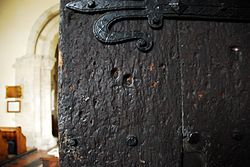
| Church of St Lawrence, Alton, Hampshire showing shot holes from the English Civil War |
and you can find out more about my novels here:
The Lady's Slipper The Gilded Lily A Divided Inheritance
Further Info: The Country Priest in English History by A.Tindal Hart
Birth Marriage and Death in Tudor and Stuart England by David Cressy
Tuesday, 25 December 2012
The Twelve Days of Christmas: a historical meander
We all know the song "The Twelve Days of Christmas": I thought, for this post, I would have a look into its history. As with any research, one thing leads to another ...
The words to the song were first printed in a children's book, Mirth Without Mischief, in 1780.
(The title is quite delightful as is, but even more so with the addition "...or the Gaping Wide Mouthed Waddling Frog." You can buy a reproduction copy of Mirth Without Mischief through Amazon: click here.)
In Mirth Without Mischief, "The Twelve Days of Christmas" is presented as a memory game. Players gather in a circle, and each one in turn says the first line. Then, when it comes around to the first player again, he gives the second line, and so on, until someone messes up and punishment ensues.
Of course the song itself dates further back, some even claiming its origin in the 16th century. It is generally thought that the original verse was French. Others claim it was a Catholic catechism memory song, taught to the children of oppressed English Catholics during the Reformation. (This theory is considered to be an urban legend by some.)
The twelve days of Christmas is a custom that originally goes back to the Roman celebration of Saturnalia followed by twelve holidays, ending January 1. Now (usually) the twelve days of Christmas—known as Christmastide and Twelvetide—begin on December 25, Christmas day, and end on January 5. In some cultures, the twelfth day is January 6, the first day of Epiphany.
As with any historical exploration across cultures, dates will differ. For some, Saint Steven's Day (Boxing Day) marks the beginning of the twelve days of Christmas, with welcome candles put in windows. A Yule Log (an ancient custom handed down from the Druids) was kept burning until the New Year to ensure good luck from year to year.
Twelfth Night marks the traditional end of the Christmas season: but does it fall on January 5th or 6th? That, too, depends. We live in very Catholic Mexico in the winter, and January 6th is the big event here. The night before, while children sleep, fathers swarm into the markets to buy their children a gift to discover in the morning. Even the big department stores stay open, and taxis and buses are busy taking parents from shop to shop in the dark of night.
The Twelfth Night party is celebrated with a King Cake (Rosca de Reyes here, Gateau de Rois in French-speaking countries) in honour of the three Wise Men. It's a yeast cake filled with dried fruits and nuts. It is based on an ancient Arab recipe, and has been made in this way by Christians throughout most of Europe since the Middle Ages.
In Mexico, as in times past, the person who gets the piece with a plastic baby Jesus in it (a pea or bean in former times, of course) is crowned. Here the tradition is that that person is then obliged to give the Twelfth Night party the following year.
I love this etching of Christmas festivity gone wild:
Rest assured that however you celebrate the holidays, whatever you do has a long and very merry tradition.
Here's wishing everyone Happy Holidays, and a wonderful New Year! Keep that Yule Log burning.
Sandra Gulland
(The Josephine B. Trilogy, Mistress of the Sun)
Latest newsletter: http://bit.ly/11keASw
Website: http://www.sandragulland.com/
Links:
Wikipedia on the song "The Twelve Days of Christmas"
Lyrics for "The Twelve Days of Christmas"
The words to the song were first printed in a children's book, Mirth Without Mischief, in 1780.
(The title is quite delightful as is, but even more so with the addition "...or the Gaping Wide Mouthed Waddling Frog." You can buy a reproduction copy of Mirth Without Mischief through Amazon: click here.)
In Mirth Without Mischief, "The Twelve Days of Christmas" is presented as a memory game. Players gather in a circle, and each one in turn says the first line. Then, when it comes around to the first player again, he gives the second line, and so on, until someone messes up and punishment ensues.
Of course the song itself dates further back, some even claiming its origin in the 16th century. It is generally thought that the original verse was French. Others claim it was a Catholic catechism memory song, taught to the children of oppressed English Catholics during the Reformation. (This theory is considered to be an urban legend by some.)
The twelve days of Christmas is a custom that originally goes back to the Roman celebration of Saturnalia followed by twelve holidays, ending January 1. Now (usually) the twelve days of Christmas—known as Christmastide and Twelvetide—begin on December 25, Christmas day, and end on January 5. In some cultures, the twelfth day is January 6, the first day of Epiphany.
As with any historical exploration across cultures, dates will differ. For some, Saint Steven's Day (Boxing Day) marks the beginning of the twelve days of Christmas, with welcome candles put in windows. A Yule Log (an ancient custom handed down from the Druids) was kept burning until the New Year to ensure good luck from year to year.
Twelfth Night marks the traditional end of the Christmas season: but does it fall on January 5th or 6th? That, too, depends. We live in very Catholic Mexico in the winter, and January 6th is the big event here. The night before, while children sleep, fathers swarm into the markets to buy their children a gift to discover in the morning. Even the big department stores stay open, and taxis and buses are busy taking parents from shop to shop in the dark of night.
The Twelfth Night party is celebrated with a King Cake (Rosca de Reyes here, Gateau de Rois in French-speaking countries) in honour of the three Wise Men. It's a yeast cake filled with dried fruits and nuts. It is based on an ancient Arab recipe, and has been made in this way by Christians throughout most of Europe since the Middle Ages.
In Mexico, as in times past, the person who gets the piece with a plastic baby Jesus in it (a pea or bean in former times, of course) is crowned. Here the tradition is that that person is then obliged to give the Twelfth Night party the following year.
I love this etching of Christmas festivity gone wild:
Rest assured that however you celebrate the holidays, whatever you do has a long and very merry tradition.
Here's wishing everyone Happy Holidays, and a wonderful New Year! Keep that Yule Log burning.
Sandra Gulland
(The Josephine B. Trilogy, Mistress of the Sun)
Latest newsletter: http://bit.ly/11keASw
Website: http://www.sandragulland.com/
Links:
Wikipedia on the song "The Twelve Days of Christmas"
Lyrics for "The Twelve Days of Christmas"
Subscribe to:
Posts (Atom)