Sunday, 16 December 2012

Bacon's Rebellion

During the 1650s and 60s, the English population increased dramatically in Virginia. Economic situations and the addition of new arrivals caused conflicts with the Native people. Raiding from both sides resulted, and the colonists were either confused or didn't care as to which tribes were friendly. Governor Berkeley gathered a force to deal with the situation, but the colonists murdered five chiefs who had requested peace. The governor pleaded for restraint from the colonists.

Nathaniel Bacon, an owner of Indian and African slaves, captured some friendly Appamattuck Indians for "allegedly" stealing corn. This set the seeds for the rebellion, at a time when the colonists wondered which man was taking the right action.

As a result, the governor feared a complete Indian rebellion. In March 1676, the English declared war on the Indians with their Acts of Assembly, and laws were enacted to build forts for protection from the Indians. Farmers requested a force to suppress the Indians, but when they were ignored, they took matters into their own hands with Bacon as their leader.

Berkeley labeled them as rebels and attempted to control the situation by riding to Bacon's headquarters with 300 armed men. Bacon fled into the forest.

The governor issued pardons for Bacon's men if they went home peacefully. Instead, Bacon marched on the friendly Occaneechi tribe. He convinced them to attack the Susquehanock. When the Occaneechi returned with captives, Bacon and his men killed the captives. They then turned their fire on the Occaneechi, killing most of the people of the town.

In order to try and keep the peace, Berkeley agreed to pardon Bacon if he turned himself in. Ironically, Bacon was elected to the House of Burgesses due to sympathy from his Indian attacks. When he appeared in Jamestown for the June Assembly, he was captured. Tensions flared between Berkeley and Bacon, but in the end, Bacon became the commander-in-chief to fight the Indians. He lead a revolt and drove the friendly Pamunkey from their lands, killing and capturing many of them in doing so.

Soon after, the governor declared Bacon's commission void. Bacon returned to Jamestown, and Berkeley immediately fled. Each of the men tried to gain support, promising freedom to the slaves that would join in their cause. In September, Bacon set fire to Jamestown.

The rebellion ended when a royal force arrested many of the rebels, and it failed completely soon after Bacon died from dysentery in October 1676.

Kim Murphy
www.KimMurphy.net

Sunday, 9 December 2012

The Maitlands of Thirlestane Castle


During my research, and search for another worthy heroine [!] it struck me how often names and places crop up repeatedly. The 1600’s were an almost incestuous time where all the prominent families were related to each other somewhere along the line.  The hero of my book was John Maitland, 2nd Earl Lauderdale, whose great uncle was William Maitland of Lethington, the renowned, ‘Secretary Lethington’ to Mary Queen of Scots.  

Mary Queen of Scots
Maitland married Mary Fleming, one of the "Four Marys" who attended Mary, Queen of Scots, in France and accompanied her to Scotland in 1561. As an ambassador at Elizabeth I's court, he was also involved in the conspiracy to murder David Rizzio (the private secretary and rumoured lover of Queen Mary) by her King consort, Henry Stuart, Lord Darnley and his supporters. 

William accompanied Mary into the Scottish Highlands against the powerful Earl of Huntly, who led his troops at the Battle of Corrichie in 1562 where he was killed. William regained the Queen's favour and continued in her service until Mary surrendered herself to Sir William Kirkaldy, another accessory to Rizzio’s murder, and the insurgent nobles at the Battle of Carberry Hill. William then openly joined them and was present at the Battle of Langside, which finally ruined Mary's cause in Scotland.  


Sir John Maitland was created the 1st Lord of Thirlestane and married Jean Fleming, the heiress of Lord Fleming, Lord High Chamberlain of Scotland during Mary’s reign.

When Mary fled to England in 1567, Maitland joined with the new government, but acted in Mary’s interests and formed a party to restore her to power. In 1573, Kirkaldy, held Edinburgh Castle for Mary, along with William and his elder brother, John.

Elizabeth I sent troops to quell the uprising, the defences of the castle were demolished and John, 1st Lord Maitland of Thirlestane was imprisoned in Tantallon castle, while William was held at Leith prison where he died, either from illness or, some said, suicide.


The Maitlands were notorious for playing both sides in their own interests, a tradition continued when John Maitland, 2nd Earl Lauderdale, a staunch Covenanter up to 1647, then he rode south and attempted to help Charles I escape his captors at Hampton Court. When that plan didn’t go quite the way he wanted, he joined the young Charles II and was eventually to become part of his famous Cabal when the king was restored to the throne in 1660.

The Maitlands came from France with William the Conqueror in 1066, and settled in Northumberland. In about 1250, Sir Richard Maitland married Avicia, the daughter and sole heiress of Thomas du Thirlestane. Their Norman name, originally spelled Mautalent, Matulant or Matalan, translates as ‘evil genius’, a name the men of that family seemed to live up to through the centuries.

Thirlestane Castle, Lauder, Scotland
Their ancestral home is Thirlestane Castle at Lauder on the Scottish borders which dates back to the 13th century, when a Border fort was built on the site to defend the approach to Edinburgh from the south. The central part of the present Castle was completed in 1590, remodelled in the 1670s, and then again in the 1840s.

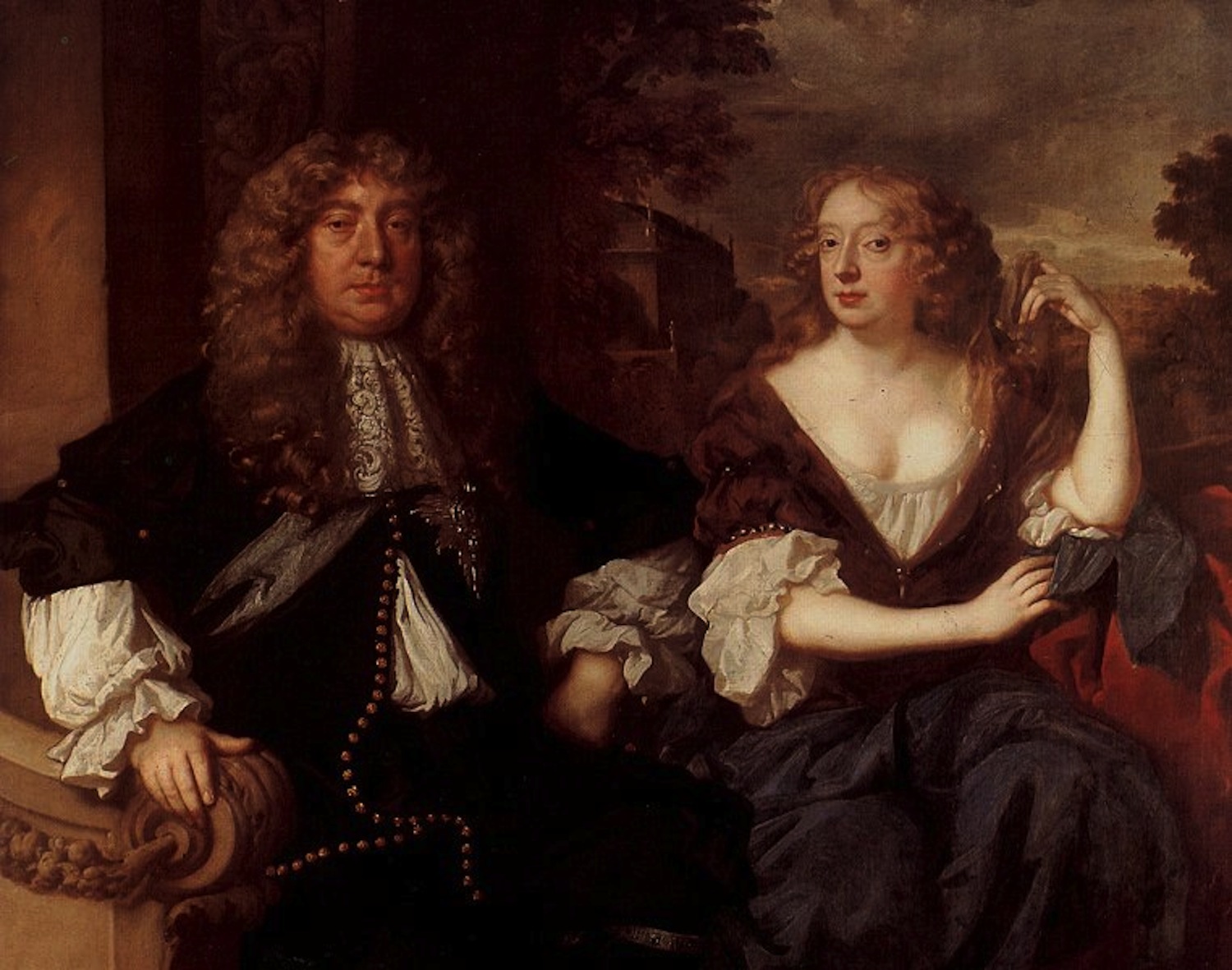
The 2nd Earl was made Duke of Lauderdale by Charles II and he and his second wife, Elizabeth Tollemache, renovated Thirlestane in the 1670’s, and turned it into a magnificent residence fit for their king to visit, as they did with Ham House in Richmond. The stone surround on the front door at Thirlestane bears the entwined initials of the duke and Elizabeth, who was Countess of Dysart in her own right.

Early in 1680, Lauderdale suffered a stroke and resigned his posts, although he had quarelled with Charles II before that. He retired to Tunbridge Wells to take the waters and died there in August 1682. The Dukedom died with him and his brother Charles became the 3rd Earl of Lauderdale.
Duke and Duchess of Lauderdale 1679
Much of the furniture in the Castle today is from the 19th century, mainly because the earlier contents were removed on the Duke's death by Duchess Elizabeth who dispatched fourteen wagon loads of furniture to Ham House in Richmond, before the people of Lauder grew so incensed that they prevented the last wagon from leaving.

Duchess Elizabeth was at heart a Scot, a tradition she maintained when her daughter by Lionel Tollemache, another Elizabeth, married Archibald Campbell, 1st Duke of Argyll in 1678, who was the son of James Stuart, 4th Earl of Moray, a direct descendant of a daughter of the Regent James Moray, half brother to Mary Queen of Scots.

Prince Charles Edward Stuart, Bonnie Prince Charlie, stayed at Thirlestane in 1745 after victory at the Battle of Prestonpans when he led the clan armies south through Lauder, and the troops camped in the Castle Parklands.  

A dividing arch in the dining room contains a bust of Captain Sir Frederick Maitland, to whom Napoleon surrendered on board HMS Bellerophon after the Battle of Waterloo.

Sunday, 2 December 2012

Hildegard's House of Light


Elizabeth Erickson’s 2008 painting “Hildegard’s House of Light.” 


Today marks the First Sunday of Advent and the first post of our Viriditas Interfaith Advent Calendar, “Journey into Light.”

Here in Northern England, I find myself plunging into the depths of midwinter darkness. It is in this womb of night and stillness that the Light is reborn. Through the ages and across cultures, world faith traditions have marked this sacred passage through the darkness, as our guest bloggers shall explore in the coming days of Advent.

In Christian tradition, Advent is a period of expectant waiting, of anticipating the birth of Christ. The word Advent comes from the Latin adventus, which means “coming.” This First Sunday of Advent marks the beginning of the Western Christian liturgical year.

The Advent wreath and Advent calendar are relatively recent innovations. Christmas and Advent celebrations have gone through many permutations throughout history, as our guest bloggers will reveal, from boisterous celebrations with mummers and feasting to Oliver Cromwell’s Puritan backlash in which he outlawed Christmas because he believed the feast was far too pagan.

Back in Hildegard von Bingen's day, in the 12th century, Advent was a season of fasting and penitence in preparation for the Twelve Days of Christmas, which begin on Christmas Eve and end on January 6, the Feast of the Epiphany.

The season would have been especially numinous for Hildegard as a child anchorite at the remote Benedictine monastery of Disibodenberg. Imagine the enduring the depths of midwinter without central heating or electric lights, in an age when even religious people believed that there were demons lurking in the shadows. This would have pitched Hildegard into the deep drama of the season—the rebirth of the Light out of teeming darkness.

One German seasonal tradition that young Hildegard might have treasured was the Barbara Zweig, or the Barbara Branch. This was a branch cut from a fruit bearing tree on the Feast of Saint Barbara, December 4. Kept in a vase of water in a warm and sunlit corner, it would bloom on Christmas Day.

There were other, more atavistic traditions associated with the season. In Northern Europe, long before the Christian era, the Twelve Nights of Yule were held in awe—time out of time when fate hung suspended, when secrets were revealed and fortunes could be reversed, when the most powerful magic was afoot. Well into the Christian era, people believed that the ghostly Wild Hunt still roared across the midwinter skies along with the gales and storm winds.

I experienced these traditions first hand when I lived in Germany. In the Bavarian town of Kirchseeon, just east of Munich, mummers in hand-carved wooden masks perform the “Perchtenlauf,” a wild torchlit procession through the winter forest to awaken the dormant nature spirits and call back the dwindling sun. I'll discuss these folkways in greater depth in another post.


Now we return to young Hildegard, the child anchorite at Disibodenberg Monastery.

Here is an excerpt from Illuminations: A Novel of Hildegard von Bingen


After Vespers, I went to see if our Barbara Branch still had enough water. Though the buds had once seemed to swell, it now felt like a dead twig I could snap between my fingers. The forest would not stop haunting me. How the wild places called out to me in the face of Jutta’s direst warnings. Again and again she told me that I must dread everything dark and untamed.

Demons ruled the nocturnal hours, she insisted. On stormy nights, outside our anchorage walls, trees writhed, tossing their branches against the moon-drenched sky. As I lay in my narrow bed, my ears rang with the shrieking wind, the cries of owls and wolves in search of prey.

Little did it matter that Christmas was fast approaching. For centuries before the Irish missionaries brought the faith of Christ to this land, before Carolus Magnus toppled the Irminsul, the idolatrous pillar of the heathens, my ancestors had held the Rauhnaechte, the Twelve Nights of Yuletide, in awe—time out of time when fate hung suspended, when secrets were revealed and fortunes could be reversed. This I knew from Walburga’s tales. The servants and peasant folk back home had muttered stories of the Old Ones roaring across the midwinter skies: the Wild Hunter of a thousand names in pursuit of his White Lady with her streaming hair and starry distaff, the whirlwind before the storm.

Leaving Jutta to her dreams, I crept out of bed and stole into the courtyard where I pranced barefoot in the swirling snowflakes like the mummers who came to Bermersheim every Yuletide in their fearsome wooden masks to frighten away harmful spirits.

A gale howled overhead, and the cold stung my soles, sending me spinning as the Wild Hunt of Walburga’s nursery stories raged overhead, that endless stream of unbanished gods and the souls of the unchristened dead. Anyone who dared venture out on a night such as this risked being swept along in that unearthly train.

But did I cross myself and flee inside to safety? No, I raised my face to the clouds racing across the full moon and I begged those invisible riders to take me with them.


Clouds shrouded the moon. Everything went black. I plummeted, down and down, as if there would be no end to my falling. De profundis clamavi ad te. Gazing up from the depths, I saw a circle of sky, now emptied of moon and stars. Had I been cast into hell for my sin? From out of that murk came a white cloud bursting with a light that was alive, pulsing and growing until it blazed like a thousand suns.

In that gleaming I saw a maiden shine in such splendor that I could hardly look at her but only catch glances like fragments from a dream. Her mantle, whiter than snow, glittered like a heavenful of stars. In her right hand she cradled the sun and moon. On her breast, covering her heart, was an ivory tablet and upon that tablet I saw a man the color of sapphire. A chorus rose like birdsong on an April dawn—all of creation calling this maiden Lady. The maiden’s own voice rose above it, as achingly beautiful as Jutta’s singing.

  I bore you from the womb before the morning star.

I didn’t know whether the maiden was speaking to me, lost and wretched, or to the sapphire man in her breast. My vision of the Lady was lost but her voice lingered. You are here for a purpose though you don’t understand it yet.

Barefoot and mother naked, I found myself within a greening garden so beautiful, it made me cry out. Each blade of grass and newly unfurled spring leaf shimmered in the sun. Every bush and tree was frothy with blossom and heavy with fruit at the same time. In the midst of that glory, the Tree of Life with its jeweled apples winked at me, and yet I saw no serpent. The Lady’s voice whispered: See the eternal paradise that has never fallen.

I saw a great wheel with the all-embracing arms of God at its circumference, the Lady at its heart. Everything she touched greened and bloomed.


Pealing bells wrenched me back into this world. The monks were ringing in Christmas morning. I lay on my pallet, the blankets piled over me, my legs swaddled in damp cloth. Above me hovered a maiden with glowing blue eyes. Her veil had slipped and the sun shone through her halo of cropped auburn curls. Whispering my name, Jutta held out a blossoming apple branch, each pink and white flower scented of the Eden I had glimpsed.

Sunday, 18 November 2012

WILLIAM and MARY

This week we welcome Andrea Zuvich as our guest blogger. William and Mary are the forgotten Stuarts (except to the Irish!) and we are very excited to find out a little bit more about them!


The story of William & Mary is one of duty, love, war, heartbreak, betrayal, and revolution. It was a real game of thrones. This was a unique reign as there was a joint King and Queen upon the throne for the first time in English history.

Mary II, eldest daughter of James, Duke of York (later James II) and niece of the Merry Monarch, Charles II, was a romantic, naturally intelligent but poorly educated, beautiful, feminine girl when she married William III of Orange in 1677.  


William III, by contrast, had lived a solemn lifestyle – one of hard work and duty. He was Stadtholder, or Chief Magistrate, of the United Provinces/Dutch Republic (now the Netherlands) and the constant threat from and warfare with Louis XIV’s France always plagued his thoughts. His passions included hunting and collecting artwork.

William was struck by Mary’s sweet nature and stunned by her incredible beauty, and he immediately asked Charles for her hand in marriage. Mary, then fifteen years old, was devastated to learn that she would have to marry her first cousin William, who was at first sight unattractive, morose, old, and a good deal shorter (William and Mary’s height difference was almost the same as that between Nicole Kidman and Tom Cruise). Remember, Charles II’s Restoration court was flamboyant and colourful, whereas the Dutch Republic was more sombre and calm. Fortunately, she soon fell completely in love with her husband, who was kind-hearted and even funny with his intimates, and also with her adoptive country.


Within a few months of their marriage, 1678, Mary became very happily pregnant. At around four months pregnant, she decided to visit him at his encampment at Breda. Unfortunately, the roads were rough and the coach jostled her about so violently, resulting in a miscarriage. As there was no doctor around with knowledge of gynaecology, she developed an infection. Eventually, in 1679, she became pregnant a second time, but the damage from the first miscarriage was too great and she lost the baby again. Call it wishful thinking, she had all the symptoms of pregnancy again in 1680, but no child came, the symptoms had been misdiagnosed and this was unbearable for the young couple. Mary’s childlessness was a source of deep heartache for her for the rest of her life.

William, in sadness or desperation, turned to another. Imagine how heartbreaking it must have been for Mary, who loved him passionately, to learn that he was carrying on with her lady-in-waiting, Elizabeth Villiers, a woman she had grown up with. There is still debate as to whether William’s relationship with Elizabeth Villiers was sexual, as she never gave birth to any of his children, though the affair presumably lasted for 15 years, and when she did marry, she quickly had children. No letters between them, nothing at all, has survived. Elizabeth remains shrouded in mystery. Perhaps we will never know what their relationship was. One thing remains clear: William was not, unlike his uncles, a highly sexed man. This can be attributed to his ill health – he had severe asthma, suffered from headaches, haemorrhoids, and later, painfully swollen legs and feet.

Persistent rumours of William’s homosexuality, popularised in Jacobite propaganda, cannot be accepted due to lack of evidence. We even have William’s own writing against it. When told of scurrilous rumours surrounding his relationship with his young favourite, Arnold Joost von Keppel, he wrote, “I find it extraordinary that one cannot have esteem for a young man without it being criminal.” (Sodomy was illegal at this time).

Then, in 1688, the Glorious Revolution occurred, in which the Immortal Seven – seven of the most influential, powerful men in England – invited William to take the throne from James II, his uncle/father-in-law, who was unpopular and Catholic. For a brief summary, click here,

William and Mary were crowned in 1689 at Westminster Abbey – he crowned in St. Edward’s Chair, she in a copy of the chair which is on display at the Abbey museum today. Mary was Queen regnant, like Elizabeth I had been (Catherine, Duchess of Cambridge will become Queen consort when her husband William becomes King, not Queen regnant). Mary, though unfortunately not given the same excellent education as Elizabeth I had had, was nevertheless a very intelligent woman and there were pamphlets at the time which depicted her as the new Elizabeth.

Together they purchased the home that would become Kensington Palace and they hired Christopher Wren to remodel both it and Hampton Court Palace.

Their joint reign was short-lived. In late 1694, Mary contracted hemorrhagic smallpox – the most deadly strain of the disease. She considerately sent anyone who had not already had the disease away from Kensington House and put her affairs in order. She went through her journal and ripped out and burned pages that she did not wish anyone else to see.  Mary, aged only 32, died in the early hours of the 28th December, 1694, leaving her husband (who fainted) and the entire nation broken-hearted. To William, whose father had died of smallpox a week before he was born, and who also lost his mother to the same disease when he was ten, it was an earth-shattering blow. Her body lay in state in the Banqueting House until the costly funeral at Westminster Abbey, where “Music for the Funeral of Queen Mary” by Henry Purcell was played.

After Mary’s death, William ruled alone until his death in 1702, and in the intervening years he had become more unpopular, the target of several assassination attempts and he increasingly drank to excess. As he rode his favourite horse, Sorrel, out on Home Park, Hampton Court; the horse stumbled on a molehill, sending William flying off, breaking his collarbone in the fall. Within days pneumonia had set in and William III died at Kensington House. Loathed by his sister-in-law, Mary’s younger sister, now Queen Anne, he was interred with little fanfare. A sad end for someone once heralded as the Protestant Champion of Europe! 

Andrea (aka 17th Century Lady) is a 17th century historian specialising in the late Stuarts & the middle Baroque composers. She went to the University of Central Florida and Oxford University and is a Garden History tour guide at Kensington Palace.  She is currently writing a historical fiction book about William and Mary. You can find her at The Seventeenth Century Lady

Sunday, 11 November 2012

17th Century History of A Haunted House - Borwick Hall


Just up the road from where I live is a massive gatehouse and high walls and a tantalising view of crenellated stone and high roofs. Walking all around the wall it becomes apparent that behind the walls lies  a wonderful old house, not open to the public, but a gorgeous stately stone building which has obviously stood for many generations. Enquiries revealed this building to be Borwick Hall.

This gateway was built by Robert Bindloss, the third Robert of his family, in 1650. He had been created a Baronet by Charles I. The Bindloss family had amassed a fortune from their business as clothiers. Robert was elected as the Member for Parliament for the Borough of Lancaster (aged 16) in 1640 and the following year he was knighted by Charles I. In London there was a saying "As rich as Sir Robert in the north." Nowadays it is hard to imagine anyone of 16 becoming an MP.

During the English Civil Wars however, he did not fight for his King - he was afraid to take sides in case his property was requisitioned by one side or the other. He was appointed a High Sherriff for Parliament as well as serving the Crown.

When the young Prince Charles (to be CharlesII ) fled in 1651 he insisted on a safe house at Borwick but Sir Robert himself was nowhere to be found, having taken refuge at a safe house himself away from the possible embarrassment of his two-faced position.

According to local legend, the young King Charles wasted no time in using his considerable charm to take advantage of the warm August night and a first floor bedroom at Borwick Hall to father a child with a young local woman, Lady Dashwood, arranged for his convenience. Afterwards he did honour his obligations though and made provision for the child. Rents from certain properties were made over to Lady Dashwood and were still paid right up until the last century.

After the young Charles's visit, Robert Bindloss stole quietly home. He was by all accounts an extravagant man who took to living beyond his means. He was also not well liked for his persecution of the Quakers at Yealand who were associated with the then radical George Fox. Sir Robert often sent armed guards to break up their meetings, egged on by his personal chaplain Dr Sherlock, a zealot who applied what he regarded as God's will with sinister enthusiasm.

Borwick Hall is said to be haunted by a starving girl who fought against her parents who had arranged her wedding - as punishment she was locked in the tower and forgotten about and starved to death, but her ghost still walks the corridors looking for vengeance.

There is also a story that an old lady knocked on the door in a blizzard one New Years Eve looking for some place to stay. Sir Robert put her up and made sure she was well fed. The next day she gave him a ripe apple and said if he kept it high up above the fireplace all year he would have good fortune that year. If he took it down then disaster would happen. It is still a tradition for someone to knock on the door and hand over an apple to this day.

Sir Robert died without a male heir in 1664 leaving Borwick Hall and his estate to his daughter, Cecilia. She married a Standish, a local prominent Lancashire Catholic family.

As for the Hall, it was used by the military in World War II, then sold off for the sum of £8,800. An amount of £650 was paid by the war department for dilapidations.Later it became a holiday camp and now it belongs to the Lancashire Youth Clubs Association who remain the present owners.
My books are 

The Lady's Slipper - An artist, a wild orchid and early Quakers  in the years following the English Civil War. 
The Gilded Lily - Beauty, desire, danger and redemption in Restoration London